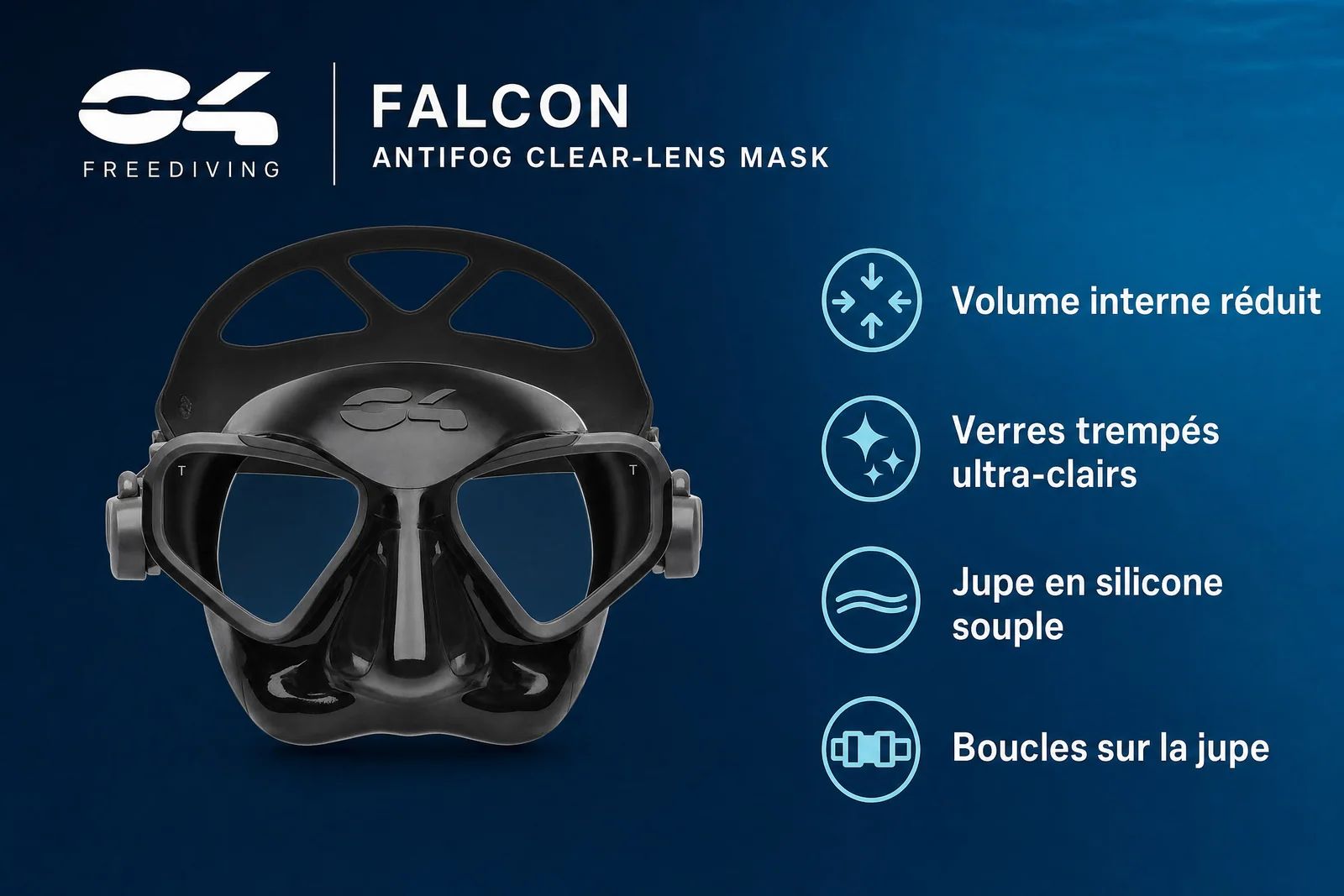
Detailed technical analysis of the C4 Freediving Falcon antifog mask. Documented evaluation from level M1 to M7, overall score, and buying advice for freediving.
What is the documented internal volume of the C4 Freediving Falcon antifog mask?
The documented internal volume of the C4 Freediving Falcon Antifog is extremely small, measuring only 95 cm3 with dimensions of 100 by 137 millimeters.
Why does the anti-fog treatment on this mask require specific maintenance?
This model features a permanently applied anti-fog coating on the lenses. Never rub or touch the inner surface with your fingers, and avoid any contact with oily substances.
Does the C4 Freediving Falcon antifog mask require an initial thermal conditioning process?
No, unlike traditional masks with untreated tempered glass, the integration of an anti-fog coating from the factory eliminates the need for any initial thermal or chemical preparation.
How can I ensure the mask is watertight before purchasing it?
The most important step is the "no-strap" facial fit test. The mask should stay in place simply by inhaling through your nose, without any pressure points or leaks. This proper fit is crucial and accounts for over 80% of successful purchases.
Discover our structured learning programs and online courses on our platform AquaExposure training.
Introduction
The analysis of freediving and spearfishing equipment is based on the technical specifications published by manufacturers and specialized retailers. Choosing a diving mask involves finding a match between verifiable manufacturer data and a unique facial structure. This study examines the C4 Freediving Falcon Antifog model from the perspective of its intrinsic performance, architectural choices, and documented limitations.
The data comes exclusively from official technical sheets and authorized distributors as of August 18, 2026. No facial tests were conducted by our team for this model. The goal is to provide freedivers with a neutral evaluation tool to structure their thinking before making any investment. The scores assigned reflect the characteristics reported in the technical documentation, while also reminding that each face has irreducible anatomical requirements that cannot be captured by numbers.
Summary of Findings
The C4 Freediving Falcon Antifog mask achieves an overall documented score of 4.53 out of 5, reflecting its specialized design for deep freediving and spearfishing. The summary of the seven criteria evaluated according to the AquaExposure methodology is presented in the table below.
Evaluation Section
Weight
Score
Documented Features
M1 Internal Volume and Field of View
25%
4.8 / 5
Internal volume of 95 cm3, frameless single-lens design
M2 Skirt and Fit
20%
4.5 / 5
Soft silicone 50°shA, matte velvety finish, reinforced seal
M3 Lenses and Communication
20%
4.3 / 5
Ultra-clear tempered glass lenses, 3 mm thick, with anti-fog coating
M4 Anti-Fog and Maintenance
10%
4.8 / 5
Integrated permanent anti-fog film, no thermal preparation required
M5 Strap and Ergonomics
10%
4.4 / 5
Micro-metric buckles integrated directly into the skirt
M6 Durability and Accessories
10%
4.2 / 5
Design without a rigid external frame, optimized structure
M7 Price and Availability
5%
4.5 / 5
Consistent pricing within the high-end segment
This mask is designed for freedivers and spearfishers who are looking for a minimal internal volume of 95 cm3 to reduce equalization effort at depth, as well as an integrated anti-fog treatment that eliminates the need for any initial chemical preparation.
This mask is not ideal for divers who require corrective lenses and have documented prescriptions. Users who handle their lenses carelessly risk damaging the anti-fog film. It is also unsuitable for facial profiles incompatible with the geometry of the skirt.
Detailed Analysis
M1: Volume and Field of ViewThis first section evaluates the mask's internal volume and visual clarity. The C4 Freediving Falcon Antifog model offers an architectural design focused on reducing internal air space. [1]
Internal Volume and Compactness: A measured internal volume of 95 cm3 with dimensions of 100 by 137 millimeters (Score: 4.8/5) Frameless Monolens Design: Absence of a rigid external frame to bring the lenses closer to the eyes (Score: 4.8/5) Undocumented Data: Exact weight in grams and precise viewing angle measurements in degrees (Not rated)
M2: Skirt and Fit
The skirt is the primary interface with the skin. Its mechanical properties affect stability and comfort during extended dives. [1]
Silicone Quality: Soft silicone with a hardness of 50°shA, featuring a matte and velvety interior finish (Score: 4.5/5) Structural Seal: Reinforced internal sealing ring to minimize water intrusion under pressure (Score: 4.5/5) Undocumented Data: Availability of multiple skirt sizes and detailed dimensions (Not rated)
M3: Lenses and Visibility
This section analyzes the type of lenses and their contribution to light transmission as well as underwater visibility. [1]Optical quality of the lenses: Tempered glass with a thickness of 3 millimeters, ultra-transparent (Score: 4.3/5) Surface treatment and communication: Permanent anti-fog coating integrated on the inner surface (Score: 4.3/5) Undocumented information: Availability of corrective lenses and variations of masks (Not rated)
M4: Anti-Fog and Maintenance
This criterion assesses the presence of preventative measures against condensation and the simplicity of associated maintenance procedures. [1]
Documented anti-fog treatment: Permanent anti-fog coating applied in the factory (Score: 4.8/5) Maintenance compatibility and limitations: Thermal conditioning is no longer required, but rubbing is strictly prohibited (Score: 4.8/5) Undocumented information: Precise lifespan of the anti-fog coating under intensive conditions (Not rated)
M5: Strap and Ergonomics
Overall ergonomics encompasses the tightening system, the handling of the buckles, and the stability of the strap during underwater movements. [1]
Buckle system: Micrometric buckles integrated directly into the silicone skirt (Score: 4.4/5) Handling and fit: Easy adjustment and even distribution of occipital pressure (Score: 4.4/5) Undocumented information: Possible provision of a replacement neoprene strap (Not rated)
M6: Durability and AccessoriesThis section examines the overall structural integrity and the quality of the protective elements provided when purchasing the product. [1]
Architecture and materials: Removal of the rigid external frame reduces potential failure points (Score: 4.2/5) Original accessories included: Standard protective case for transport (Score: 4.2/5) Undocumented data: Long-term durability of plastic components and buckles (Not rated)
M7: Price and Availability
The final section summarizes the product's economic positioning in relation to the technical specifications outlined in the official documentation. [1]
Market price: Consistent pricing within the high-end technical segment (Score: 4.5/5) Availability: Regularly available through specialized distribution networks (Score: 4.5/5) Undocumented data: Seasonal stock fluctuations and discounts offered by retailers (Not rated)
What you need to know before buyingAcquiring a technical mask like the C4 Freediving Falcon Antifog requires careful attention to its specific design features. The presence of a permanent anti-fog coating applied by the manufacturer significantly changes maintenance procedures compared to a standard tempered glass mask. It is essential never to rub or touch the inner surface of the lenses with your fingers, as organic deposits and micro-abrasions will damage the effectiveness of the treatment.
Similarly, any contact with oils or sunscreens should be avoided. Contrary to popular belief, this model does not require any thermal conditioning or surface heating. Any attempt to clean it using abrasive methods will result in deterioration of the internal coating. Finally, the lack of documented information regarding corrective lenses means that divers who wear corrective lenses must confirm this aspect with their retailer before making any purchase.
Trying on the mask before buying: The most important factor.This comparison helps you to compare the different models. However, it cannot tell you if a mask is suitable for your face. Before purchasing, try on the mask without the strap, inhale gently through your nose, and check that it fits securely on its own, without any pressure points or leaks. This step represents more than 80% of the actual importance of your purchase. If the skirt doesn't fit your facial structure, no ultra-clear lens, anti-fog treatment, or buckle system will compensate for the problem.
Safety Reminder
Freediving and spearfishing require strict safety precautions, especially regarding visual communication and situational awareness within a dive group or with a buddy. Non-verbal signals underwater rely heavily on observing facial expressions and eye movements through the mask lenses.
Users choosing specific lens types should ensure that reciprocal visibility remains optimal in the lighting conditions encountered. Lenses with standard anti-reflective coatings or UV protection do not hinder communication, unlike very dark tints used in deep water or low light conditions. Every equipment choice should consider these factors to guarantee shared safety while diving.
Our VerdictThe C4 Freediving Falcon Antifog mask demonstrates remarkable technical qualities for freediving and spearfishing, thanks to its compact internal volume of 95 cm3 and a highly effective permanent anti-fog treatment. The performance scores reflect a design that meets the expectations of demanding users. However, it is essential to validate the purchase with a preliminary fit test, as the flexibility of the silicone skirt does not guarantee a universal seal for all face types.
Maintenance and Lifespan
The longevity of this mask depends on rigorous maintenance practices tailored to its technological specifications. A thorough rinsing with clean freshwater is mandatory after each dive to remove salt residue and impurities. Drying should be done in the shade, in a well-ventilated area, away from any direct heat source that could deform the silicone skirt. Storing it in a rigid protective case is recommended to prevent accidental pressure on the structure during periods of inactivity.
Other models from the brand to compareThe current evaluation database does not include any other models from the manufacturer C4 Freediving. To broaden your purchasing options and compare available designs on the market, we invite you to consult the comprehensive mask comparison tool available on our platform at /comparateur-masques.
FAQ
What is the documented internal volume of the C4 Freediving Falcon Antifog mask?
The documented internal volume of the C4 Freediving Falcon Antifog mask is extremely low, reaching 95 cm3 with dimensions of 100 by 137 millimeters.
Why does the anti-fog treatment on this mask require specific maintenance?
This model incorporates a permanent anti-fog film applied to the lenses. You should never rub or touch the inner surface with your fingers, and avoid any contact with oily substances.
Does the C4 Freediving Falcon Antifog mask require an initial thermal conditioning process?
No, unlike traditional masks with raw tempered glass, the integration of a factory-applied anti-fog treatment eliminates the need for initial thermal or chemical preparation.
How can you ensure the seal of this mask before purchasing?
The priority step is to perform a test without the strap on your face. The mask should stay in place by simply inhaling through your nose, without any pressure points or leaks. This compatibility represents over 80% of the success of the purchase.To delve deeper into the analysis of your equipment and optimize your underwater experience, discover our specialized training programs on our platform .