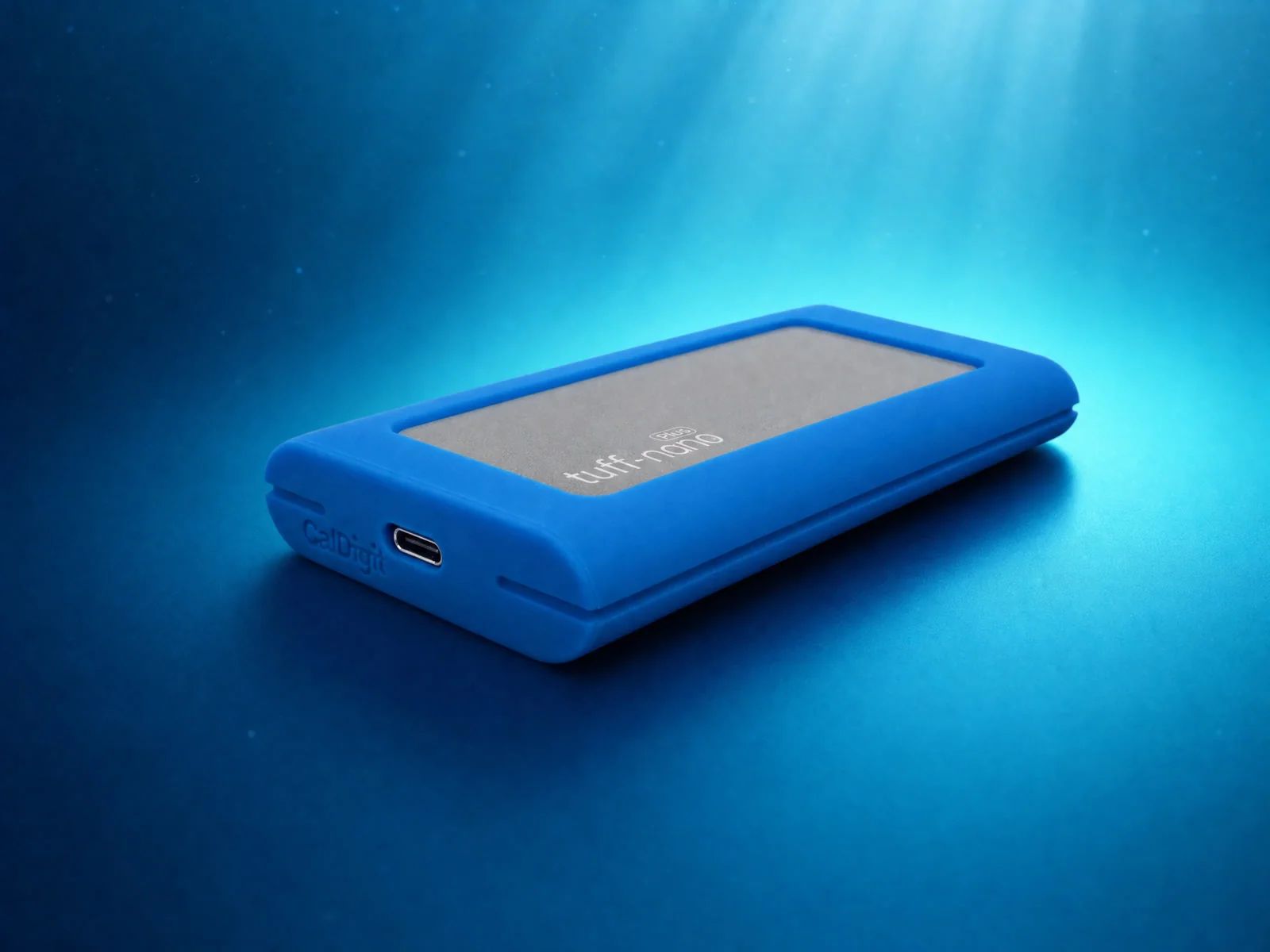
CalDigit Tuff nano Plus: IP67 protection for underwater photographers.
Discover the CalDigit Tuff nano Plus SSD review. This rugged, IP67-rated external hard drive is perfect for protecting your underwater photos and videos while traveling.
To improve your mastery of your equipment and optimize your procedures while diving, discover our specialized training modules on .
Is the CalDigit Tuff nano Plus compatible with Windows?
Yes, but it requires manual reformatting. The drive is pre-formatted in HFS+ for macOS. To use it on Windows, you will need to use the disk management utility to format it as exFAT or NTFS.
Can this SSD be used directly underwater?
No. While certified IP67 for accidental immersion up to 1 meter for 30 minutes, this device is not designed for underwater use. It must be completely dry before connecting to a computer.
Is the USB-A cable included with the Plus model?
No, unlike the standard version, the CalDigit Tuff nano Plus comes only with a 0.25-meter USB-C to USB-C cable. An adapter or a separate cable is required for older USB-A ports.
CalDigit Tuff nano Plus: IP67 protection for underwater photographers
On the deck of a cruise ship, when salt dries on the housings, downloading memory cards becomes a ritual as crucial as checking your decompression stops. In this humid environment where sea spray is always close to the keyboards, data security is not measured in gigabytes, but in the physical survival of the equipment. The CalDigit Tuff nano Plus fits into this niche, combining modern speeds with a robustness capable of withstanding harsh conditions.
Military-grade protection for humid environments
The first thing you notice when you pick up the CalDigit Tuff nano Plus is its solid feel. Weighing 100 grams and measuring 10.19 x 5.44 x 1.45 cm, it's on the higher end for portable SSDs, a size justified by enhanced protection [1]. The aluminum casing is wrapped in a silicone layer that not only absorbs shocks. This drive has a military-grade MIL-STD-810G certification, guaranteeing its survival after drops of up to 3 meters onto a hard surface [2].For an underwater photographer, this shock resistance provides a crucial first line of defense against accidental damage on a moving boat. Its IP67 certification is its real strength. This standard guarantees complete protection against dust and resistance to accidental immersion in water up to 1 meter deep for 30 minutes [1]. This waterproofing provides a safety net against accidents, such as a spilled glass or a rogue wave on the editing table, while also preventing the use of the drive underwater.
NVMe Performance for Lightning-Fast Card Transfers
Beyond its rugged exterior, the CalDigit Tuff nano Plus houses an NVMe PCIe unit capable of delivering top-tier performance. The manufacturer claims sequential read speeds of up to 1088 MB/s and a peak write speed of 1087 MB/s [1]. These figures, made possible by the USB 3.2 Gen 2 interface at 10 Gbps, revolutionize the workflow after a dive. Transferring a 128 GB card filled with RAW files or 4K footage takes only a few minutes, allowing you to quickly free up your storage for the next session.In practice, these sustained transfer rates remain stable thanks to the aluminum chassis, which acts as a passive heat sink. Unlike some ultra-compact models whose performance degrades due to heat, the Tuff nano Plus maintains a consistent speed. This reliability is a significant advantage in tropical climates, where ambient temperatures already put a strain on the components. The drive is powered directly by the USB-C bus, which eliminates the need to carry an additional power supply when traveling.
Who is this SSD for?
The CalDigit Tuff nano Plus is primarily aimed at image creators who don't work in the comfort of a climate-controlled studio. If your work takes you on boats or expeditions where equipment is subject to rough handling, this drive becomes a valuable asset. Its robustness allows you to slip it into a bag without worry, and its reusable hard carrying case provides an extra layer of protection during air or boat travel [2].Users of the Apple ecosystem will find an immediate solution here, as the drive is pre-formatted in HFS+ for macOS. It is ready to use with a MacBook, an iPad Pro, or the latest iPhones with a USB-C port. This native integration simplifies a mobile workflow where you want to start editing photos as soon as you surface. For photographers who create multiple backup copies, the availability of the product in several colors allows you to visually distinguish between the working drive and the backup drive.
Limitations, Protection, and Compatibility
Despite its advantages, the CalDigit Tuff nano Plus involves certain compromises. The first point concerns Windows users. Since the drive is formatted for Mac, a manual reformatting step is essential for it to be recognized by a PC. This model does not offer AES-256 hardware encryption [1]. For professionals transporting sensitive data, you will need to rely on software encryption solutions, which may slightly impact overall performance.Another factor to consider is the duration of the manufacturer's warranty. Limited to 2 years, it is shorter than the 5 years often offered on premium SSDs. The contents of the box have also changed with the Plus version. While the 0.25-meter USB-C to USB-C cable is included, the USB-A cable that was previously included is no longer present [2]. If your computer only has older ports, you will need to provide an adapter or a compatible cable. These details do not detract from the performance, but they define the scope of its ideal use.
AquaExposure Expertise: Beyond the Specifications
At AquaExposure, we have given the CalDigit Tuff nano Plus a Diver Score of 7/10. This score reflects a product that is serious in terms of physical protection, but loses points in terms of software versatility and its warranty. The choice of an IP67 rating is a consistent decision for marine use. Unlike lighter IP55 ratings, the IP67 rating offers that extra peace of mind in the face of unforeseen circumstances.
The inclusion of the rigid carrying case encourages a disciplined storage routine, which is a guarantee of longevity. The MIL-STD-810G certification translates to a construction that resists the vibrations of boat engines, a factor of wear that is often underestimated when traveling.
ConclusionChoosing a storage solution for travel involves balancing speed, capacity, and durability. The CalDigit Tuff nano Plus offers a robust solution, capable of making the backup process quick and easy. While it requires some configuration for Windows users and lacks hardware encryption, it more than compensates with its excellent construction and real water resistance, providing peace of mind in the field.
When the download session is complete and the files are safely stored behind the aluminum casing, there's a sense of satisfaction knowing that your work is protected. It's in this quiet serenity, when the equipment fades into the background, that you can truly appreciate the rest between dives.
[1]: https://www.caldigit.com/tuff-nano/ "CalDigit Tuff nano Official Page" [2]: https://uk.caldigit.com/products/tuff-nano-plus-2tb "CalDigit Tuff nano Plus Product Details"Here's the translation:
[Image 1: A top-down view of the CalDigit Tuff nano Plus SSD placed on a damp wooden table next to an underwater camera housing. The lighting is warm, suggesting the end of the day on a boat. The silicone bumper is clearly visible.] Alt text 1: The CalDigit Tuff nano Plus SSD is placed next to a camera on the deck of a dive boat.
[Image 2: A close-up of the USB-C port on the SSD, with its protective cap open, showing the quality of the aluminum finish and the thickness of the silicone coating.] Alt text 2: Detail of the USB-C connector and the robust protection of the CalDigit Tuff nano Plus.