Canary Islands for underwater photography: El Hierro and its marine reserve, Lanzarote and the Museo Atlantico. Year-round destination, no long-haul flight.
Yes. That is one of the archipelago's great strengths. Water temperature stays between 19 and 24 degrees depending on the season, and sites are divable twelve months a year. The European winter becomes a perfectly usable photo window.
El Hierro, with its La Restinga marine reserve (Mar de las Calmas), offers the densest wildlife and the clearest water. Lanzarote appeals through its volcanic landscapes and the Museo Atlantico, an underwater sculpture museum unique in Europe. The two islands complement each other.
Yes, and it is even preferable. The sculptures rest at twelve to fifteen metres in clear water. The natural light falling on the stone faces creates a mood a flash would crush. You expose to keep the blue and place a diver in the frame for scale.
Most sites at La Restinga are accessible from the Open Water level. Some drop-offs go deep and suit Advanced divers better, but the marine reserve offers many shallow sites rich in life and light.
Curious brown groupers, schools of barracuda, stingrays, angel sharks, turtles and, with luck, mantas or sharks at El Hierro. Atlantic wildlife is less colourful than the tropics but photogenic through its density and behaviour.
A smartphone in a housing with a wide-angle lens is enough for the volcanic landscapes and the Museo Atlantico. For drop-off wildlife, a waterproof compact or a wide-angle action camera works well. The key remains mastering the hard Atlantic natural light.
About four hours direct from Brussels to the larger islands, then an internal connection for El Hierro. It is the sunniest dive destination reachable without a long-haul flight or significant jet lag.
To learn how to get the most out of your gear underwater, discover the AquaExposure training.
We often imagine a good dive destination has to be earned through twelve hours on a plane. Yet four hours from Brussels, the Atlantic sets down a volcanic archipelago where you dive in the middle of January in twenty-degree water. The Canary Islands are the destination many French and Belgian photographers forget, wrongly.
The Canary Islands are the most accessible year-round dive photography destination from Europe: a four-hour flight, water between 19 and 24 degrees twelve months a year, volcanic underwater landscapes and the El Hierro marine reserve. It is the ideal ground to progress without long-haul travel or a dead season.
That accessibility changes how you practise. Where a tropical destination demands heavy logistics once a year, the Canaries allow short, repeated trips at any time. You can come back to fix what you missed last time. That is exactly what a photographer needs to progress.
El Hierro is the smallest and wildest of the Canaries, and its village of La Restinga shelters a marine reserve that is one of Europe's best dive spots. The site's name, Mar de las Calmas, already says the essential: a sea sheltered from prevailing currents, so often calm and clear water.
The reserve's protection has a visible effect underwater. The brown groupers are large and curious, schools of barracuda spin in open water, and the density of life allows compositions you look for elsewhere without always finding them. For the photographer, wildlife that is used to divers and not skittish is a gift, because it allows the slow, respectful approach I stand for.
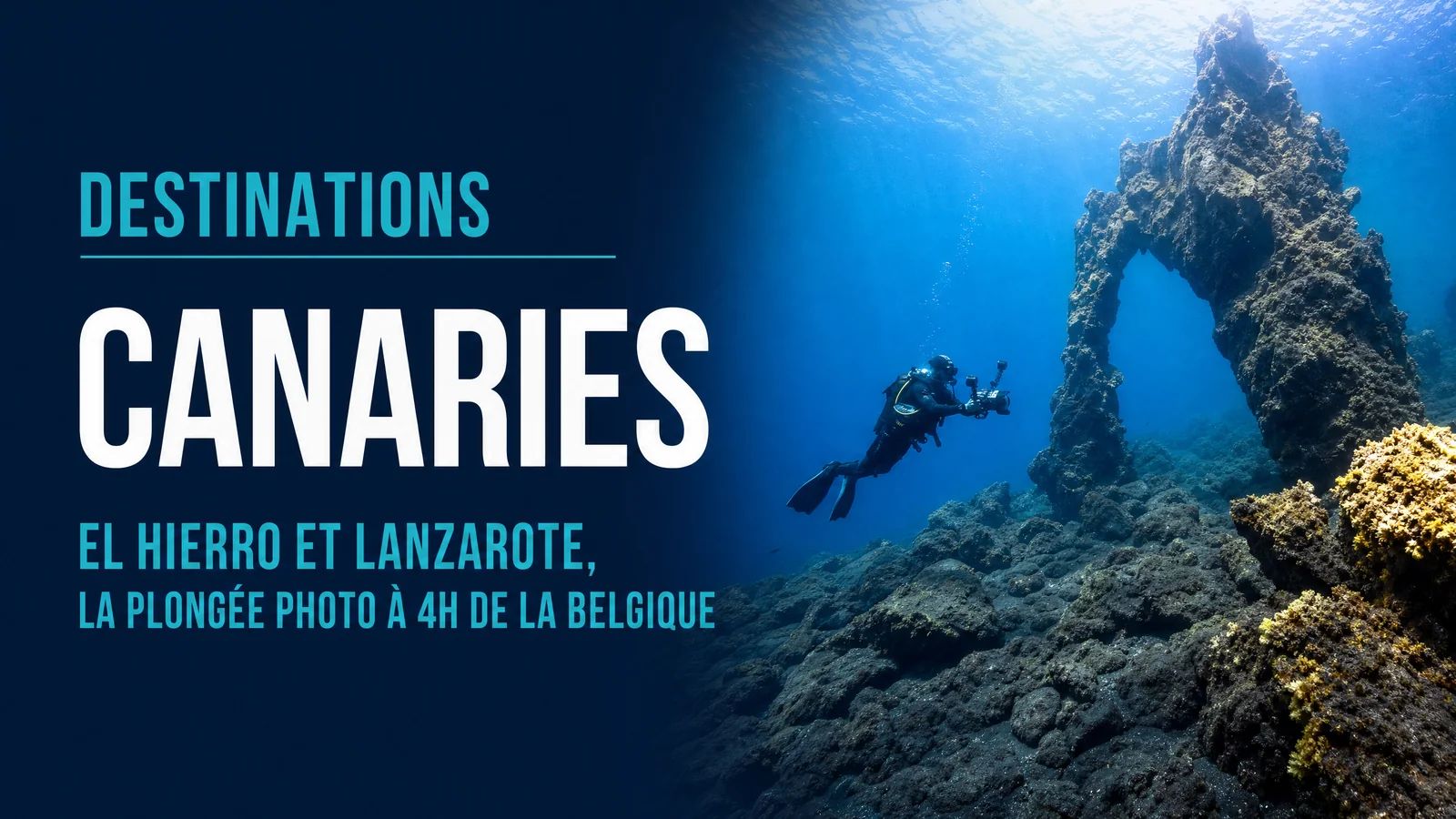
The volcanic relief adds the graphic dimension. Frozen lava flows, arches, caves, black drop-offs the Atlantic light strikes. This dark mineral setting brings out the colours of the fish and gives images a depth that pale sand bottoms never offer.
Lanzarote offers a photographic experience unique in Europe: the Museo Atlantico, an underwater museum of sculptures by the artist Jason deCaires Taylor. Dozens of pH-neutral concrete human figures rest at twelve to fifteen metres, slowly colonised by marine life.
Photographing these sculptures is an exercise in light and composition. The stone faces turned toward the surface catch the descending light, and Lanzarote's clear water lets you play the upward angle with blue in the background. A flash would crush the mood and reveal the particles. You expose for the blue, look for the angle that adds mystery, and sometimes place a living diver among the stone figures for scale and unease.
Beyond the museum, Lanzarote unfolds some of the archipelago's most spectacular volcanic underwater landscapes. The Puerto del Carmen sites line up drop-offs, caves and arches where the light plays constantly. It is a perfect ground to work on natural-light wide angle.
It must be said honestly, the light of the Canaries is not that of turquoise lagoons. The temperate Atlantic gives a deeper blue water, sometimes darker, with light that can be hard at the surface and fading at depth. That is precisely what makes it a good learning ground.
This light forces rigour. You learn to use the hours when the sun is high for shallow sites, to position yourself so the light comes from behind you on drop-off subjects, to accept deep blue as an aesthetic choice rather than a fault to correct. The photographer who masters Atlantic light progresses fast everywhere else.
It is also why I advise against the race for filters and flashes to compensate. The right answer to demanding light is not an accessory, it is a better reading of the light and better positioning. The AquaExposure natural-light doctrine takes on its full meaning here.
The trump card remains the logistics. Four hours of direct flight from Brussels to the larger islands, with no significant jet lag, and a short internal connection to reach El Hierro. You can leave on a Saturday and dive on Sunday morning.
For a first trip, Lanzarote is the simplest choice: developed infrastructure, shore sites, the Museo Atlantico, and a wide range of levels. El Hierro takes a little more organisation because of the internal connection, but rewards you with preserved nature and exceptional wildlife. Photographers with time combine both.
All these islands feature in our overview of the best underwater photography destinations 2026. And since the Canaries dive all year, the seasonal guide by destination will help you pick the ideal month for what you want, the warmest water or the smallest crowds.
At La Restinga, the Mar de las Calmas reserve is capped at twelve divers per site, so you never crowd each other. To make the most of it, the Arrecifal centre, run by Carlos and Anita, ticks every box I look for: small groups, a warm welcome, and a guide's eye able to spot the tiny critter no one else sees. It is the kind of family-friendly place you come back to, and where you progress because you are not just a number.
To make the most of the demanding Atlantic light of the Canaries, the AquaExposure underwater photography course prepares you to read and use natural light rather than endure it. Arriving in La Restinga already knowing how to compose with deep blue means coming home with images you are proud of.
In the same logic of European proximity, Malta and Gozo offer a complementary Mediterranean alternative, softer in light and more focused on wrecks and caves. Between the Atlantic of the Canaries and the Mediterranean of Malta, the Belgian photographer has enough to fill a whole year without ever taking a long-haul flight.


