Can you dive freely in the Cerbere-Banyuls reserve?
The reserve is open to diving across most of its perimeter, but the reinforced protection zone at Cap Rederis (65 hectares) is strictly off limits to all human activity. Other zones are accessible provided you respect the rules: no collecting, no feeding, no contact with fauna or flora. Going with a certified dive centre is recommended.
What species can you photograph in the reserve?
The reserve is home to over 1,200 animal species. The most iconic subjects are brown groupers (over 630 individuals), red and white sea fans, red coral, nudibranchs (purple flabellina, dalmatian doris), brown meagre, Mediterranean barracuda, noble pen shells and octopuses. The density of life is unmatched along the French coast.
Do I need a specific diving level for the reserve?
Sites like Les Trois Moines are accessible from Level 1 (Open Water). Coralligenous formations and red sea fans, found from 25-30 metres, require Level 2 or equivalent. The Peyrefite underwater trail is open to everyone, even without a diving qualification, in July and August.
Is the Cerbere-Banyuls reserve accessible year-round?
Yes, the reserve is accessible year-round for diving (excluding restricted zones). The best conditions are found between June and September, with water at 22-25 degrees and visibility often exceeding 20 metres. Spring and autumn also offer beautiful dives with less crowding, though the water stays cooler.
Before talking about the Cerbere-Banyuls reserve, you first need to understand what it means to dive in a place that's been protected for over fifty years. It means that marine life has had time to re-establish itself, to reclaim its rights, to rebuild what decades of intensive fishing had undone. And when you put your head underwater in this reserve, you see it immediately.
I dived on the sites adjacent to the reserve long before it was extended. I earned my Level 1 there, I discovered diving on those very seabeds. And what I observe today when I return is a transformation that commands respect.
A protection story that began in 1965
The idea of a marine reserve between Cerbere and Banyuls didn't appear overnight. As early as 1965, the municipalities of both towns initiated the project. In 1971, the Laboratoire Arago (the renowned Banyuls marine station) presented a scientific report highlighting the need to protect certain particularly threatened species.
On 26 February 1974, the inter-ministerial decree officially created the first natural marine reserve in France. Six and a half kilometres of coastline, 650 hectares of protected space. A reinforced protection zone of 65 hectares at Cap Rederis, where all human activity is formally prohibited.
Fifty years later, the reserve has expanded. New reinforced protection zones were created at Cap Ullestrell (38 hectares) and Cap Cerbere (32 hectares), bringing the total area to 1,680 hectares. The perimeter now extends from Cap Cerbere to Cap Bear, covering the entire most spectacular stretch of the Pyrenees-Orientales coast.
The reserve also renewed its IUCN (International Union for Conservation of Nature) label, an international recognition confirming the effectiveness of its management. As one of the reserve's managers put it, it's a sample of what the Mediterranean could have looked like fifty years ago.
The grouper's return, symbol of a rebirth
The number is striking. In the 1980s, there were around fifty brown groupers in the reserve. Today, there are over 630.
This grouper comeback is one of the finest achievements of marine protection in the Mediterranean. The fishing moratorium on this species, in place since 1993, was extended by ten years at the end of 2023. And the results are there, visible on every dive.
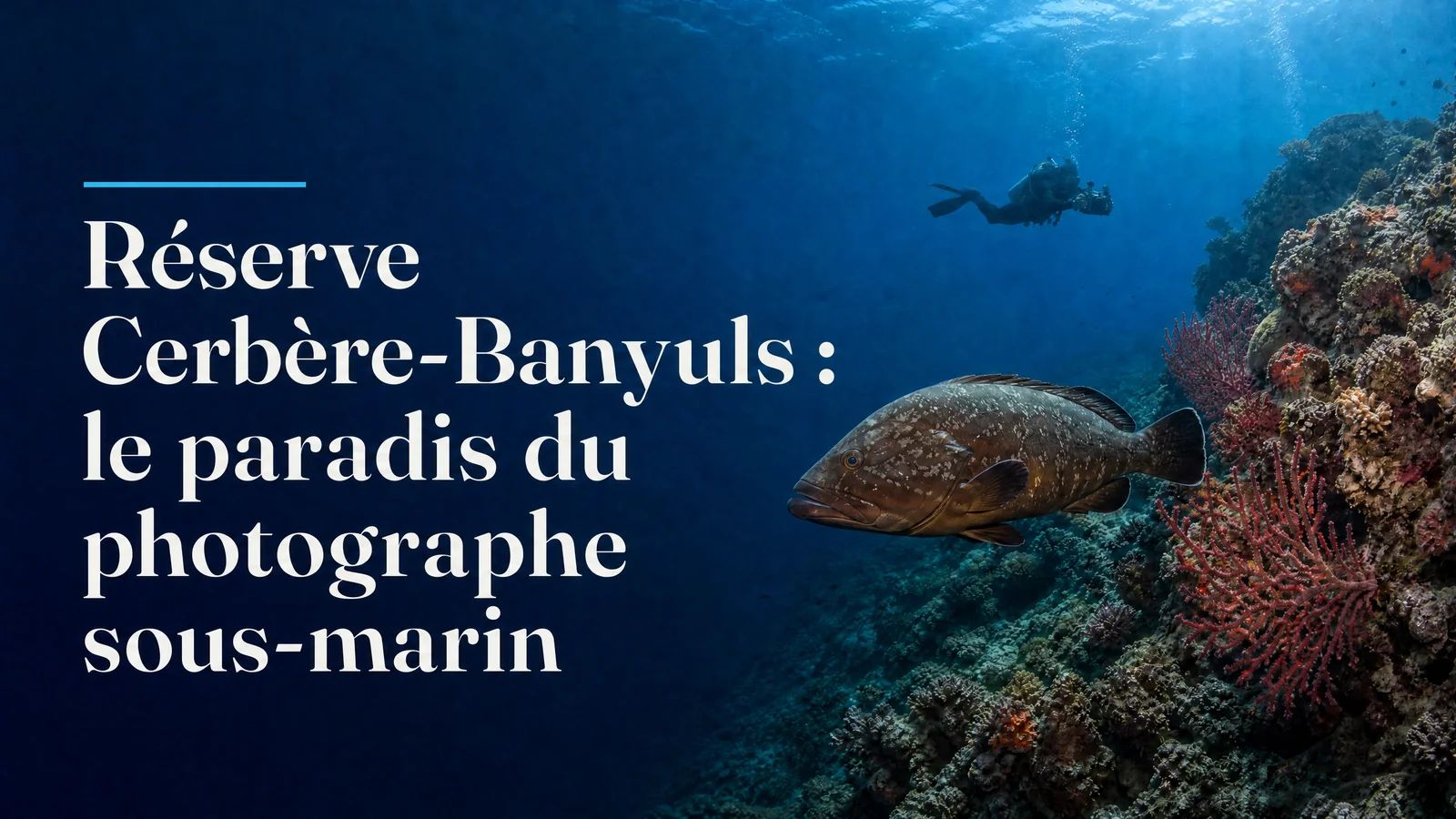
For an underwater photographer, the brown grouper of Cerbere-Banyuls is a fascinating subject. These fish, which can grow to over a metre long and live for several decades, have developed within the reserve a behaviour rarely found elsewhere in the Mediterranean. They are curious, unafraid, and certain individuals approach divers with a quiet confidence that leaves all the time needed to compose an image.
The key, as always in natural light underwater photography, is patience. The grouper won't come to you if you charge towards it. But if you settle down, if you wait, if you give the animal time to assess you, then it approaches. And there, the Mediterranean light does the rest.
Coralligenous formations, an overlooked treasure
When people think "coral", they generally think of tropical reefs. But the Mediterranean has its own equivalent: coralligenous formations. And in the Cerbere-Banyuls reserve, they cover 53 hectares, or 10% of the total area.
These biogenic formations are built by calcareous organisms (encrusting algae, bryozoans) that slowly construct, over centuries, an underwater relief of remarkable complexity. Red coral grows there, red and white sea fans spread their fans, sponges colonise every crevice.
It's a habitat of extraordinary richness for photography. Macro finds subjects on every square centimetre: nudibranchs, shrimps, tube worms, small crustaceans. Medium shots allow compositions with sea fans in the foreground and natural light filtered through the surface as background.
The challenge for the photographer is that coralligenous formations are generally found from 25-30 metres depth, where natural light begins to fade. This is where the Mediterranean demands from the photographer a technical mastery that shallow tropical waters don't always require. Exposure management, stability in current, speed of execution. It's a demanding exercise, and that's precisely what makes the images so rewarding.
The reserve's dive sites
Les Trois Moines
Three rocks that emerge at the surface and continue underwater in a rugged relief of faults, passages and overhangs. Life is dense: schools of sea bream, thousands of damselfish, resident groupers. The site is accessible from Level 1 and offers varied photo conditions, from wide angle in fish schools to macro on walls covered in sessile life.
Les Tignes
A deeper site, with a wall that descends towards the coralligenous formations. Sea fans are particularly well-developed here, and you regularly encounter brown meagre, those dark fish with their distinctive sound that live in the wall's crevices. For the photographer, Les Tignes is an atmosphere site: light playing through the sea fans, diver silhouettes in the blue, backlighting effects.
Cap l'Abeille
The historic reinforced protection zone. Access is strictly regulated, and this is where life density reaches its peak. Groupers are the most numerous, largest, and most confident here. It's the site where you truly understand what fifty years of protection can produce.
The reserve's wildlife through a lens
Beyond the grouper, the reserve harbours wildlife that would make more than one tropical site pale. Brown meagre, with their dark colouring and gregarious behaviour in rocky cavities. Mediterranean barracuda, less imposing than their tropical cousins but equally photogenic when they patrol in schools through the water column. Noble pen shells, those giant protected shellfish that can reach a metre in height.
And then there are the nudibranchs. The purple flabellina (Flabellina affinis), Hypselodoris picta with its purple and yellow patterns, the dalmatian doris. These small shell-less molluscs are the "jewels of the sea", and the reserve harbours a remarkable diversity of them. For the macro photographer, it's an inexhaustible hunting ground.
The Peyrefite underwater trail, open in July and August, even gives non-divers a glimpse of this richness. Five hundred metres there and back from the beach, five stations with information panels presenting five different ecosystems. It's a magnificent gateway for those who haven't yet taken the plunge.
Photographing in the reserve: practical advice
The reserve imposes strict rules, and that's a good thing. No feeding, no collecting, no contact with fauna or flora. For the photographer, these rules are in perfect alignment with the AquaExposure philosophy: observe without disturbing, photograph without intervening.
A few tips specific to the reserve. Visibility is generally excellent but can change rapidly with weather conditions. The best moments for photography are early morning, when light enters at a low angle creating magnificent atmospheres, and when pleasure boats haven't yet arrived.
The recommended wetsuit is a 5mm minimum in spring and autumn, a 3mm in high summer. Water can drop to 14 degrees at depth even in summer, and cold is the number one enemy of photographer stability.
For AquaExposure training sessions in partnership with Aquatile, the reserve is the privileged learning ground. The diversity of subjects, quality of light and density of life allow you to work on all aspects of underwater photography in just a few dives.
FAQ
Can you dive freely in the Cerbere-Banyuls reserve?
The reserve is open to diving across most of its perimeter, but the reinforced protection zone at Cap Rederis (65 hectares) is strictly off limits to all human activity. Other zones are accessible provided you respect the rules: no collecting, no feeding, no contact with fauna or flora. Going with a certified dive centre is recommended.
What species can you photograph in the reserve?
The reserve is home to over 1,200 animal species. The most iconic subjects are brown groupers (over 630 individuals), red and white sea fans, red coral, nudibranchs (purple flabellina, dalmatian doris), brown meagre, Mediterranean barracuda, noble pen shells and octopuses. The density of life is unmatched along the French coast.
Do I need a specific diving level for the reserve?
Sites like Les Trois Moines are accessible from Level 1 (Open Water). Coralligenous formations and red sea fans, found from 25-30 metres, require Level 2 or equivalent. The Peyrefite underwater trail is open to everyone, even without a diving qualification, in July and August.
Is the Cerbere-Banyuls reserve accessible year-round?
Yes, the reserve is accessible year-round for diving (excluding restricted zones). The best conditions are found between June and September, with water at 22-25 degrees and visibility often exceeding 20 metres. Spring and autumn also offer beautiful dives with less crowding, though the water stays cooler.
Want to learn how to photograph without disturbing marine life?
Module 3 of the AquaExposure training is entirely dedicated to ethical approach and animal behaviour. Knowing how to observe without intervening is the key to bringing back powerful images while respecting the environment. AquaExposure training