Bleaching occurs when corals expel the symbiotic algae that provide them with food and color. Without these algae, the coral turns white and weakens. If the thermal stress lasts too long, the coral dies. A bleached reef loses its ability to shelter the thousands of species that depend on it.
How can an underwater photographer contribute to reef protection?
By documenting the state of reefs over time. Comparative photos from one year to the next serve as visual evidence that scientists use. Participating in Reef Check, choosing Green Fins certified centers, and mastering buoyancy to never touch the coral are direct and measurable contributions.
Can corals regenerate after bleaching?
Yes, if the thermal stress ends soon enough. A bleached coral is not yet dead, it is weakened. If the temperature drops within the following weeks, the symbiotic algae can recolonize the coral. Full recovery takes several years. Researchers are also working on heat-resistant strains.
Where does research on heat-resistant super-corals stand?
Scientists have identified corals surviving at 36 degrees Celsius, well above the usual bleaching threshold. KAUST University in the Red Sea is exploring assisted evolution through selective breeding of resistant strains and introduction of heat-tolerant bacteria. These approaches are promising but still at the experimental stage.
When you dive regularly on the same sites, you become familiar with each coral formation just as you would with the trees in a familiar garden. You know where to find the massive brain coral, what time of year the acropores take on this particular pink hue, and where the clownfish have made their home in their anemone for years. It is this intimacy with the reef that makes the figures published this week so difficult to interpret.
The NOAA and Yale figures
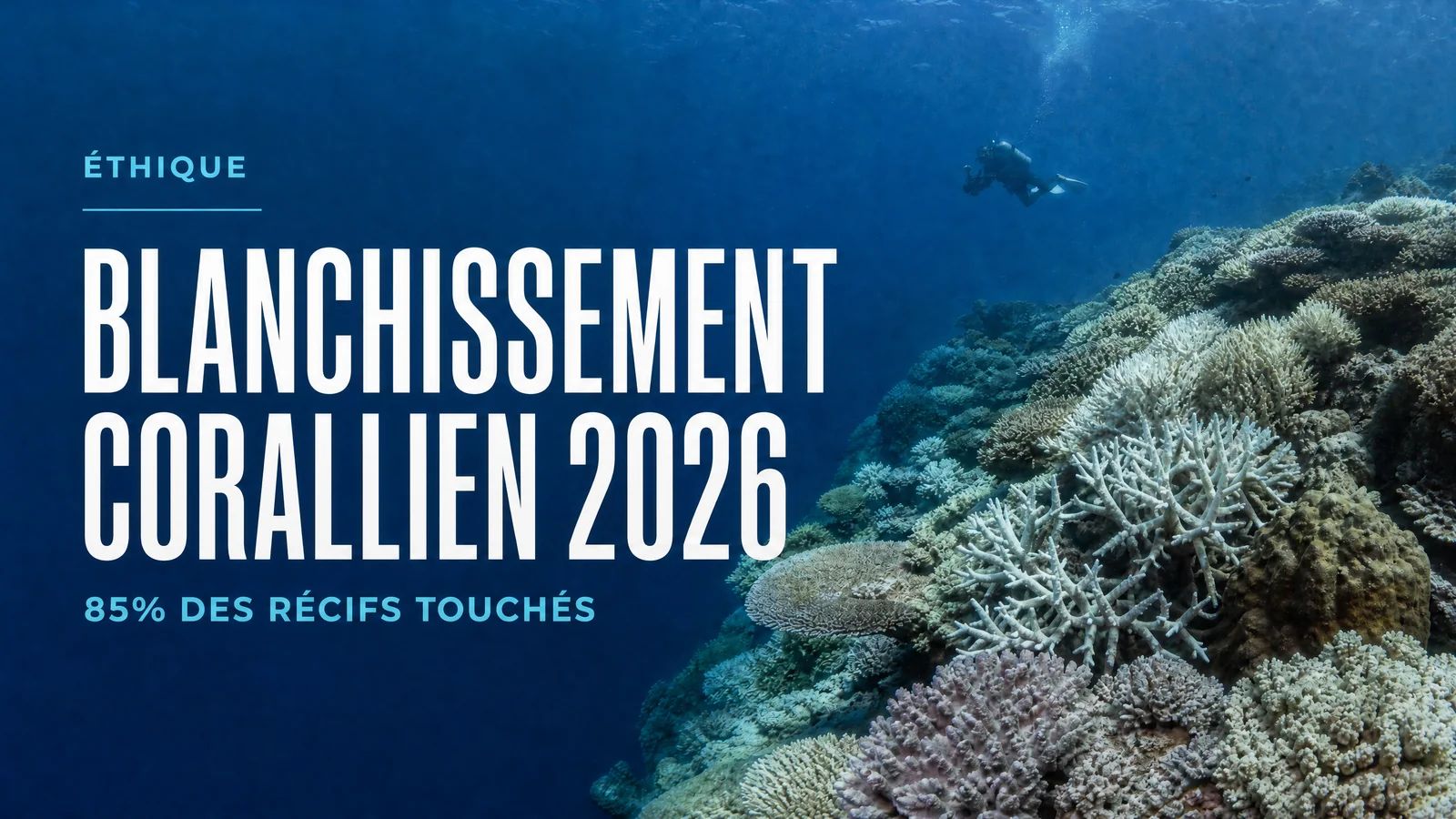
According to the latest data published by NOAA and relayed by Yale Climate Connections, the world is experiencing its fourth global coral bleaching event. Between 2023 and 2025, approximately 85% of the global reef surface has experienced thermal stress at bleaching levels. More than half of the planet's reefs have actually bleached during this three-year marine heatwave.
ScienceAlert goes further and poses the question that worries the entire scientific community and divers: could 2026 be the year when some coral reef systems irreversibly collapse?
These are not remote projections. They are on-site observations, confirmed by satellite data and on-site measurements.
August 2026 update: 84.4%, 83 countries, two simultaneous records
Data from the GCRMN (Global Coral Reef Monitoring Network) published in August 2026 refines the tally: 84.4% of the world's reefs experienced bleaching-level thermal stress between January 2023 and September 2025, across 83 countries. The 85% figure cited initially was a preliminary estimate. The definitive result remains catastrophic.
Among the records set during this heatwave, one stands out: for the first time in documented history, the Great Barrier Reef and Ningaloo Reef (Western Australia) bleached simultaneously. These two reef systems, separated by an entire continent, experienced synchronized thermal stress.
On the restoration side, several programs are advancing in parallel. AIMS (Australian Institute of Marine Science) has expanded its selective breeding program for heat-resistant corals, with colonies capable of withstanding temperatures 3 to 4 degrees above the usual bleaching threshold. NOAA's Mission Iconic Reefs is concentrating its efforts on three key sites in Florida. And the Coral Reef Breakthrough, backed by governments and private foundations, targets the restoration of 125,000 km² of reefs by 2030, with nearly 11 billion euros mobilized.
NOAA's Strategy for Coral Reefs Up to 2040
In response to this crisis, NOAA published its new National Coral Reef Resilience Strategy in May 2026, an action plan that will guide U.S. conservation efforts until 2040. The approach is multidisciplinary: continuous monitoring, high-resolution mapping, research on resilience, social sciences to understand reef-dependent communities, and communication to raise public awareness.
It's an ambitious framework, but one that implicitly acknowledges the scale of the problem: we're no longer talking about saving reefs in their current state, but about maximizing their ability to survive and regenerate in a warming ocean.
Coral Species That Thrive
Not all news is bad. Researchers have identified corals capable of surviving temperatures reaching 36 degrees Celsius, well above the usual bleaching threshold. These "super-corals" pave the way for assisted evolution strategies: selective breeding of resistant strains, and the introduction of thermo-tolerant algae and bacteria into fragile colonies.
In Saudi Arabia, KAUST University and digiLab are developing an AI-powered digital twin platform to accelerate the monitoring and restoration of reefs in the Red Sea. The idea is to create a virtual model of the reef that evolves in real-time, allowing scientists to simulate different restoration scenarios before implementing them.
What a marine photographer sees on a bleached reef
For those who have never seen a bleached reef in person, the reality is difficult to describe with words. The coral, which is normally adorned with browns, greens, pinks, and purples, becomes a ghostly white, almost luminous. The fish are still there, at first, but they swim around structures that resemble bones. If the stress continues, the algae invade the dead coral, and what was once an underwater garden becomes a field of greenish ruins.
As an underwater photographer, documenting a bleached reef is both a responsibility and a challenge. Images have a power that numbers cannot: they make visible, immediately, what it means to lose an ecosystem.
What divers can do
Divers will not save the reefs on their own. Coral bleaching is caused by ocean warming, and the solution is systemic, not individual. But there are concrete contributions.
Choose certified Green Fins dive centers, which adhere to measurable environmental standards (SDI officially adopted the program in April 2026). Master your buoyancy to never touch the coral. Participate in citizen science programs such as Reef Check. And above all, document. Take photos. Compare year after year. Show what is changing.
The reefs that still survive deserve to be seen, documented, and protected. Those that are suffering deserve to have someone witness them. And underwater photographers, perhaps without realizing it, are among the most valuable witnesses of this transformation.
Somewhere beneath the surface, a coral that has survived three very hot summers continues to filter the water and sustain an entire ecosystem. It doesn't know that we are talking about it in reports. But it is still there.
Frequently Asked Questions
Why coral bleaching is so serious for reefs?
Bleaching occurs when corals expel the symbiotic algae that provide them with food and color. Without these algae, the coral turns white and becomes weakened. If the thermal stress lasts too long, the coral dies. A bleached reef loses its ability to host the thousands of species that depend on it, from fish to crustaceans to mollusks.
How can a marine photographer contribute to reef protection?
By documenting the state of the reefs over time. Comparative photos from year to year provide visual evidence that scientists use in their research. Participating in citizen science programs such as Reef Check, choosing certified Green Fins dive centers, and mastering buoyancy to never touch the coral are direct and measurable contributions.
Can corals regenerate after bleaching?
Yes, if the thermal stress subsides early enough. A bleached coral is not yet dead, it is weakened. If the water temperature drops again in the following weeks, the symbiotic algae can recolonize the coral. Complete recovery takes several years. Researchers are also working on thermo-resistant strains that can survive in warmer waters.
Where are the research efforts on "heat-resistant" super corals?
Scientists have identified corals surviving at 36 degrees Celsius, well above the usual bleaching threshold. The KAUST University in the Red Sea and other laboratories are exploring assisted evolution: selective breeding of resistant strains and the introduction of thermo-tolerant bacteria. These approaches are promising but are still in the experimental stage.
Photographing reefs is also about documenting their evolution. Our module "Ethics and Marine Environments" in the underwater photography course prepares you to document the underwater world responsibly.