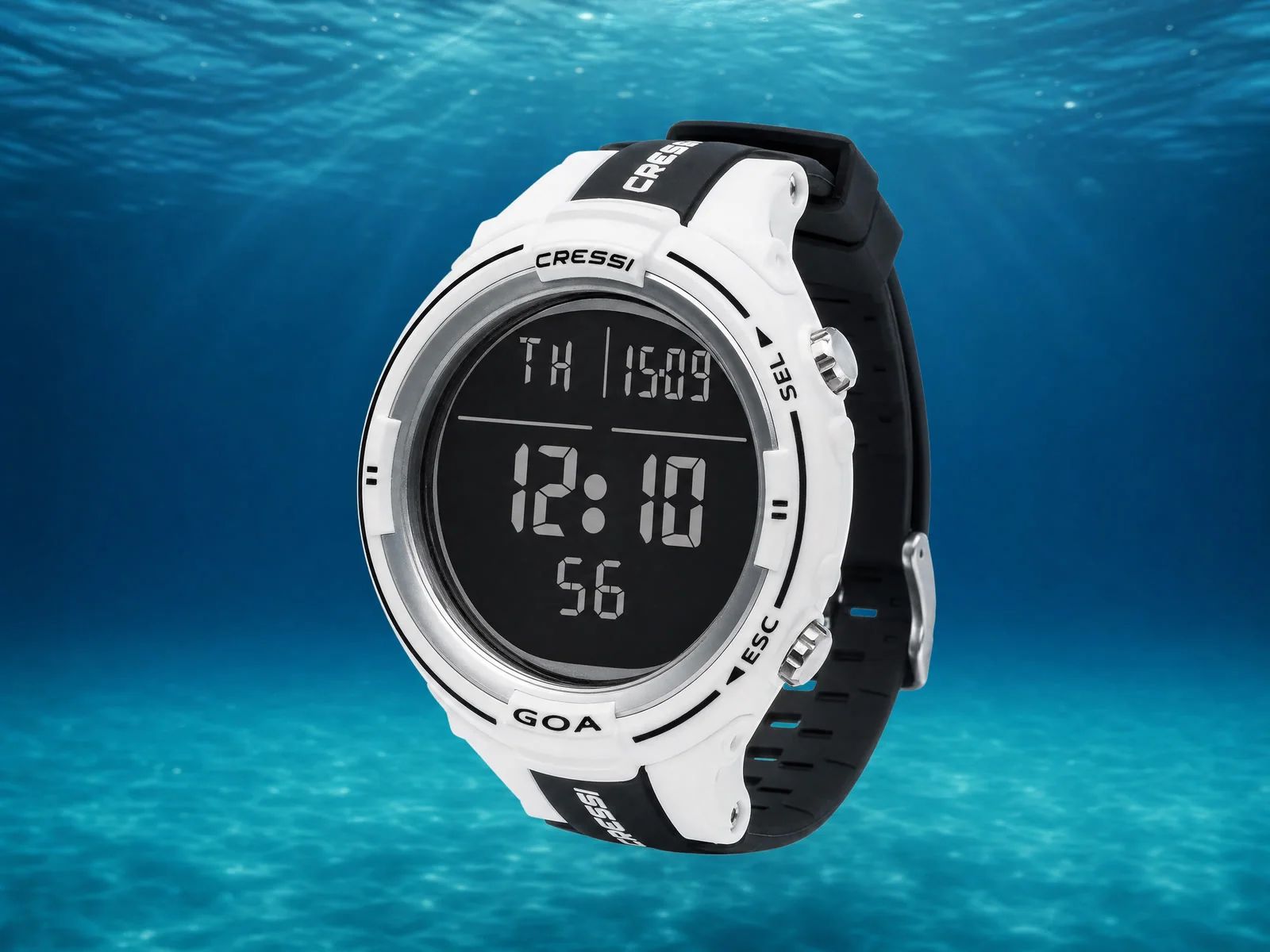
Cressi Goa Dive Computer Review: The Ultra-Compact Watch-Computer for Leisure and Freediving
Detailed review and test of the Cressi Goa dive computer. An affordable watch format, featuring the RGBM algorithm, ideal for recreational divers and freedivers.
Does the Cressi Goa allow gas switching underwater?
No, the Cressi Goa manages a single gas mixture per dive (Air or Nitrox up to 50% O2). It is not designed for technical dives requiring switching to a decompression cylinder.
Is the Cressi Goa's screen readable at night or in dark water?
It has a high-contrast segmented LCD screen and a powerful backlight, but the latter must be manually activated by pressing a button. It is not a permanently backlit AMOLED screen.
Can I change the computer's battery myself?
Yes, the Cressi Goa runs on a standard CR2450 button cell battery that is easily user-replaceable. Cressi announces a battery life of approximately 4 years (for 50 dives per year).
Does the Cressi Goa dive computer have a built-in compass?
No, this compact watch-format model does not have a built-in digital compass.
To learn how to get the most out of your gear underwater, discover the AquaExposure training.
Introduction
The quest for streamlined gear is a constant concern, especially when handling bulky underwater camera equipment, such as a heavy SLR housing or a video pole. Any extra centimeter of equipment can hinder access to controls or cause snagging on the bottom. The Cressi Goa fits precisely into this niche: an extremely compact watch-format dive computer that is easily forgotten on the wrist. With its 48 mm diameter and extra-flat 14 mm profile, it guarantees never to hinder access to your controls and limits the risk of snagging. Oriented toward recreational diving (Air and simple Nitrox) and featuring a highly advanced mode for freediving, it relies on Cressi's renowned RGBM algorithm. But does this miniaturization and accessible price point imply compromises for use in demanding, dark, or cold environments? Here is our rigorous analysis of this Italian watch-computer.
Summary Verdict
Global Score: 3.4/5
Criterion
Score
What this means
Algorithm & stops
3.5/5
Reliable Cressi RGBM algorithm for leisure, with 3 safety levels, but more opaque than an open Bühlmann model.
Air & multi-gas
2.5/5
Simple management of a single Air or Nitrox mixture (up to 50%). No multi-gas underwater or air integration.
Screen & ergonomics
3.5/5
Very clear UFDS segmented LCD screen. Effective but manual backlight.
Battery & power
4.5/5
Excellent battery life of several years, with a user-replaceable CR2450 battery.
Connectivity & app
2.0/5
No native Bluetooth chip in the watch. Transfer requires the purchase of an optional external interface.
Compass & instruments
2.5/5
No digital compass, but the Freediving (Free) and depth gauge (Gauge) modes are very well designed.
Robustness & depth
4.0/5
Shockproof technopolymer casing, scratch-resistant mineral glass, waterproof to 120 meters.
Price & service
This computer is suitable for: The recreational diver (Air/Nitrox) or freediver looking for a compact watch to travel light, or the photographer who wants a reliable and unobtrusive backup depth gauge.
This computer is not ideal for: Technical divers requiring multiple gas switches (Trimix/Deco), or those demanding a permanently backlit color screen for regular dives in complete darkness.
Detailed Analysis
O1 Algorithm & stops (3.5/5)
The mathematical heart of the Cressi Goa relies on a model renowned for recreational diving, prioritizing micro-bubble management.
Algorithm: Cressi RGBM (developed by Bruce Wienke, Haldane 9-tissue model). A very solid safety standard for square or repetitive recreational dives. (Score: 3.5/5)
Conservatism: No fine tuning by Gradient Factors, but a choice among 3 pre-defined safety levels (SF0, SF1, SF2). (Score: 3.5/5)
Deco display: Clear visibility of mandatory stops (time and depth) and graphic CNS toxicity indicator. (Score: 4/5)
O2 Air & multi-gas (2.5/5)
The computer goes to the essential and targets the diver who performs the entirety of their dive with the same cylinder.
Number of gases managed: A single programmable gas per dive (Air or Nitrox from 21% to 50%, adjustable PO2 from 1.2 to 1.6). (Score: 2.5/5)
Trimix & CCR: Not supported. (Score: 1/5)
Air integration: No wireless connection with a pressure transmitter. (Score: 1/5)
O3 Screen & ergonomics (3.5/5)
The speed and clarity of access to information are decisive parameters underwater.
Readability: The numbers are massive for the size of the dial and perfectly readable in the 20-meter zone under natural light. For dives in dark quarries, you will need to manually activate the backlight by pressing a button, which occupies a hand. (Score: 3.5/5)
Navigation: Two low-profile metal push buttons. Simple to use, they prevent the accumulation of sediment or sand. (Score: 4/5)
O4 Battery & power (4.5/5)
The watch format and LCD screen eliminate the constraint of USB charging before each weekend.
Battery type: Standard CR2450 button cell. (Score: 4.5/5)
Autonomy: About 4 years for an average profile of 50 annual dives. Replacement by the user is easy (the case disassembles via two small screws), ideal for being autonomous when traveling. (Score: 4.5/5)
O5 Connectivity & app (2.0/5)
Transferring your logbook requires an additional investment that weighs on the overall budget if you wish to digitize your profiles.
Synchronization: The Goa does not integrate Bluetooth natively. Transfer is done via an optional external interface (Bluetooth or USB) sold separately by Cressi. (Score: 1.5/5)
Companion app: Compatible with Cressi applications and desktop software once the interface is acquired. (Score: 3/5)
O6 Compass & instruments (2.5/5)
Devoid of navigation instruments, the Goa makes up for it with excellent versatility for freedivers.
Built-in compass: Absent. (Score: 1/5)
Freediving (Free Dive) mode: Particularly complete. It calculates depth in real-time, dive time, and clearly displays surface recovery time. The depth alarm is very useful for working on the cable. (Score: 4.5/5)
O7 Robustness & depth (4.0/5)
The quality of Italian manufacturing is felt in the selection of materials.
Materials: High-strength technopolymer casing (absorbs shocks very well) and scratch-resistant mineral glass. A transparent silicone protective shield (bumpon) is also provided to preserve it further. (Score: 4.5/5)
Operational depth: 120 meters. (Score: 4/5)
O8 Price & service (4.5/5)
At purchase, the economic promise is very interesting for equipping oneself with new gear under warranty.
Value for money: Generally offered around €230, it is highly competitive in the range of watch dive computers, provided you accept the extra cost of the PC/Mac interface if you want to extract your data digitally. (Score: 4.5/5)
Warranty & Service: Cressi offers a highly reliable global and European distribution network. (Score: 4.5/5)
What to know before buying
Light management in murky water: Unlike a color screen computer (OLED/AMOLED) that glows continuously, consulting the Cressi Goa in complete darkness will require you to let go of your light or video equipment to press one of the buttons and trigger the high-intensity backlight (which stays on for 5 seconds).
The transfer interface option: Be careful when purchasing: the computer is most often sold alone. If keeping a digital logbook on a computer or smartphone is important to you, plan to add the Cressi interface to your overall budget.
An excellent "Backup": Its discretion, the lack of a proprietary charger to carry, and its long-lasting battery make it the backup computer par excellence. It can remain attached to a shoulder strap of your BCD or in a pocket to be instantly functional in case of primary computer failure.
Safety Reminder
Reading your parameters on a small dial or activating the screen light sometimes requires the use of a hand, especially if the other is already supporting camera equipment. This instrument manipulation must never compromise your breathing safety: from water entry to complete surface return, your regulator must remain firmly in your mouth in all circumstances.
Furthermore, a dive computer's algorithm has the unique function of mathematically modeling your desaturation to ensure your safety and calculate mandatory stops. There is no function to "reduce bubbles" or "maximize your bottom time"; these concepts are erroneous, dangerous, and completely contrary to the physiological rules of diving. The computer displays constraints related to your immersion, and it is your absolute responsibility to respect them scrupuleously.
Our Verdict
The Cressi Goa is a model of compactness and simplicity. By choosing the extra-flat watch format and LCD technology, Cressi offers a robust and durable instrument that is perfectly suited for recreational divers wishing a clear display without cluttering themselves with complex functions. While its two-button navigation interface and RGBM algorithm (limited to a single gas) will not meet the logistical requirements of deep technical divers, the Goa remains a highly pragmatic and elegant choice. Its proven robustness and high-performing freediving mode make it a particularly relevant tool for beginners, frequent travelers, or as a reliable and discreet backup instrument on the wrist of the underwater photographer.
Power Source
The watch dive computer runs on a standard CR2450 Lithium button cell battery. Thanks to the frugality of its segmented LCD display, power consumption remains minimal. It offers an average battery life of four years for approximately 50 dives per year, and its replacement can be performed directly by the user.