Table of Contents
Cressi Nano mask review- apnea and spearfishing. Detailed analysis of technical features and design. Documented buying guide. AquaExposure, Benjamin Coste.
Share
/blog/cressi-nano-en
Table of Contents
- 01Introduction
- 02Summary Verdict
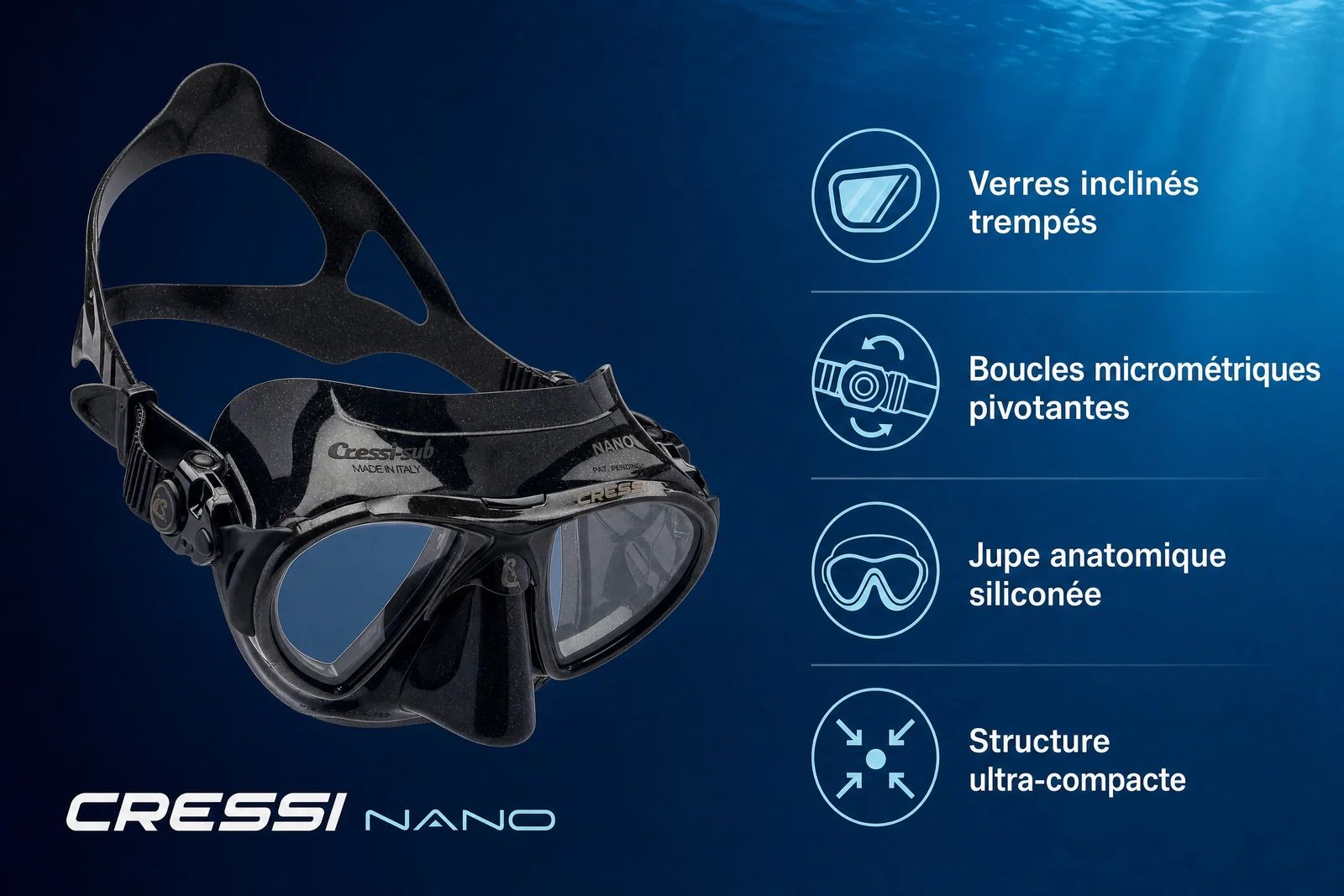
- 03Detailed Analysis### M1: Volume and Field of View The first criterion assesses the mask's design in terms of its air volume and lens configuration. The Cressi Nano is a dual-lens model designed to minimize dead space. Its internal volume is documented at approximately 85 cm3, which limits the amount of air needed for equalization during dives. The angled tempered lenses provide a wider overall field of view. Criterion: Internal volume and lens arrangement (Score: 4.5/5)
- 04M2: Skirt and Fit The skirt design determines contact with the face and the overall stability of the equipment. The Cressi Nano features a high-quality, soft silicone skirt designed to conform to the contours of the face with minimal bulk. The general geometry aims to reduce resistance during movement. However, the precise dimensions of the skirt in millimeters are not documented in primary sources, which requires careful attention to nasal fit. Criterion: Silicone skirt and facial geometry (Score: 4.0/5)### M3: Lenses and Communication The optical quality and lens options directly affect visual perception and nonverbal communication with your dive buddy underwater. The Cressi Nano uses safety tempered glass lenses and offers several aesthetic and functional variations, including clear versions as well as mirrored finishes like the Black Mirror. These variations allow you to adapt the mask to the lighting conditions encountered on the surface or at depth. Criterion: Lens quality and finish options (Score: 4.0/5)
- 05M4: Anti-Fog and Maintenance Maintenance and condensation management are essential technical aspects for ensuring consistent visibility. The Cressi Nano's specifications do not mention any permanent anti-fog treatment applied to the tempered glass lenses during manufacturing. Therefore, an initial preparation of the lenses through thorough cleaning is indispensable before the first dive to remove any manufacturing residues that can cause fogging. Criterion: Anti-fog treatment and initial maintenance (Score: 3.0/5)### M5: Straps and Ergonomics The ergonomics of the buckles and the stability of the strap affect user comfort. This model features rotating buckles with micro-adjustment that are directly connected to the rigid frame, which improves tension distribution and prevents distortion of the skirt. The anatomical strap provides a secure fit. Criterion: Rotating buckles and anatomical strap (Score: 4.5/5)
- 06M6: Durability and Accessories The durability of the structure and the quality of the materials ensure resistance to the stresses of the marine environment. The Cressi Nano benefits from careful manufacturing, designed for freediving and spearfishing, where impacts and pressure changes are common. The rigidity of the frame protects the lens inserts. Criterion: Structural integrity and overall design (Score: 4.0/5)
- 07M7: Price and Availability The final criterion analyzes the relationship between the observed price point and the intrinsic value of the features offered. The Cressi Nano is priced within a range consistent with specialized freediving equipment, and it enjoys wide distribution through specialty retailers at the time of data collection. Criterion: Pricing and accessibility (Score: 4.5/5)
- 08What to know before you buyAcquiring a technical mask like the Cressi Nano requires careful attention to several functional parameters. Firstly, the reduced internal volume of 85 cm3 alters the visual perception compared to a traditional mask. Because the lenses are closer to the eyes, the field of vision focuses on the essentials, which is suitable for freediving but may surprise a diver accustomed to a wide, panoramic view.
- 09Trying on the mask before buying: The most important factor.This comparison helps you to compare the different models. However, it cannot tell you if a mask is suitable for your face. Before purchasing, try on the mask without the strap, inhale gently through your nose, and check that it fits securely on its own, without any pressure points or leaks. This step represents more than 80% of the actual importance of your purchase. If the skirt doesn't fit your facial structure, no ultra-clear lens, anti-fog treatment, or buckle system will compensate for the problem.
- 10Safety Reminder
- 11Our VerdictThe analysis of documented information confirms that the Cressi Nano meets the specific needs of freedivers and spearfishers who are looking for compactness and hydrodynamics. Its overall score of 4.1 out of 5 reflects solid performance, but is tempered by the lack of precise weight specifications and the need for an individual fit test.
- 12Maintenance and Lifespan
- 13Other Models from the Brand to Compare
- 14FAQ**What is the documented internal volume of the Cressi Nano mask?** The documented internal volume of the Cressi Nano is minimal, estimated to be around 85 cm3, which reduces the need for frequent equalization during deep freediving.
- 15Sources
- 16CTA comparatorTo compare this mask with other models, see our [diving mask comparison tool](/tools/mask-comparison). For more equipment reviews, also check out our [selection of diving tools](/tools).
Questions about the Journal
What is the documented internal volume of the Cressi Nano mask?
The documented internal volume of the Cressi Nano is minimal, estimated at around 85 cm3, which reduces the need for frequent equalization during deep freediving descents.
Is the Cressi Nano suitable for recreational scuba diving?
Designed primarily for advanced freediving and spearfishing due to its hydrodynamic profile and low volume, it can be used in scuba diving provided that morphological compatibility is validated through a test.
Are there any original corrective lenses available for the Cressi Nano mask?
Official sources do not provide information regarding the availability of original corrective lenses for this specific type of angled bifocal mask.
How is the strap adjusted on the Cressi Nano?
The adjustment relies on pivoting buckles equipped with a micrometer system- directly connected to the housing to ensure optimal stability underwater.

