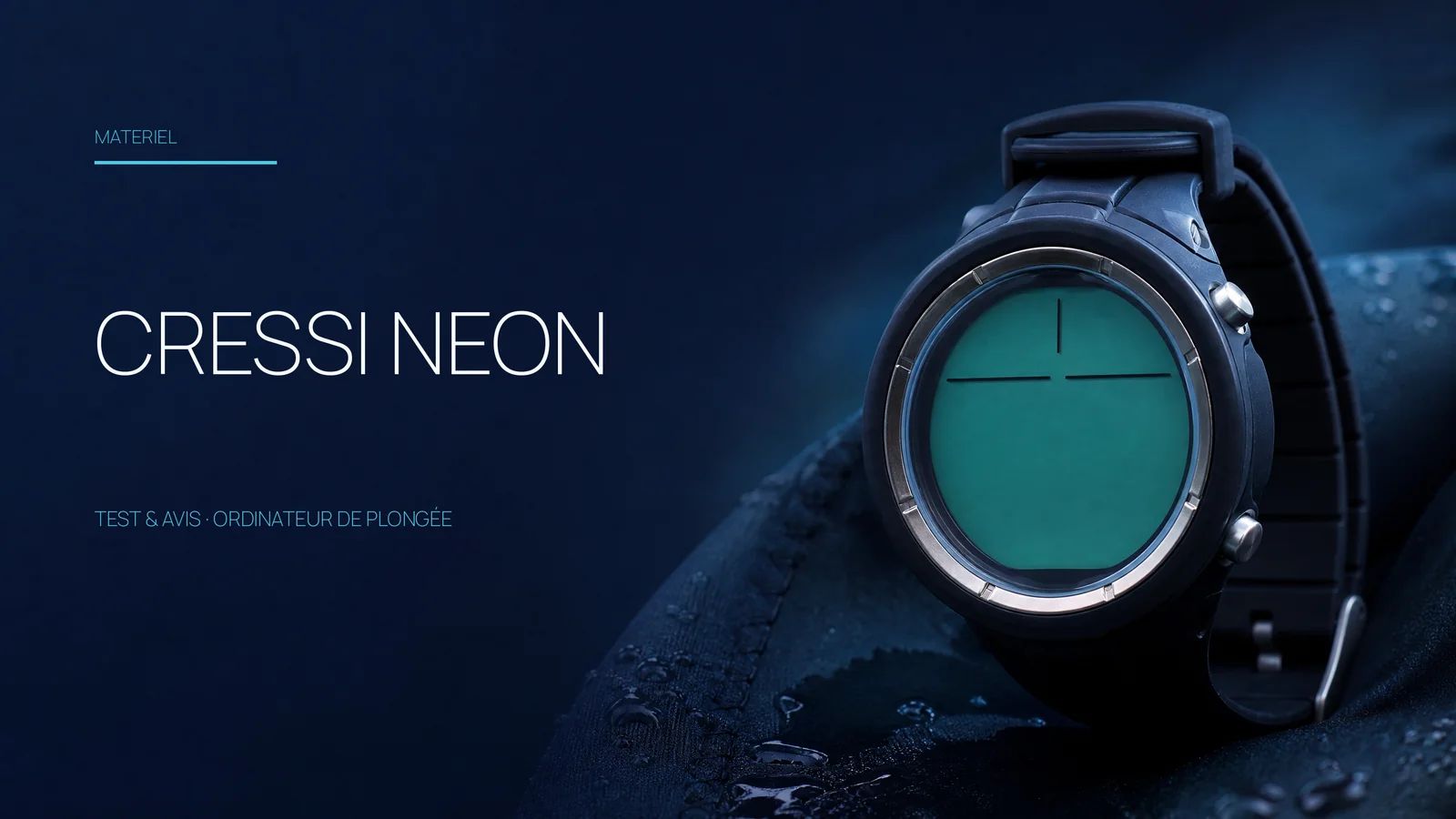
Cressi Neon Dive Computer Review: The Ultra-Flat Watch-Computer with Multi-Gas Management
Detailed review and test of the Cressi Neon dive computer. A compact watch format, 14mm thick, integrating the RGBM algorithm and 2-gas management (Nitrox).
What is the main difference between the Cressi Goa and the Cressi Neon?
Unlike the Goa, which only manages one gas, the Neon allows programming two gas mixtures (a bottom gas and a decompression gas up to 99% O2), making it perfectly suited for Advanced Nitrox divers.
Is the Cressi Neon's screen permanently backlit?
No, to preserve battery life, the matrix screen lights up very intensely (4000 Mlux) only when a button is pressed or when an alarm is triggered.
Do I need to send the computer to a service center to change the battery?
No, the Cressi Neon uses a standard CR2450 battery that the user can change themselves, provided they clean, grease, and correctly position the sealing O-ring.
Does the Cressi Neon have built-in Bluetooth?
Transferring dives to a smartphone or computer requires purchasing an optional external Bluetooth/USB connection interface sold separately by the brand.
To learn how to get the most out of your gear underwater, discover the AquaExposure training.
Introduction
Wrist clutter is a crucial logistical challenge when maneuvering a bulky underwater camera system, such as a housing for a Sony RX10V or a long Insta360 pole. Every extra centimeter of equipment can hinder access to controls or cause snagging on the bottom. It is in this logic of absolute minimalism that the Cressi Neon fits. A direct technical evolution of the Goa model, this watch-computer maintains tiny dimensions (only 48 mm in diameter with an extra-flat 14 mm profile) while achieving a major operational step: the introduction of 2-gas management. Built on the RGBM algorithm, the Neon is designed for divers and freedivers who want to plan safe Nitrox decompressions without the bulk of a massive console. How does this promise of compactness stand up to the demands of cold or low-visibility environments?
Excellent evolution with 2-gas management (Air/Nitrox up to 99% O2), but no air integration (AI).
Screen & ergonomics
3.5/5
Very sharp matrix LCD screen, mineral glass. Ultra-powerful backlight but manually triggered.
Battery & power
4.5/5
User-replaceable CR2450 battery. Excellent battery life of several years.
Connectivity & app
2.0/5
Transfer interface (Bluetooth/USB) is not integrated into the watch and remains a paid option.
Compass & instruments
2.5/5
No digital compass, but a highly detailed Freediving (Free) mode.
Robustness & depth
4.0/5
Shockproof technopolymer casing, perfect hydrodynamics, certified to 120 meters.
Price & service
4.5/5
Formidable gear/price ratio for a 2-gas computer (around €250).
This computer is suitable for: The advancing diver (Advanced Nitrox), the underwater photographer looking for an extra-flat profile to avoid hindering movements, or the regular freediver.
This computer is not ideal for: Trimix technical divers, those demanding wireless block pressure integration, or those used to large color AMOLED screens that remain on continuously.
Detailed Analysis
O1 Algorithm & stops (3.8/5)
The calculation engine is based on the decompression model developed by Dr. Wienke, particularly suitable for managing repetitive dive profiles over several days.
Algorithm: Cressi RGBM. (Score: 3.5/5)
Conservatism: Three safety levels adjustable by the user (SF0, SF1, SF2) to adapt planning to environmental conditions (cold, current, fatigue). (Score: 3.5/5)
Deco display: Immediate visibility of mandatory stop times and depths. The deep stop function is integrated and can be activated or deactivated according to your habits. (Score: 4/5)
O2 Air & multi-gas (3.0/5)
This is the true operational demarcation compared to the brand's entry-level models.
Number of gases managed: 2 gases. You can set your bottom gas (21-50%) and switch underwater to a suroxygenated decompression gas (21-99%). This is a major asset for accelerated decompression protocols. (Score: 3.5/5)
Trimix & CCR: Not supported. (Score: 1/5)
Air integration: No receiver module for a pressure transmitter. (Score: 1/5)
O3 Screen & ergonomics (3.5/5)
The computer assumes its go-anywhere daily watch format by betting on a proven segmented screen technology.
Screen type: High-contrast LCD protected by a resistant mineral glass. (Score: 3.5/5)
Readability: Very clear in the zone near the surface or in clear water. On the other hand, in a dark quarry, a button press triggers an extremely powerful backlight (announced at 4000 Mlux) for 5 seconds. (Score: 3.5/5)
Navigation: Managed by two profiled steel buttons. The menus are linear, which avoids getting lost in complex architectures underwater. (Score: 4/5)
O4 Battery & power (4.5/5)
The compact format allows for fully autonomous energy logistics, particularly appreciated when traveling.
Battery type: Standard CR2450 button cell. (Score: 4.5/5)
Autonomy: Approximately 4 years for an average profile of 50 annual dives. Being able to perform the replacement yourself (with careful o-ring greasing) cancels the constraint of regular workshop returns. (Score: 4.5/5)
O5 Connectivity & app (2.0/5)
To export your data, the brand maintains its architecture based on an external module.
Synchronization: The watch does not embed a native wireless chip. You must use a contact interface (Bluetooth or USB) sold as an option by Cressi, which clips onto the dial. (Score: 1.5/5)
Companion app: The Cressi software ecosystem, once coupled with the interface, allows for rigorous analysis of dive profiles and gas management. (Score: 3/5)
O6 Compass & instruments (2.5/5)
The absence of a navigation compass is compensated here by the integration of a high-quality mode for breath-holding.
Built-in compass: Absent. (Score: 1/5)
Freediving (Free) mode: Very advanced. It samples activity quickly, displays real-time depth, dive time, and triggers surface recovery alarms. The extreme hydrodynamics of the watch (no sharp edges) becomes a decisive advantage during descent. (Score: 4.5/5)
O7 Robustness & depth (4.0/5)
Designed to slip through the water without catching anything, its "puck" design naturally protects it.
Materials: Shockproof technopolymer casing, rubber strap firmly fitting the forearm even over thick drysuits. Cressi also provides an additional silicone protector to preserve the mineral glass. (Score: 4.5/5)
Operational depth: 120 meters. (Score: 4/5)
O8 Price & service (4.5/5)
At this price, access to the secure planning of two gases is an excellent deal.
Value for money: Generally sold between €250 and €280, the Neon is among the cheapest 2-gas watch computers on the market. (Score: 4.5/5)
Warranty & Service: You benefit from the very solid Cressi European distribution network for access to parts or protection accessories. (Score: 4.5/5)
What to know before buying
Night ergonomics: The need to press one of the metal buttons to activate the light underwater mobilizes a hand. This is a logistical factor to consider if you are continuously handling a camera rig.
Connectivity cost: If extracting your profiles to a digital logbook (smartphone or Mac/PC) is primary for you, do not forget to include the price of the optional Cressi interface in your budget.
Smart deactivation: The Neon integrates an "Off" mode allowing you to completely turn off the pressure sensors. This is particularly practical for using the computer as a daily watch, or swimming in a pool without triggering false immersion alerts.
Safety Reminder
The algorithmic calculation of decompression, no matter how rigorous, only models a mathematical desaturation and indicates physical limits. Technology does not have the power to arbitrarily push these limits, eliminate nitrogen micro-bubbles, or optimize bottom time. Rigor regarding stops remains the only acceptable standard.
Likewise, the ease offered by an extra-flat computer should not induce any relaxation in basic protocols. Whether you are modifying your gas setting on the dial, filming your buddy, or performing a safety stop in a drift, keeping your regulator in your mouth remains mandatory from the descent to the complete surface return. No visual distraction or instrument manipulation justifies giving up access to your gas source.
Our Verdict
The Cressi Neon strikes the right chord by targeting the essential. By managing gas switching between two mixtures in a casing only 14 mm thick, it establishes itself as a versatile tool that completely frees the wrist. It is ideal for the recreational diver taking their Advanced Nitrox certification, the photographer fleeing bulk, or the demanding freediver. Although you have to compose with a manual light in dark environments and invest in an external module for Bluetooth transfer, its invulnerability to shocks, easily replaceable battery, and highly competitive price make it a very smart instrument of exploration.
Power Source
The watch-computer runs on a CR2450 Lithium button cell battery. Thanks to its energy-efficient segmented LCD screen design, the battery life reaches approximately 4 years for 50 dives per year. Changing the battery is easily done directly by the user.
In the same compact watch format, Cressi also offers the Cressi Goa for a simplified single-gas approach, or our Cressi Cartesio review. If you prefer a larger classic wrist format, you can also refer to our Cressi Giotto review.
Take your practice further
Managing two distinct gas mixtures is an exciting step in a diver's progression. To master the physiological impact of Nitrox and secure your gas switches, discover the AquaExposure training.