Is the DJI Osmo Action 6 reliable at 20 meters without a housing?
The native waterproofing at 20 meters works for the majority of shallow recreational dives and snorkeling. Some isolated reports mention housing issues, but the rule remains the same for all underwater equipment: check the seals, test on the surface before each dive, and never assume waterproofing is guaranteed.
How does the automatic color correction on the Action 6 work?
A dedicated color temperature sensor analyzes the color cast of the water in real time and automatically adjusts white balance. This should significantly reduce color correction work in post-production. The system adapts to both tropical blue water and temperate green water.
Why a square sensor on an action camera?
The square format captures more vertical field than the traditional 16:9. In post-production, you can crop to the format of your choice (16:9, 4:3, 9:16 for social media) without losing resolution. Underwater, where vertical movements are frequent, this format offers more flexibility in editing.
DJI Action 6 or GoPro Mission 1 for diving?
The two philosophies differ. The GoPro Mission 1 relies on a larger 1-inch sensor, better in low light. The Action 6 relies on automatic color correction, more practical for everyday use. If you dislike post-production, the Action 6 may suit you better. If you want the best raw image quality, the Mission 1 has the advantage.
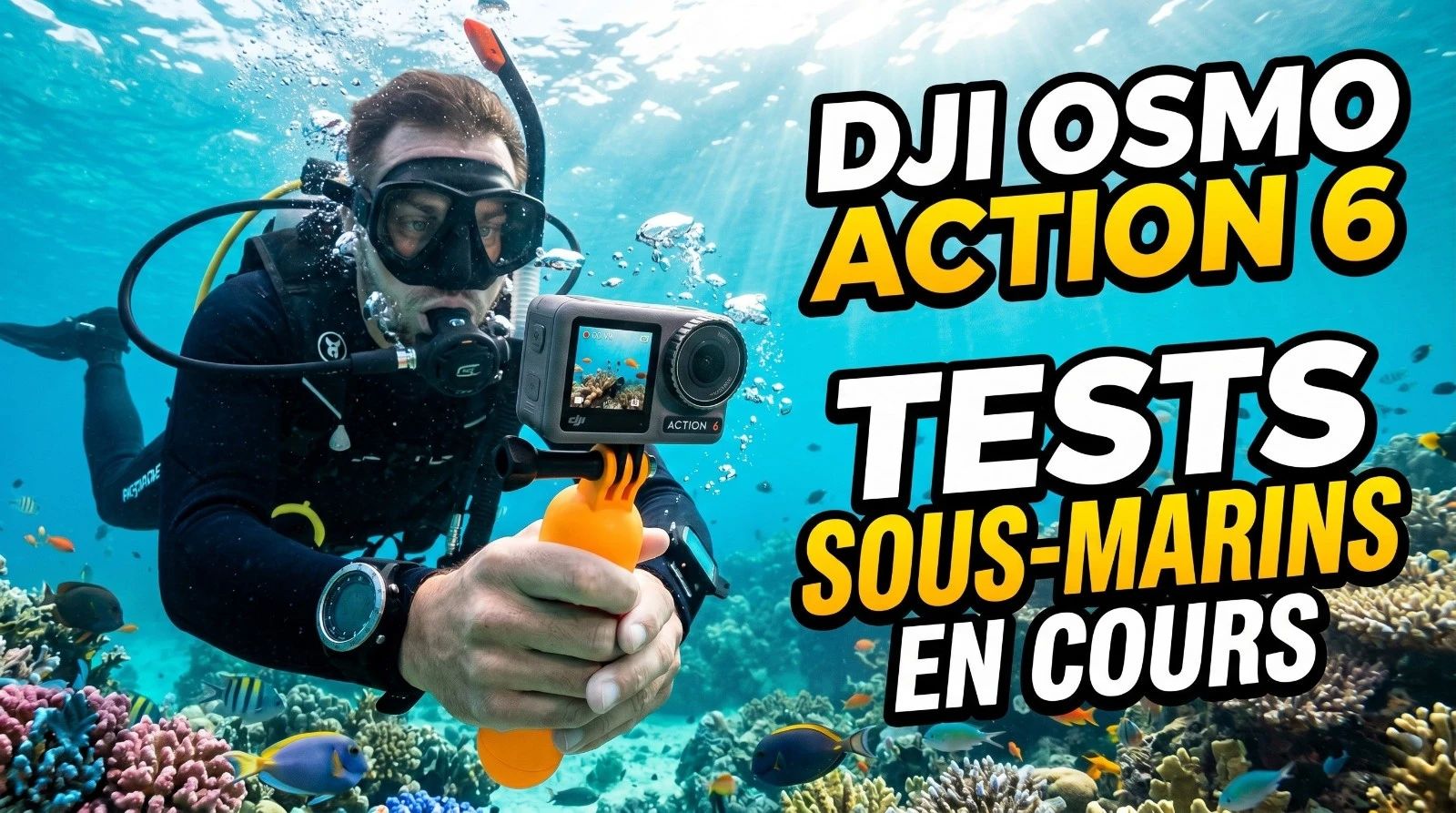
DJI Osmo Action 6 while diving: square sensor and auto color
When DJI released the Action 5, divers had already noticed its native waterproofness at 20 meters. With the Action 6, the Chinese brand not only pushes the specs: it integrates features that show that someone, on the design team, has actually dived with the product.
The 1/1.1-inch square sensor
The most surprising decision from DJI on this generation is the sensor format. A square sensor, whereas everyone else is using 16:9 or 4:3. The advantage for divers is concrete: by filming in square, you capture more vertical field, which allows you to crop in post-production in the format of your choice without losing resolution.
With a variable aperture of f/2.0 to f/4.0, the Action 6 offers an exposure flexibility that was previously only available on much more expensive cameras. In clear water with sunlight, setting to f/4.0 provides sharpness across the entire field of view. In a cave or during night diving, opening to f/2.0 captures the maximum available light.
The color correction that makes the difference
This is perhaps the most interesting feature for underwater photographers: the Action 6 integrates a dedicated color temperature sensor. This sensor analyzes the color temperature of the water in real time and automatically adjusts the white balance.
For those who have spent hours correcting blue-green footage in post-production, this is a promise that deserves to be tested in real conditions. If the correction works as well as advertised, it could make a large part of the color post-processing work obsolete.
The integrated barometer also displays the depth in real time, and the camera can start and stop recording automatically when entering and exiting the water. These features simplify life when you already have your hands full with a main camera or a light.
Waterproofing: 20 meters native, 60 meters with a rebreather
Without additional protection, the Action 6 can descend to 20 meters. This is sufficient for most recreational dives in shallow water and for snorkeling.
For deep diving, the official DJI waterproof case pushes the waterproofness to 60 meters. The diving kit includes the case, anti-fog inserts, a wrist strap, a floating handle, and a fixing screw.
One point of vigilance, however: feedback on the ScubaBoard forum reports a case of a flooded dive computer. This is an isolated case for now, but it highlights the importance of systematically checking seals and performing a surface test before each dive. This is a ritual that every underwater photographer should follow, regardless of the equipment used.
For whom?
The Action 6 is aimed at divers who want a reliable, compact, and capable secondary camera that can produce usable images without hours of post-processing. Automatic color correction, if it lives up to its promise, could make it the best option for those who want to film underwater without complicating things.
In light of the arrival of the GoPro Mission 1 at the end of May, the choice will likely be between the 1-inch sensor of GoPro (larger, therefore theoretically better in low light) and the automatic color correction of DJI (more practical for everyday use). Two different philosophies for the same goal: to bring beautiful underwater images.
And between us, it's actually a good thing to have a choice.
August 2026 update: available worldwide, first real dive tests
The DJI Osmo Action 6 is now available internationally, and the first tests specifically dedicated to diving have been published by Backscatter and UWPhotographyGuide. Their conclusions are nuanced.
The automatic color correction is described as "impressive but not magic at depth." It works best in shallow, clear, well-lit water. Beyond 10 to 15 meters, the blue cast is too strong for the color sensor to fully compensate, and manual correction remains necessary for divers wanting precise colors.
The variable aperture f/2 to f/4, on the other hand, proves genuinely useful underwater: the difference between f/2 and f/4 is "visible even in low visibility." In clear water, stopping down to f/4 adds depth of field. In caves and dark dives, f/2 provides a real gain.
Full confirmed specs: 1/1.1-inch sensor, 38MP, 4K120, 50GB internal storage, 4-hour battery, integrated barometer. The camera automatically starts and stops recording when entering the water. At the current price (around 450 euros), the Action 6 remains one of the most complete options for a secondary dive camera.
Frequently Asked Questions
Is the DJI Osmo Action 6 reliable at 20 meters without a housing?
The native 20-meter waterproof rating works for most shallow recreational dives and snorkeling. Isolated reports indicate issues with the camera housing (naked camera), but the rule remains the same for all underwater equipment: check the seals, test on the surface before each dive, and never assume that the waterproofness is guaranteed.
How does the Action 6 automatic color correction work?
A dedicated color temperature sensor analyzes the water's color dominance in real time and automatically adjusts the white balance. This should significantly reduce the color correction work in post-production. The system works well in both tropical blue water and temperate green water, but the performance in real-world conditions remains to be confirmed over the long term.
Why a square sensor on an action camera?
The square format captures more vertical field than the traditional 16:9. In post-production, you can crop to your desired format (16:9, 4:3, 9:16 for social media) without losing resolution. Underwater, where vertical movements are common, this format offers more flexibility in editing.
DJI Action 6 or GoPro Mission 1 for diving?
The two philosophies differ. The GoPro Mission 1 relies on a larger 1-inch sensor, which performs better in low light. The Action 6 focuses on automatic color correction, which is more convenient for everyday use. If you dislike post-production, the Action 6 might be a better choice. If you are looking for the best raw image quality, the Mission 1 has the advantage of the sensor.
Are you filming with an action camera underwater? Our underwater photo and video training teaches you the settings and techniques that transform your footage into images you'll be proud of.