AquaExposure
HomepageTrainingToolsArticles
AquaExposure

© 2026 AquaExposure. Ethically preserving the depths.

AquaExposure
Homepage
Pricing
Menu
Homepage
PricingShopArticles
AquaExposure — Explore Beneath, Capture Beyond
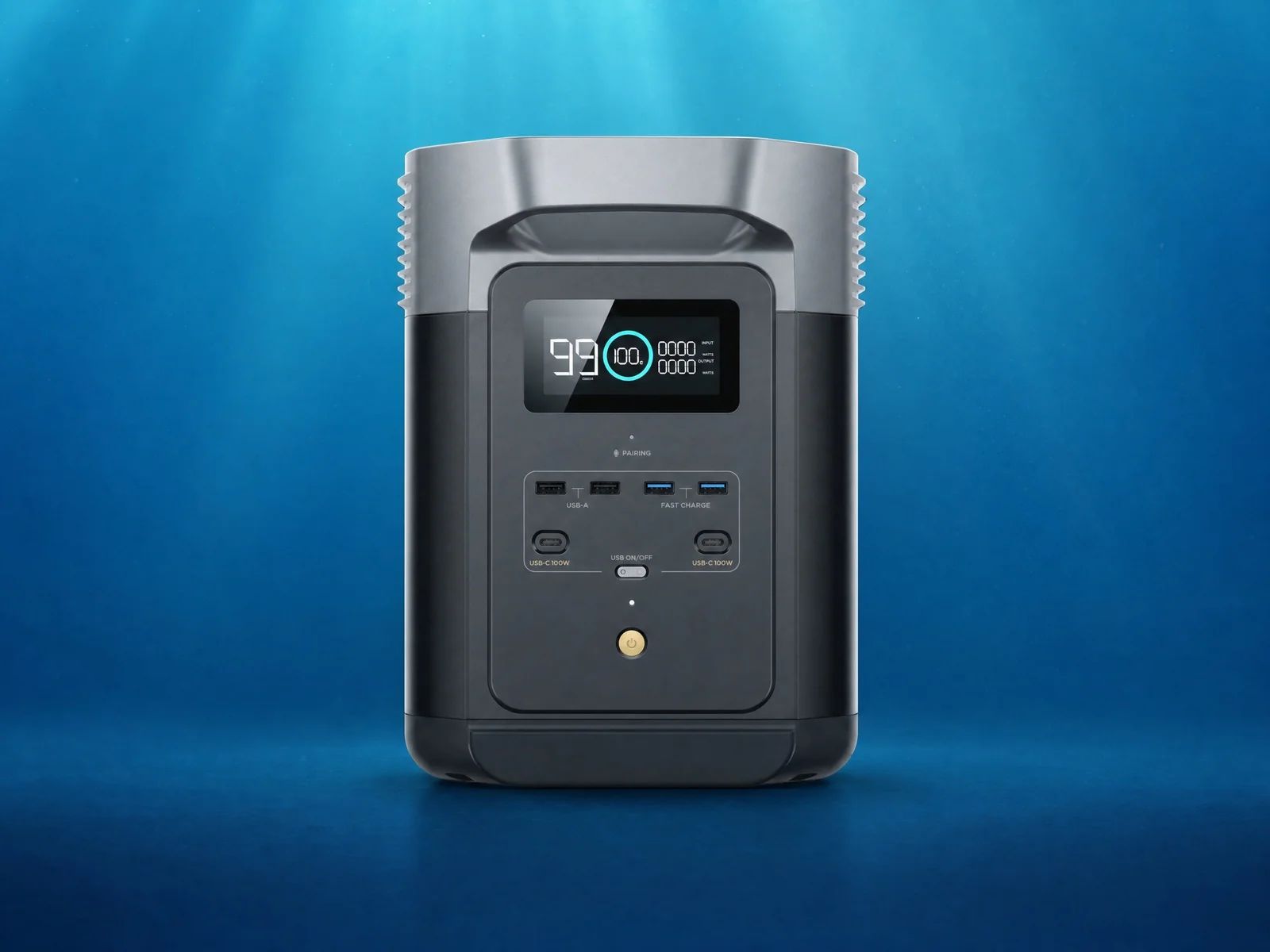
EcoFlow Delta 2: The LiFePO4 power hub for diving expeditions.
Table of Contents
  • 01A Massive Reserve for Camera Battery Packs
  • 02The Versatility of a Multi-Port Charging Station
  • 03Ultra-Fast Charging and Solar PowerThe charging speed is crucial on dive trips where the boat's generator only runs for a few hours each day. The Delta 2 stands out with its X-Stream technology, allowing it to charge from 0% to 80% in just 50 minutes using a standard AC outlet [1]. A full charge is reached in approximately 80 minutes, which generally corresponds to the surface interval between two dives.
  • 04Power and X-Boost Technology for Demanding Equipment
  • 05Transportation and Logistics in a Marine Environment
  • 06Who is this battery suitable for?This charging station is primarily intended for professionals in underwater photography and for organizers of expeditions. It is particularly useful on liveaboard boats where access to power outlets is often limited. By centralizing the charging of its own batteries, the photographer avoids having to use numerous makeshift connections and ensures a smooth workflow. It is also relevant for dive centers located in areas with unreliable power grids. When combined with solar panels, it becomes a reliable source of energy for maintaining communications and charging dive computers.
  • 07Limitations and Compatibility
  • 08ConclusionThe EcoFlow Delta 2 is a robust tool for anyone who prioritizes image production in their diving activities. Its ability to handle rapid charging cycles and its versatility make it a valuable asset for turning any space on a boat into a functional studio. While airline transport restrictions require careful planning, the peace of mind offered by such a power reserve justifies the logistical effort. Ultimately, having a reliable power source allows you to focus on what's most important: capturing the light and the encounters that enrich our underwater explorations.
MATERIEL 7 minBenjamin Coste

EcoFlow Delta 2: The LiFePO4 power hub for diving expeditions.

Discover the EcoFlow Delta 2- a 1024 Wh power station perfect for underwater photographers and diving expeditions in remote locations.

To improve your mastery of your equipment and optimize your procedures while diving, discover our specialized training modules on AquaExposure training.

EcoFlow Delta 2: The LiFePO4 Power Hub for Dive Expeditions

Between the wet deck of a cruise ship and the increasing power needs of underwater photographers, battery management has become a major logistical challenge. It's no longer just about charging a phone, but about keeping entire battery packs for hybrid housings, power-hungry strobes, and laptops operational. The EcoFlow Delta 2 power station presents itself as a central hub capable of replacing the unreliable power strips found on ships.

A Massive Reserve for Camera Battery Packs

At the heart of this power station is a 1024 Wh battery using Lithium Iron Phosphate technology, or LiFePO4 [1]. Unlike conventional lithium-ion batteries, the LFP cells in the Delta 2 can withstand over 3,000 charge cycles before their initial capacity drops to 80%. For a diver undertaking several expeditions per year, this represents an estimated lifespan of ten years of regular use.This capacity allows it to meet the needs of a complete team. In practice, this means being able to recharge NP-W235 or LP-E6NH batteries dozens of times, while also powering a video editing computer. The AquaExposure capacity rating places this device among the heavy-duty power stations, designed to centralize power rather than being moved individually during each dive.

The Versatility of a Multi-Port Charging Station

One of the strengths of the Delta 2 is its comprehensive connectivity. The European version features four AC outlets that deliver a pure sine wave, which is essential for the safety of flash chargers or laptop power supplies.

The station also integrates a variety of USB ports that meet current standards: two 100W USB-C Power Delivery ports, two 18W fast-charging USB-A ports, and two standard 12W USB-A ports. This diversity allows you to charge up to thirteen devices simultaneously. Power management is facilitated by an LCD screen that displays the input and output power in real time, as well as the estimated remaining time.

Ultra-Fast Charging and Solar PowerThe charging speed is crucial on dive trips where the boat's generator only runs for a few hours each day. The Delta 2 stands out with its X-Stream technology, allowing it to charge from 0% to 80% in just 50 minutes using a standard AC outlet [1]. A full charge is reached in approximately 80 minutes, which generally corresponds to the surface interval between two dives.

For expeditions in remote locations, the unit can accept up to 500W of solar panels. With a voltage range of 11 to 60V, it is compatible with a wide range of foldable photovoltaic panels. This option provides true independence away from any infrastructure, provided there is sufficient sunlight available on the deck or on the beach.

Power and X-Boost Technology for Demanding Equipment

The nominal output power of 1800W is sufficient for almost all underwater photography equipment. The Delta 2 handles power surges during startup thanks to a peak capacity of 2700W. The X-Boost technology allows powering certain devices up to 2400W by regulating the voltage, although this function is not recommended for the most sensitive electronic equipment [4].If the station can power a small travel compressor, its primary function is managing digital data flow. The EcoFlow app, which can be connected via Wi-Fi or Bluetooth, allows you to monitor power consumption remotely and activate the outputs without touching the unit. This is a significant convenience when the station is stored in a storage compartment.

Transportation and Logistics in a Marine Environment

The Delta 2 weighs 12 kg, making it portable by hand thanks to its integrated handles, but it remains a stationary piece of equipment once installed. Regarding air travel, the regulations are strict. With an energy capacity of 1024 Wh, this station far exceeds the IATA limit of 160 Wh allowed for transport in the cabin or in the cargo hold [2]. Therefore, it is strictly prohibited on commercial aircraft. For a long-distance expedition, it is necessary to arrange for transport by sea or land freight.

At sea, protection from the elements is crucial. The Delta 2 is not certified as waterproof, and its fans can draw in air containing salt. It is essential to keep it in a dry environment, protected from water splashes and excessive humidity. A protective cover or a raised location within the interior cabin will ensure its longevity in a saline environment.

Who is this battery suitable for?This charging station is primarily intended for professionals in underwater photography and for organizers of expeditions. It is particularly useful on liveaboard boats where access to power outlets is often limited. By centralizing the charging of its own batteries, the photographer avoids having to use numerous makeshift connections and ensures a smooth workflow. It is also relevant for dive centers located in areas with unreliable power grids. When combined with solar panels, it becomes a reliable source of energy for maintaining communications and charging dive computers.

Limitations and Compatibility

Despite its performance, the Delta 2 requires certain compromises. Its weight and size preclude carrying it in a backpack over long distances. The noise level also warrants attention: while the fan is relatively quiet under moderate load, it can become audible during intensive use or when performing a rapid recharge at 1200W, which can be disruptive in a small boat cabin at night. In terms of compatibility, the USB-C ports support most modern protocols, but some laptops with proprietary requirements may not achieve their maximum charging speed.

ConclusionThe EcoFlow Delta 2 is a robust tool for anyone who prioritizes image production in their diving activities. Its ability to handle rapid charging cycles and its versatility make it a valuable asset for turning any space on a boat into a functional studio. While airline transport restrictions require careful planning, the peace of mind offered by such a power reserve justifies the logistical effort. Ultimately, having a reliable power source allows you to focus on what's most important: capturing the light and the encounters that enrich our underwater explorations.

To compare this model with other products on the market, please see our external battery/power bank comparator and our complete selection of diving equipment.

[1]: https://fr.ecoflow.com/products/delta-2-portable-power-station "EcoFlow Delta 2 - Official Website" [2]: https://www.iata.org/en/youandiata/travelers/batteries/ "IATA - Lithium Batteries Guide" [3]: https://www.faa.gov/hazmat/packsafe/airline-passengers-and-batteries "FAA - PackSafe for Passengers" [4]: https://manuals.ecoflow.com/us/product/delta-2-portable-power-station?lang=en_US "EcoFlow Delta 2 User Manual"Here's the translation:

[Image 1: A three-quarter view of the EcoFlow Delta 2 placed on a wooden table inside a boat cabin. Several camera battery chargers and a laptop are plugged into it. The LCD screen is lit and displays charging statistics. The lighting is warm.] Alt text: EcoFlow Delta 2 power station in use to charge photographic equipment on a dive boat.

[Image 2: A close-up of the side panel of the Delta 2, showing the USB-C and USB-A ports, with braided cables connected. In the blurred background, a diving mask and a waterproof housing are visible.] Alt text: Detail of the USB charging ports on the EcoFlow Delta 2 power station, with diving equipment in the background.
Share

/blog/ecoflow-delta-2-en

Table of Contents

  • 01A Massive Reserve for Camera Battery Packs
  • 02The Versatility of a Multi-Port Charging Station
  • 03Ultra-Fast Charging and Solar PowerThe charging speed is crucial on dive trips where the boat's generator only runs for a few hours each day. The Delta 2 stands out with its X-Stream technology, allowing it to charge from 0% to 80% in just 50 minutes using a standard AC outlet [1]. A full charge is reached in approximately 80 minutes, which generally corresponds to the surface interval between two dives.
  • 04Power and X-Boost Technology for Demanding Equipment
  • 05Transportation and Logistics in a Marine Environment
  • 06Who is this battery suitable for?This charging station is primarily intended for professionals in underwater photography and for organizers of expeditions. It is particularly useful on liveaboard boats where access to power outlets is often limited. By centralizing the charging of its own batteries, the photographer avoids having to use numerous makeshift connections and ensures a smooth workflow. It is also relevant for dive centers located in areas with unreliable power grids. When combined with solar panels, it becomes a reliable source of energy for maintaining communications and charging dive computers.
  • 07Limitations and Compatibility
  • 08ConclusionThe EcoFlow Delta 2 is a robust tool for anyone who prioritizes image production in their diving activities. Its ability to handle rapid charging cycles and its versatility make it a valuable asset for turning any space on a boat into a functional studio. While airline transport restrictions require careful planning, the peace of mind offered by such a power reserve justifies the logistical effort. Ultimately, having a reliable power source allows you to focus on what's most important: capturing the light and the encounters that enrich our underwater explorations.

Questions about the Journal

Can the EcoFlow Delta 2 be transported on an airplane?

No, with a capacity of 1024 Wh, this power station significantly exceeds the 160 Wh limit set by the IATA. It is strictly prohibited both in the cabin and in the cargo hold on commercial flights.

How long does it take to recharge the Delta 2?

On a standard power outlet, it reaches 80% charge in approximately 50 minutes thanks to its 1200W input power, which is ideal for recharging between dives.

Is the station resistant to saltwater?

No, it is not certified waterproof. It is essential to protect it from splashes and salt water, especially on the deck of a boat or in a zodiac.

Articles in the same category

Metalsub Inox Tech 1.5 mm Stainless Steel Reel with Stainless Snap - Review, Features, and Scuba Diving Opinions (2026)

Metalsub Inox Tech 1.5 mm Stainless Steel Reel with Stainless Snap - Review, Features, and Scuba Diving Opinions (2026)

Metalsub 1.5mm Dive Reel with Brass Snap Spool: Review, Features, and Scuba Diving Opinions (2026)

Metalsub 1.5mm Dive Reel with Brass Snap Spool: Review, Features, and Scuba Diving Opinions (2026)

Mares XR Regular SMB Deco Buoy: Review, Visibility, and DSMB Parachute Opinions (2026)

Mares XR Regular SMB Deco Buoy: Review, Visibility, and DSMB Parachute Opinions (2026)

AquaExposure

Underwater photography excellence, accessible to everyone.

Stay in touch

[email protected]

Stay informed about our new courses and expeditions.

Support the project
Legal Notices·CGV·Confidentiality·

© 2026 AquaExposure. Ethically preserving the depths.