Do you need an advanced level for a dive cruise in Egypt?
For northern itineraries (Thistlegorm, Ras Mohammed), Open Water level is sufficient with good experience. For offshore sites like Brothers Islands, Daedalus, or Elphinstone, Advanced Open Water is required and real experience with currents is essential.
How many dives do you do per day on a cruise?
On a Red Sea dive cruise, the standard pace is 3 to 4 dives per day, sometimes 5 with a night dive. Over a week, you can log more than 20 dives. On a resort stay, expect 2 to 3 dives per day with a more flexible schedule.
Are early morning dives really worth the wake-up call?
Absolutely. Dives before the day boats arrive offer ideal conditions: empty sites, more active and relaxed animals, soft morning light. This is often when the most memorable encounters happen, and it is an exclusive advantage of liveaboard cruises.
Are the most beautiful dives the deepest ones?
No. The majority of marine life is concentrated between 5 and 15 meters, where light is most abundant. Corals thrive there, fish gather, and natural light allows the best photos. Descending for the sake of depth often means missing the show.
Is diving the same site again a waste of time?
Quite the opposite. Returning to a site lets you notice details that were invisible on the first visit. For photographers, this is a major advantage: you know the spots, anticipate behaviors, and can focus on composition rather than exploration.
There are destinations that simply stand out. They demand attention. The Red Sea is one of them, and it has nothing to do with marketing or travel agency brochures. It's a concentrated area of marine life, light, and diving conditions that, for decades, has transformed beginners into enthusiasts and enthusiasts into obsessions. Egypt is probably the place in the world where the most divers have had their first memorable encounter with the ocean.
But once the destination is chosen, there's still one question that everyone asks and that no one really answers definitively. Cruise diving or resort stay? Both formats offer completely different experiences, and the choice depends just as much on your level as on what you're looking for underwater.
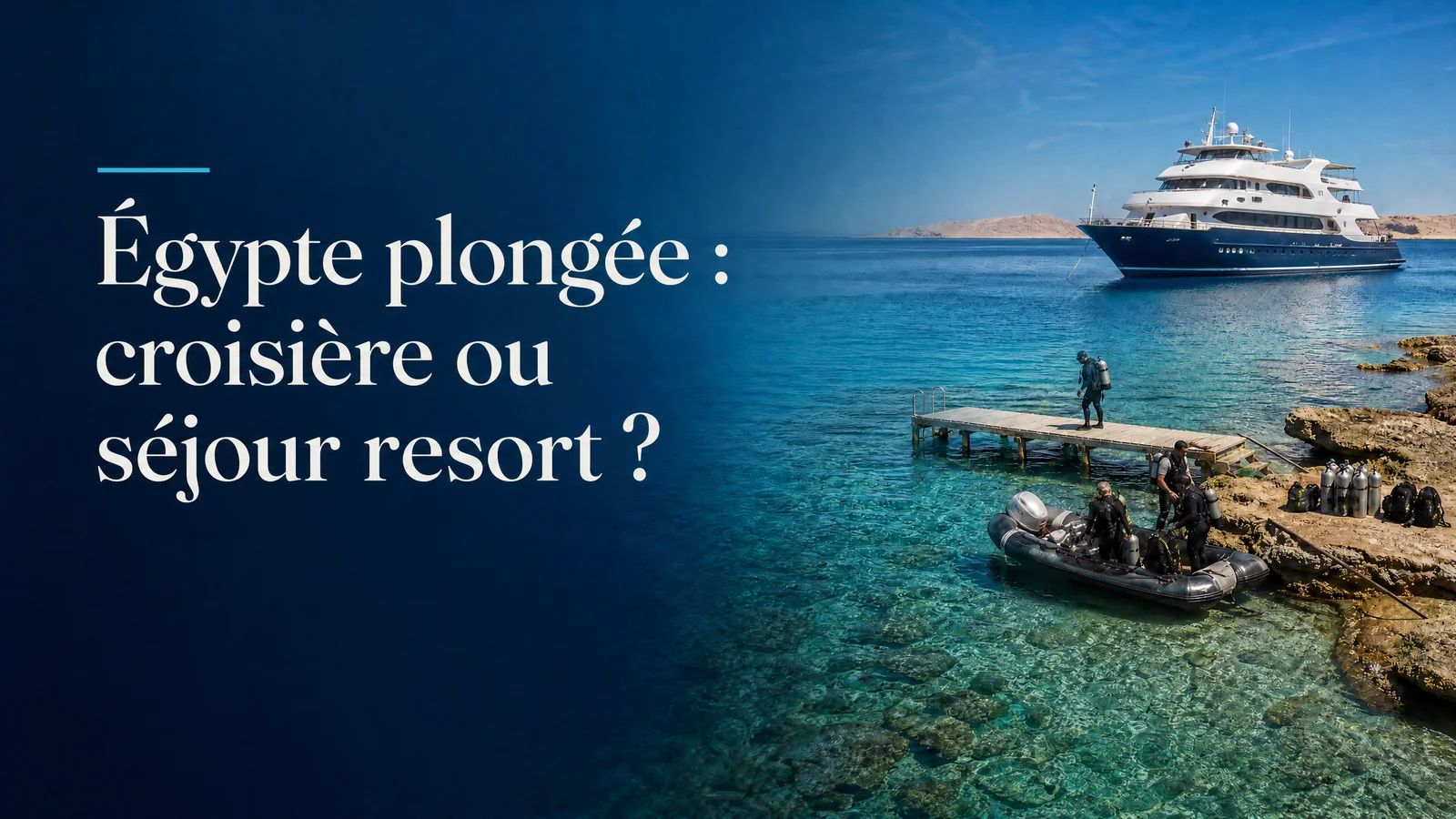
Two Formats, Two RhythmsOn a liveaboard diving trip, you live on the boat. Your cabin is a few meters from the dive platform, and the rhythm of the day revolves entirely around the water. Four to five dives per day, including night dives, which easily amounts to more than twenty immersions in a week. You eat, you sleep, you dive. The cycle repeats from morning to evening without interruption.
A resort stay operates on a completely different tempo. You leave from the boat in the morning, you dive two or three times during the day, and you return to shore in the late afternoon. The evenings are free. You can have dinner in town, go for a walk, read a book by the pool. For couples where one person doesn't dive, this format often preserves the peace of the household.
This is not a matter of quality. It's a matter of tempo. Some divers need this total immersion, where the world outside of the water ceases to exist for a week. Others prefer a balance between diving and the rest of their life. Both approaches are legitimate.
Accessible Sites According to the FormatThis is where the difference becomes concrete. A diving cruise can reach high-altitude sites such as the Brothers Islands, Daedalus, or Elphinstone. These isolated reefs, located in the open ocean, are inaccessible from the coast. This is where you can encounter large pelagic species, such as oceanic sharks and schools of barracuda, in the deep blue.
A resort stay, on the other hand, gives you access to sites in the north. The Thistlegorm (the most famous shipwreck in the Red Sea), Ras Mohammed, the fringing reefs of Hurghada, Sharm el-Sheikh, and Dahab. These sites are magnificent. The marine life is abundant, the corals are often in excellent condition, and some shore dives offer absolutely remarkable experiences.
The key point is that the high-altitude sites require an Advanced level and real experience with currents. The Brothers and Daedalus do not tolerate mistakes. The northern sites, on the other hand, are suitable for all levels and provide an ideal environment for progressing in underwater photography.
The presence of others changes everythingA daily boat typically carries twenty to thirty divers, sometimes more. When three or four boats converge on the same site at the same time (and this happens every day on popular spots in the north), you end up with sixty to one hundred divers on the same reef. Fins stirring up the sand, bubbles everywhere in the frame, divers passing between you and your subject. For a photographer, this is a subtle but real nightmare.
On a cruise, the group is smaller. Twelve to twenty divers, and often less, especially on popular dive sites. The underwater space changes completely. You can choose your position, wait for the right moment, observe animal behavior without an inadvertent fin-stirrer disrupting the scene.
This isn't about snobbery. It's about physics. The fewer divers there are on a site, the more naturally the animals behave, and the more your images tell a true story.
The Art of RepetitionThere's a very common reflex in diving: wanting to always see a new site. Checking it off the list. Moving on to the next. It's human, but it's a mistake if you really want to progress in underwater photography.
Returning to the same reef is one of the best exercises you can do. The first time, you discover the topography. The second time, you start to identify the permanent inhabitants. The third time, you know where the sea anemone is, when the school of snappers passes, and where the light comes from at 10 am.
For a photographer, this is gold. You anticipate the behavior, you choose your framing in advance, you arrive at the right place at the right time. Repetition turns a familiar site into a playground of mastery. This is exactly how we go from a correct photo to an image that tells a story.
Both formats allow it, incidentally. On land, you can ask to return to the same reef several days in a row. On a cruise, itineraries often include two or three dives on the same site. But you have to want it, and you have to resist the urge to move on.
Early Morning Dives: The Key to the Most Beautiful EncountersIf I had to choose one argument in favor of a diving cruise, it would be this one: Diving at dawn, before the daily boat trips arrive at the sites.
At six in the morning, on a reef where you're the only ones, the animals are different. The predators have finished their nocturnal hunt. The reef fish emerge from their hiding places and begin their day. The sharks patrol peacefully, without the pressure of bubbles and noise. The early morning light filters through the surface like a golden curtain.
These moments only exist when you're staying on site. A daily boat trip leaves port at 8 am, arrives at the site at 9 am, and by then the animals have already changed their behavior. The window is closed.
This is where the encounters that people have been talking about for years take place. Not because the animals are different, but because the conditions are radically different. The calm changes everything. For the animal as well as for the photographer.
Life thrives at depths between 5 and 15 metersThere's a persistent belief among beginner divers (and even some experienced ones) that depth equates to the quality of the dive. The deeper, the more impressive. But this is false.
Marine life thrives between 5 and 15 meters of depth. This is where natural light still penetrates with enough intensity to support coral reefs. It's also where algae flourish, small organisms establish themselves, and the entire food chain organizes around this abundance. Reef fish, invertebrates, nudibranchs, turtles grazing on seagrass – all of this life exists in this sunlit section of the water.
Descending to 30 or 40 meters consumes air, shortens your dive time, and moves you further from the light. Your photos will be darker, your camera will need to compensate more, and you'll have less time to compose your shots. Depth for depth, it's about wasting air and missing opportunities.
No matter the format (cruise or resort), keep this rule in mind. The best photos are often taken where the light is most generous.
Which format suits your profile bestIf you're a marine photographer looking for pelagic encounters, pristine dive sites, and the maximum number of dives, a liveaboard is the perfect format. It gives you the access, time, and calm you need to work underwater.
If you're diving as a mixed couple (one diver, one non-diver), if you're a beginner, or if you prefer to alternate between diving and life on land, a resort stay will be more suitable. The sites in the north are stunning, the logistics are simple, and the pace allows for everything else.
If you're hesitant, ask yourself a question. Do I want to live underwater for a week, or do I want to dive as part of a larger trip? The answer usually cuts through the debate quite quickly.
Preparing Your Underwater Photography TripRegardless of the format you choose, the images you bring back will depend less on the boat or the hotel, and more on your preparation. Understanding underwater light, mastering your buoyancy with the equipment in hand, and knowing how to compose in a three-dimensional environment: this is what makes the difference between a postcard and an image that reflects you.
The [AquaExposure underwater photography course](/blog/7 mistakes to avoid on a first dive photography trip.
Frequently Asked QuestionsIs an Egypt diving cruise suitable for beginners?
The northern itineraries (Thistlegorm, Ras Mohammed, Sharm el-Sheikh wrecks) are accessible from the Open Water level. However, cruises to the Brothers or Daedalus islands require an Advanced level and real experience with strong currents. Choose your itinerary based on your certification and number of dives.
How many dives are done per week on a cruise?
On average, between twenty and twenty-five dives per week, including night dives. The pace is four to five immersions per day. This is intense, and that's exactly what makes the format so effective for progressing in photography.
Can you take great photos on a resort stay?
Absolutely. The reefs of the northern Red Sea are among the most photogenic in the world. The Thistlegorm offers extraordinary compositions, the fringing reefs of Hurghada are teeming with life, and the shore dives in Dahab are accessible at any time. The resort format provides fewer dives per day but allows time to sort, edit, and progress between outings.
What is the best season to dive in Egypt?
Egypt can be dived all year round. The period from April to November offers the warmest waters (26 to 30 degrees) and the best visibility. The winter (December to March) is cooler (21 to 24 degrees) but is often less frequent, which can be an advantage for photographers.
Do you need your own photo equipment for a cruise?
This is highly recommended. Cruises generally do not provide photo equipment, and five dives per day with equipment that you don't master is a recipe for frustration. Prepare your setup before departure and test it in a pool or during a local dive.