Ethical underwater photography is a practice that places respect for wildlife and marine ecosystems above getting the shot. It means not stressing animals, not touching corals, using natural light by default, and adopting a stillness-and-effacement approach to be accepted by the living world.
How can my underwater photos contribute to science?
Your photos can be submitted to citizen science platforms like iNaturalist, Sea Watchers, or Reef Check. They help identify species, monitor ecosystem health, and document rare behaviors. It is essential to include metadata (date, location, depth).
What does ethical underwater photography actually mean?
Ethical underwater photography is much more than not touching coral. It is a complete methodology that puts respect for the marine environment at the heart of every photographic decision, from flash choice to approach distance, through to scientific contribution.
When I started photographing underwater in the Maldives a few years ago, I had no idea what I was doing. I would see a beautiful fish, pull out my camera with the flash wide open, and click. It was nice for my Instagram portfolio. It was catastrophic for the reef.
Why I had to reinvent myself as a photographer
I remember one particular dive in the Maldives, in 2015. I was descending on a site I had visited two years earlier, a vibrant, dense reef exploding with life. That day, the same spot was unrecognizable. Entire sections of coral were dead or damaged. The fish, once curious and confident, fled at our approach.
I surfaced and asked the guide what had happened. He told me: "Photographers. Too many photographers, too much flash, too many hands touching." A punch in the gut. Because I was part of it. My flashes. My rushed approaches. My "just a little hand to stabilize."
That was the day I truly began to understand the impact. Not theoretically, but concretely, looking at a reef I had helped destroy.
The numbers that should concern us
Scientific studies do not lie. Barker & Roberts (2004) documented that recreational diving impacts, including photography, directly damage coral through physical contact. Marshall et al. (2016) showed that diver behavior, particularly approaching animals too closely, increases their stress and alters their natural behavior.
And the flash? Lamb et al. (2014) demonstrated that damage caused by diver contact is direct and measurable. Repeated flashes disorient wildlife, create a false light-danger association, and disrupt natural cycles of reproduction and feeding.
What does AquaExposure propose? The 5 pillars
At AquaExposure, we developed a methodology we call the Scenography of Effacement. The idea: you must be capable of photographing underwater in a way that makes your presence nearly invisible.
Pillar 1: Flash? No, thank you. (With rare exceptions)
The default rule at AquaExposure is zero flash. Modern cameras, even in ambient light mode, offer exceptional quality. Flash is a destructive tool that creates false light, stresses animals, and reveals more of your technical incompetence than your creativity.
I spent two years relearning photography without flash. The first three months were humbling. My images were underexposed, noisy, terrible. But by month six, I had truly learned to read the ocean's natural light. By month twelve, I realized my best images came from there.
Pillar 2: Slow and respectful approach
Instead of swimming quickly toward an animal, you learn to position yourself and wait. It sounds silly, but it is the difference between a photo where the fish looks at you with fear and one where it completely ignores your presence.
Pillar 3: Understanding animal behavior
You cannot respectfully photograph an animal if you do not know what it feels, what it seeks, what stresses it. At AquaExposure, we teach ethology, the study of animal behavior in natural environments.
A fish hiding in a crevice? Leave it alone. Coral closing its polyps? Move away. A mother ray protecting her young? Respect a safety distance.
Pillar 4: Complete metadata
Here we enter citizen science territory. Every photo you take should have precise metadata: exact location (GPS if possible), depth, temperature, time, identified species. Why? Because your photos can become scientific data.
Pillar 5: Active scientific contribution
This is the turning point. Instead of just taking beautiful photos, you use them to contribute to science.
Citizen science: your photos genuinely save the ocean
Now, here is the part that does not get said often enough: your photos can genuinely contribute to scientific research and ocean protection.
Laurent Ballesta, explorer-photographer and founder of the Andromede Foundation, says it clearly: underwater photography is not just an art, it is a scientific documentation tool. His photos are data.
Cristina Mittermeier, co-founder of SeaLegacy and award-winning photographer, has transformed her art into a conservation movement. She documents threatened ecosystems precisely so scientists can use her images for studies, publications, and protection campaigns.
Here is how it works concretely.
Platform 1: iNaturalist
iNaturalist is a collaborative nature observation platform. You upload your photo (with location and species identification), and the global scientific community can: validate your identification, use your data for distribution maps, contribute to specific research projects, and help identify rare or threatened species.
Platform 2: Reef Check
Reef Check is a scientific organization that uses diver observations to monitor the health of coral reefs worldwide. You descend, you observe according to their protocol, you document what you see (coral coverage, fish, algae, disease signs, damage), and your data feeds long-term studies on climate change and reef degradation.
This is real scientific work. Not eco-tourism marketing. Real data that real institutions use.
Platform 3: BioObs
BioObs is a French-Canadian collaborative database specialized in underwater observation. You document observations (species, behaviors, locations), and the data is accessible to the scientific community for biodiversity analyses, species distribution studies, and climate change impact assessments.
Platform 4: Sea Watchers
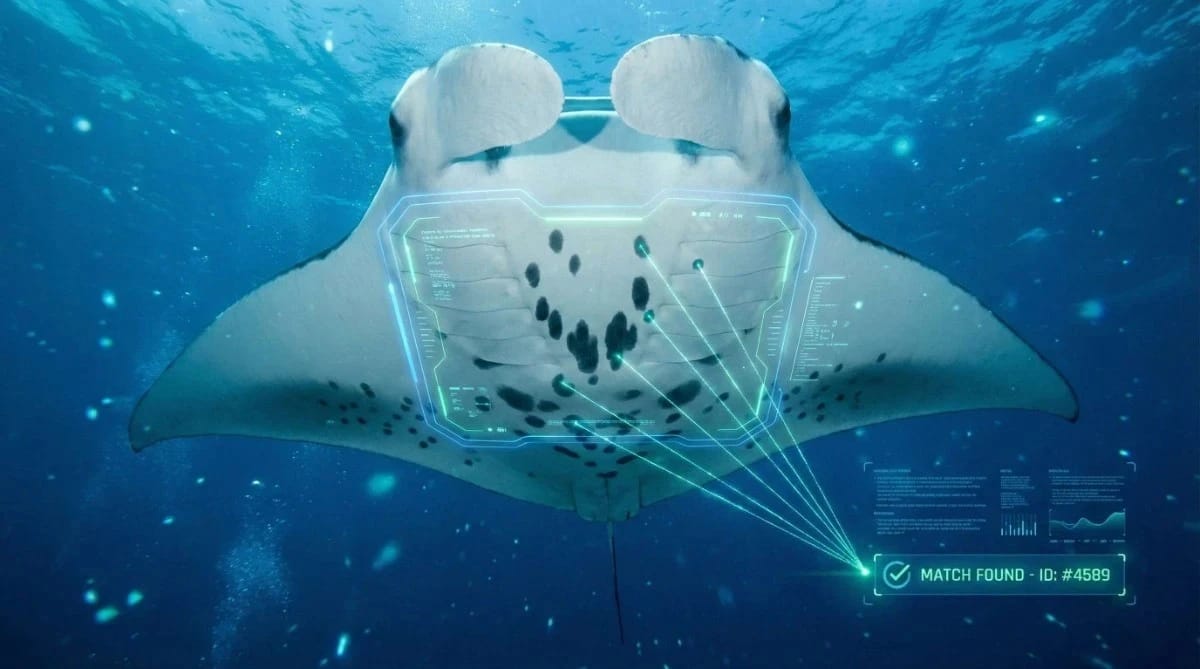
Sea Watchers offers collaborative projects to document marine wildlife. You can contribute observations specific to projects, for example documenting turtle migrations or manta ray populations.
How to properly submit your photos for science
This is where the AquaExposure methodology becomes essential.
Step 1: Capture metadata. Your camera should automatically record date and exact time, GPS location (if possible, use a submersible GPS or a GPS watch before the dive), and depth and temperature information.
Step 2: Identify the species with confidence. Do not submit a photo if you are not sure of the identification. Better to let the community identify it than to contribute bad data. Researchers rely on quality.
Step 3: Document the ecological context. Not just "I saw a blue fish." Describe the habitat, observed behavior, signs of disease or stress, and other species present nearby.
Step 4: Share on the appropriate platform. Each platform has its protocols. iNaturalist for general observation. Reef Check for reef monitoring. BioObs for European zones. Sea Watchers for specific projects.
Step 5: Let the community improve your data. Scientists will refine your identification, add comments, integrate your data into broader studies. That is normal, that is intended. You contributed, and it counts.
Why ethics and science go together
When you photograph ethically, you spend time truly observing animals, exercise discernment in your approaches, better document natural behaviors, and obtain more authentic images.
When you obtain more authentic images, you contribute to real science. Because a photo taken while the animal is stressed has zero scientific value. It captures abnormal behavior.
What changes when you switch to the ethical approach
Honestly? Everything. Not just your photos.
Your relationship with the sea changes. Instead of seeing it as an Instagram backdrop, you see it as a fragile ecosystem where you are a simple visitor.
You become a better photographer. Without flash, you must truly master exposure, composition, natural light. It is harder at the start. It is infinitely more rewarding long-term.
You contribute genuinely. Instead of publishing photos just for likes, you know your images can end up in a scientific study, or serve to document a population of threatened species.
The 5 biggest mistakes people still make
I made them. Just about everyone does.
1. Using flash by default. The most common. "It is dark at 30m, I need flash." No. You need better technique. Higher ISO, wider aperture, slower shutter. Yes, it is more technical. It is also more respectful.
2. Approaching animals too quickly. You see a fish, you charge at it. The fish stresses. Your photos show it in survival mode, not natural mode. Bad photos plus a stressed animal. Double loss.
3. Touching coral "just a little bit." There is no "just a little bit." Coral is alive. One hand means thousands of damaged polyps. And it shows in your images: the coral bleaches within minutes after contact.
4. Not identifying your species before posting. You publish a "very rare mystery species" and it is just a juvenile of a common species. Zero scientific credibility.
5. Never sharing on scientific platforms. You take good photos, you keep them for Instagram. Fine. But why not also share on iNaturalist or Reef Check? It takes 10 minutes and can feed a study that saves reefs.
Setting up your personal protocol
If you want to switch to an ethical approach, here is the checklist:
Before each dive: - Camera set to ambient light mode (no flash unless truly necessary and justified) - GPS activated or coordinates noted - Expected temperature and depth documented - List of species you hope to see (for easier post-dive identification)
During the dive: - Slow and patient approach to animals (wait rather than chase) - Minimum distance respected according to species - No contact with coral or rocks - Observe behavior before photographing - Mental notes of context (habitat, behavior, other species)
After the dive: - Download EXIF metadata - Identify species with confidence (no guessing) - Select the 3-5 best images per species - Share on at least one scientific platform (iNaturalist minimum)
FAQ
If I photograph without flash, will my images be dark and terrible? No. Modern cameras handle ambient light well. The learning curve is real, the first months will be frustrating. But once you master the settings, you will find that underwater natural light is simply magnificent. And your images will be scientifically valid.
Will my participation in iNaturalist actually help science? Yes. iNaturalist has contributed to more than 500 scientific publications. Every observation counts. Even a "simple" photo of a common species helps map distributions, understand migrations, and document seasonal changes.
Do I need a high-end camera to photograph ethically? No. A modern phone with a good rear camera can do good underwater photography. An entry-level mirrorless is already excellent. Gear accounts for 20%, technique and ethics account for 80%.
How many photos should I submit to scientific platforms? Quality over quantity. Submit 3 very good photos per species rather than 100 mediocre ones. Researchers prefer a solid identification and a clear image over a flood of questionable data.