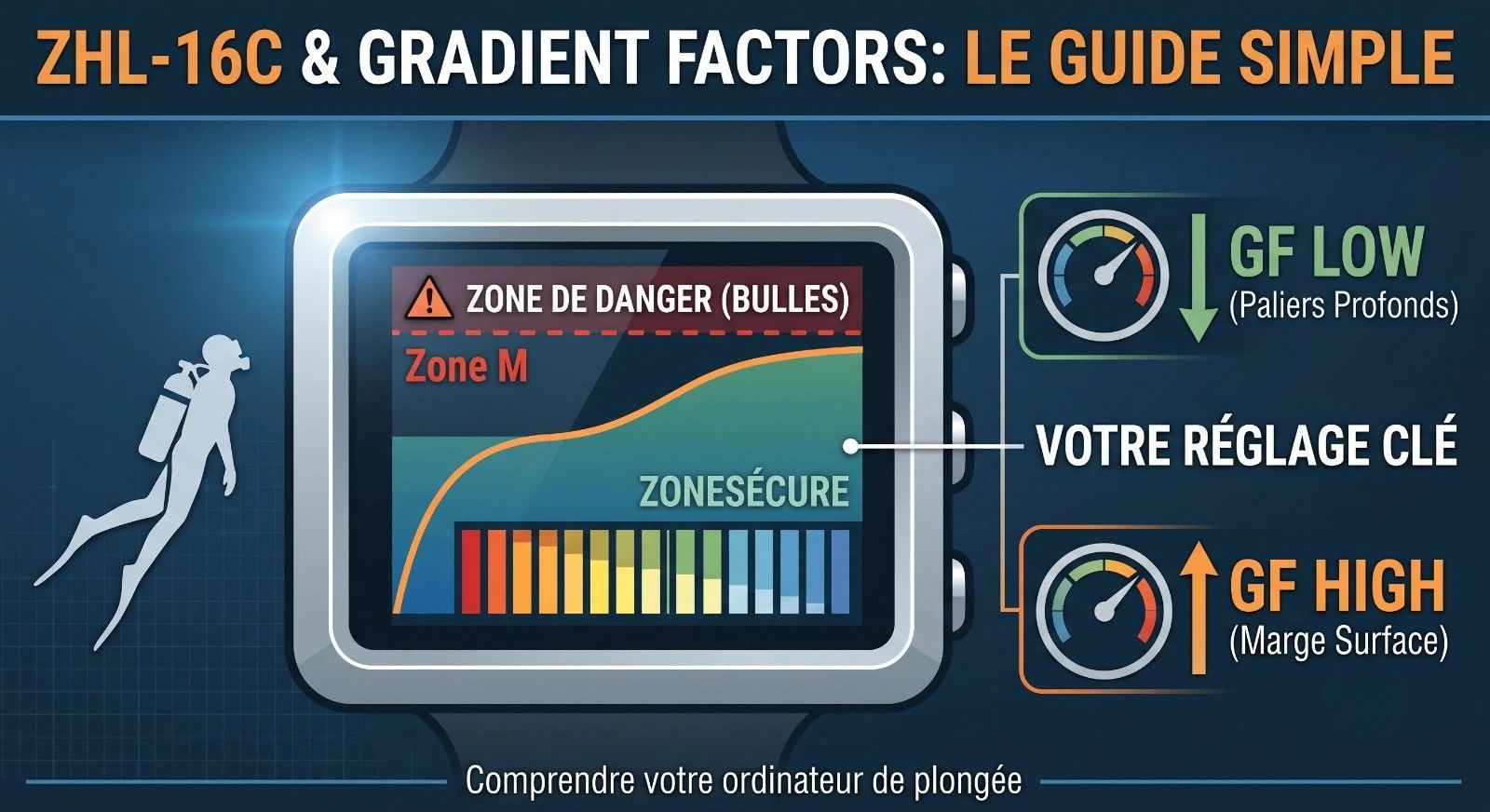
What is the Bühlmann ZHL-16C decompression algorithm?
It is a mathematical model developed by Dr. Albert Bühlmann that simulates how our body absorbs and eliminates nitrogen in 16 theoretical tissue compartments depending on ambient pressure.
What do Gradient Factors (GF Low / GF High) mean?
Gradient Factors adjust the level of conservatism. GF Low controls the depth of the first stop (a low number imposes deep stops), while GF High defines the safety margin relative to maximum saturation at the surface.
Why does hyperbaric medicine reject deep stops?
Clinical studies, notably from the US Navy's NEDU, showed that stopping too deep (low GF Low) continues to saturate slow tissues with nitrogen, increasing the overall risk of decompression sickness.
In the oppressive silence of dark waters, our body undergoes an invisible but relentless physics. With each descent into the dimness of Belgian quarries or along vertiginous drop-offs, our survival relies on a set of mathematical equations housed at the heart of our computer. The Bühlmann ZHL-16C decompression algorithm, particularly when coupled with Gradient Factors, has established itself as the absolute reference for demanding and technical divers.
I remember my first deep teaching dives in the biting cold of a northern quarry. My students struggled to understand why their computers imposed different decompression stops than mine when we had shared exactly the same dive profile. It is at that precise moment that the need to understand the mechanics of our decompression makes complete sense. The Bühlmann model does not cheat. It offers us total transparency where other brands lock us in proprietary black boxes.
Profile of the Bühlmann ZHL-16C
Originally developed by Dr. Albert A. Bühlmann, a Swiss physician and researcher specializing in respiratory physiology at the University of Zurich, this model was born in the 1960s. The ZHL-16C version represents the linear outcome optimized for microprocessors in real-time dive computers. "ZH" refers to Zurich, "L" to the linear nature of oversaturation limits, and "16" designates the number of simulated tissue compartments (ranging from very fast tissues like blood to extremely slow tissues like cartilage and bone).
To adapt this dissolved gas model to the requirements of modern conservatism, engineer Erik Baker introduced the famous Gradient Factors (GF) in 1998. This coupling is now used by the largest brands on the market such as Shearwater (on the Peregrine and Teric models), Garmin (Descent Mk2 and Mk3), Mares (on the Sirius), and more recently by Suunto (on the Ocean or EON Core) which now offer it as standard or option. Unlike closed algorithms, the Bühlmann ZHL-16C is entirely public and verifiable by the scientific community.
Ease of Use and Gradient Factors Setting
Setting one's conservatism on a computer equipped with the Bühlmann ZHL-16C is not done with vague terms but with two precise percentages: GF Low and GF High.
GF Low defines the allowed percentage of oversaturation for your first stop (the deepest). A low GF Low (like 30) will trigger a very deep stop to intercept microbubbles. A high GF Low (like 80) will push this first stop closer to the surface.
GF High determines the allowed percentage of oversaturation during the surface interval. It is what controls your overall safety margin at the end of the dive. A GF High of 70 means you exit the water at 70% of the theoretical oversaturation limit of the leading compartment, giving you a comfortable safety margin of 30%.
For beginner divers, manufacturers greatly simplify this interface by offering presets such as "Low / Medium / High" which correspond to predefined pairs of values (for example 30/70 or 50/85). For technical divers with complex mixtures (Nitrox, Trimix), multi-gas management is exemplarily reactive, instantly recalculating the profile during tank switches under water.
Real-Time Safety Adaptation
Intrinsically, the pure physical model of the Bühlmann ZHL-16C does not take into account real-time biometric data such as your heart rate or water temperature. It is a purely physical model based on the time, depth, and breathing mixture triad. However, some high-end manufacturers now couple these calculations with tank pressure or heart rate sensors to apply very light dynamic penalties.
Where the algorithm stands out is in its neutral management of risk profiles. If you perform a reverse profile or too rapid ascents (yoyos), the Bühlmann will not arbitrarily lock your device as a punishment. It calculates the exact physical state of the tension in your tissues and adapts your actual decompression stops accordingly. It is a responsible model that shows you the physics of your body without a moralizing filter.
The Verdict of Hyperbaric Medicine and DAN Data
Statistics from DAN (Divers Alert Network) and modern hyperbaric medicine bring crucial light to the evolution of our practices. For years, the fashion was deep stops imposed by bubble models (RGBM or VPM). However, the major clinical study conducted by the US Navy's experimental unit (NEDU) demonstrated in an incontestable way that stopping too deep increased decompression stress by continuing to saturate slow tissues at depth without desaturating fast tissues effectively.
Modern medical consensus now recommends prioritizing shallow and longer decompression stops. With the Bühlmann ZHL-16C, it is enough to adjust your GF Low upwards (for example 50/80 or 55/80) to align perfectly with the recommendations of modern science and minimize the risk of so-called "undeserved" decompression sickness.
Strengths and Weaknesses
The major strength of this algorithm is its absolute transparency and its peerless versatility. You know exactly what your computer is doing, which allows you to plan your dives to the minute and harmonize your safety parameters with your buddy.
The flip side of this coin is that such freedom implies rigorous training. Configuring your own Gradient Factors in a whimsical way (like a 99/99 without a safety margin) can be extremely dangerous. Understanding decompression theory is essential before manipulating advanced modes.
Field Verdict and Compatibility in a Buddy Team
In the context of a team dive, the compatibility of the Bühlmann ZHL-16C is excellent due to its flexibility. If you must dive with a buddy equipped with a very conservative device (like an older generation Suunto), you can temporarily harden your Gradient Factors to align your decompression stops.
During intensive stays or cruises (3 to 4 dives per day), the algorithm manages desaturation in a logical way during surface intervals without applying unjustified penalties over the days, as long as your slow compartments have time to eliminate the accumulated nitrogen.
If you are looking for a precise tool to associate with this model to prepare your outings, do not hesitate to use our AquaExposure dive computer comparator which lists all models exploiting the Bühlmann technology.
Conclusion
The Bühlmann ZHL-16C with Gradient Factors has become the essential standard of modern underwater exploration. It is intended for the recreational diver concerned about evolving in a safe manner as well as for the committed technical diver exploring deep wrecks. By betting on clarity and proven science, it establishes itself as the ideal companion for your marine adventures. With stars in your eyes.
Everything to Know About the Bühlmann ZHL-16C Algorithm: Review, Safety, and Settings | AquaExposure