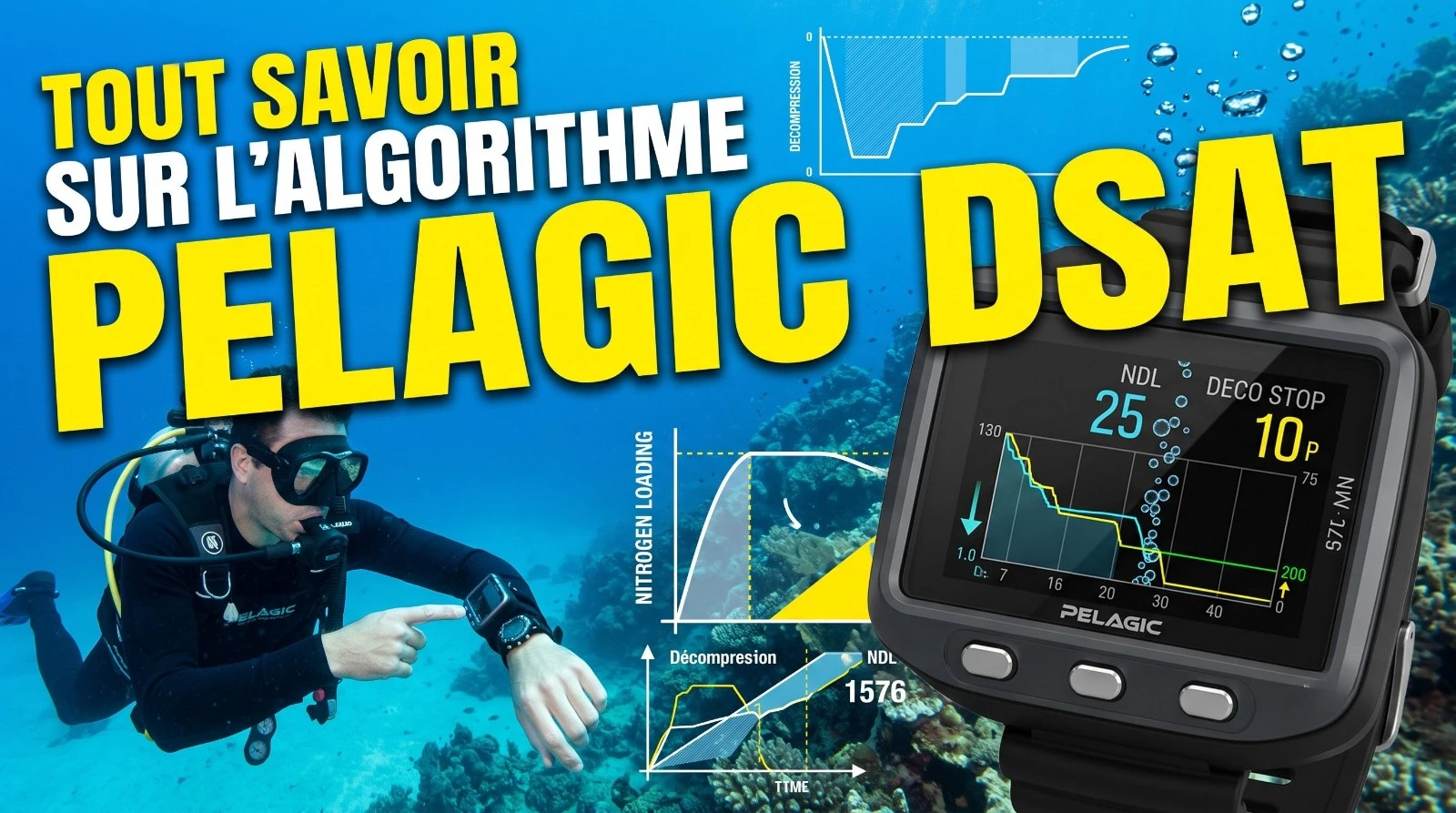
Comprehensive analysis of the Oceanic Pelagic DSAT decompression algorithm. Functionality, safety, recreational settings, and instructor review.
To learn how to get the most out of your gear underwater, discover the AquaExposure Training.
Introduction
In the world of underwater photography, every minute spent at depth counts. No-decompression time is a precious resource, and seeing it disappear too quickly on your screen is the nightmare of every photographer. Choosing a permissive algorithm can make the difference between capturing a lifetime shot or having to start your ascent prematurely. The Pelagic DSAT algorithm was specifically designed to offer recreational divers the longest possible bottom time without compromising safety.
I remember my long photo sessions on the coral reefs of the Maldives, lying face down in the sand at a depth of fifteen meters to photograph shy gobies and their symbiotic shrimp. My diving buddy, equipped with a computer from a well-known but very conservative Finnish brand, had to start his ascent much earlier than me because of its safety profile. Meanwhile, my Oceanic, set to the Pelagic DSAT mode, still showed me valuable minutes of no-decompression time, allowing me to capture the scene with perfect lighting. This experience convinced me of the superiority of this device for recreational divers who prioritize bottom time.
Algorithm Identification Card
The Pelagic DSAT dive computer originates from the research conducted by DSAT (Diving Science and Technology), PADI's research subsidiary, which developed the famous recreational diving table (RDP). The model is based on the no-decompression limits established by Dr. Merrill Spencer (who introduced Doppler bubble detection in humans) and refined by Dr. Michael Powell. This forms the foundation of modern recreational diving without mandatory decompression stops.
From a mathematical perspective, this is a classic Haldanian dissolved gas model that uses twelve theoretical tissue compartments (with half-lives ranging from 5 to 480 minutes). This algorithm is the exclusive property of Pelagic Pressure Systems, a company acquired by the Aqualung group. It is primarily found on Oceanic brand dive computers (such as the Geo watch or the Veo 4.0 console computer), which have the unique feature of offering the "Dual Algorithm" system, allowing users to switch between the recreational DSAT algorithm and the more conservative Pelagic Z+ algorithm.
Ease of use and configuration of conservatism.
Oceanic's philosophy is aimed at a broad audience. Therefore, the configuration ergonomics are incredibly simple. It is not necessary to master the physical theory of Gradient Factors in order to use this algorithm.
Conservatism is adjusted via a simple option called "Conservative Factor" in the computer menus. This can be enabled to artificially reduce the time without decompression if you want an extra margin of safety, or disabled to fully exploit the limits of the algorithm.
The management of Nitrox mixes is also very intuitive on computers equipped with this chip. It allows for quick gas switching underwater for divers using a decompression mix during their ascents, instantly recalculating surface intervals seamlessly.
Real-time adaptation for diver safety.
The Pelagic DSAT is a classic algorithm that does not take into account real-time biometric data such as the diver's heart rate or breathing effort. The calculations of saturation are based solely on the depth profile and dive duration. However, if you perform chaotic dive profiles or rapid ascents (yo-yos), the algorithm will detect this through the accelerated saturation of your tissues and immediately reduce your remaining bottom time without decompression stops, forcing a return to a calmer pace.
Because the device doesn't impose deep structural breaks in the ascent profile, the ascent is continuous. For safety, Oceanic computers include an optional standard safety stop of three minutes at five meters, complemented by a suggested "Deep Stop" option of two minutes at half the maximum depth if you exceed twenty-four meters. The diver is free to ignore this deep stop without the device locking up.
Medical Experience and DAN Data
The clinical validation of the Pelagic DSAT is one of the most robust in the diving world. Before the commercialization of RDP tables, thousands of real dive profiles were tested in both hospital and natural environments with rigorous Doppler monitoring to ensure the absence of pathogenic micro-bubbles circulating in the bloodstream. DAN statistics demonstrate that this algorithm exhibits an exceptional level of safety when used within the limits of no-decompression diving.
The contemporary scientific consensus, supported by the famous clinical study of the Navy Experimental Diving Unit (NEDU), has demonstrated the ineffectiveness of mandatory deep decompression stops, which tend to load slow tissues with nitrogen rather than promoting desaturation. The DSAT, being a shallow stop decompression model, aligns perfectly with these medical findings by promoting final desaturation at a shallow depth.
Strengths and Weaknesses
The undeniable strength of this algorithm is its controlled permissiveness. For typical recreational dives between fifteen and thirty meters, it will offer you a decompression time that surpasses almost all other algorithms on the market, preventing you from prematurely entering mandatory safety stops.
The weakness lies in its use outside of the recreational comfort zone. For deep technical diving with mixed gases, or for very demanding successive dives in cold water, PADI is too permissive and does not offer the structural conservatism necessary to safely manage long decompression stops.
Performance in the field and behavior when diving in a group.
In the water, diving with the Pelagic DSAT means that you will almost always be the diver with the most remaining dive time. Therefore, you need to monitor your buddy's computer so as not to force them into a decompression stop when yours still shows ten minutes of safety time remaining.
During surface intervals while cruising (three to four dives per day), the rapid elimination of nitrogen from your tissue compartments allows you to quickly return for the next dive with an excellent time buffer, making it the ideal algorithm for diving trips in tropical waters.
To compare this model with other chips on the market, feel free to use our AquaExposure dive computer comparator, which details the features of all Oceanic models.
Conclusion
The Pelagic DSAT algorithm is the ideal choice for recreational divers who want to maximize their time underwater to observe marine life or take photos without experiencing the excessive conservatism of more restrictive models. Simple, effective, and scientifically proven, it's designed for everyone who sees recreational diving as a way of life. It brings joy and wonder.
Share
Questions about the Journal
Can I use the photographs from this journal?
All images are protected by copyright. For any commercial or editorial use, please contact us via our form.
How can I be notified of new articles?
Follow us on social media or join the Sentinels Circle to receive our immersion stories before anyone else.
Do you offer hands-on workshops?
Yes, we organize masterclasses and field expeditions for members of our school. Check the Training page for details.


