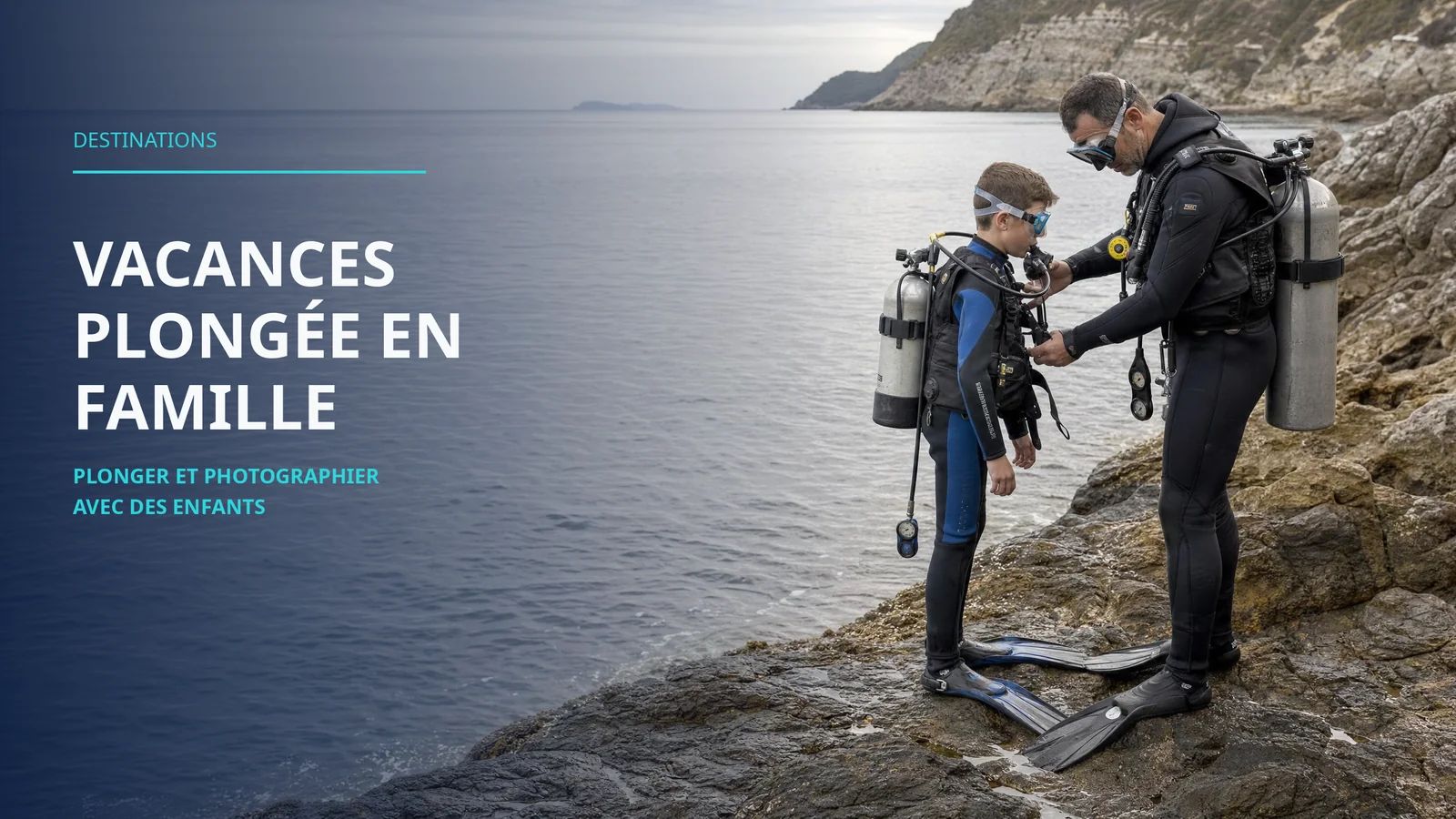
Introducing your children to snorkeling and underwater photography. Suitable gear, family friendly destinations and animal ethics from the very first mask.
As soon as they swim with ease and accept the mask, often around six or seven. Start in calm shallow water, close to shore, with an adult within reach. Comfort comes before performance.
A GoPro on a small floating handle is the simplest tool. Light, sturdy, no complicated settings. The child films and shoots wide angle without having to think about technique.
Shallow sites with no current, abundant marine life visible from the surface. Protected lagoons, sheltered bays and clear warm water reassure children and make the first images easy.
Through example and simple rules: we watch, we do not touch, we do not chase. A child who learns to observe without disturbing becomes a respectful photographer, and often a better observer than the adult.
No for surface snorkeling, which is plenty for beautiful images in shallow water. Scuba for children exists in a supervised version at limited depth, but the mask and snorkel already open a whole world.
Through short sessions and play. Give them a simple mission, photograph a fish of a certain colour, and stop before they tire. A child who keeps a good memory will want to come back.
To learn how to get the most out of your gear underwater, discover the AquaExposure training.
When a parent asks me how to share underwater photography with their children, I rarely answer with gear. I answer with a scene. Introducing a child to underwater photography starts with snorkeling in calm water, with light gear like a floating GoPro, at a shallow destination with no current, and with one golden rule passed on from the first mask: we observe without disturbing.
I remember a family I met on an outing, two parents and an eight year old girl. The parents were determined to put a sophisticated camera in her hands. The little one only looked at the fish. We gave her a simple GoPro on a floating handle. An hour later she had brought back an image of a curious sea bream, sharp, framed by instinct, better than her parents' shots. Children do not have our hurried adult reflexes. They really observe.
This article is for families who want to turn a seaside holiday into a first real photography experience, with no pressure and no danger. If you are also preparing your destination choice, my article on the mistakes to avoid on a first dive photography trip pairs well with this one.
People often believe you need a tank to make beautiful images. That is false, especially with children. The surface offers the most beautiful light, the greatest safety, and the most colourful fauna of the first few metres.
A mask, a snorkel, fins sized to their feet, and a child who swims well already has a vast photographic playground. Shallow reefs concentrate life and light, exactly what you need for successful first images.
Snorkeling also removes the technical barrier of diving. No air management, no decompression stops, no depth to watch. The child focuses on one thing only: looking, and capturing what they look at. If you later want to move to supervised diving, my walks you through the steps calmly.
The rule is simple and I repeat it to every family: the fewer settings a child has, the more fun they have, and the better their images. A complicated tool kills the spontaneity that is precisely the talent of children.
The GoPro on a small floating handle remains my first choice. Light, sturdy, waterproof with no fragile housing, it forgives knocks and floats if it slips from the hands. The camera's natural wide angle frames broad and rescues imprecise aiming.
For parents weighing the options, my smartphone, GoPro and waterproof compact comparison details the strengths of each solution. But for a child, simplicity always beats maximum quality. An image taken with joy is worth more than a perfect image never attempted.
A good family destination is not chosen like a destination for an experienced photographer. Three criteria matter: shallow depth, no current, abundant marine life visible right from the surface.
Protected lagoons and sheltered bays tick those boxes. The water is calm, warm, clear, and the fauna comes close without fear because it is used to human presence at the surface. A child stays relaxed there, and a relaxed child makes better images.
Avoid sites with current at all costs, even famous ones. What is an adventure for an experienced diver becomes a danger for a child and a source of stress for the parents. Safety comes before spectacle, always. And a pleasant first memory is what will make the child want to come back.
Here, for me, is the heart of the matter. The first thing a child learns underwater is not technique. It is the relationship with living things.
The rule fits in a few words: we watch, we do not touch, we do not chase. A child understands this very quickly, often better than an adult, because they have not yet built the habit of wanting to grab what they find beautiful. It is up to us not to teach them that bad reflex.
A child who photographs a turtle at a proper distance, without following it, without touching it, learns two things at once: respect for living things and the patience of the photographer. That is exactly the value I defend in adult photography. Natural light, calm observation, the refusal to disturb for an image. Children take it in as obvious when you pass it on early.
One last piece of advice, and perhaps the most important. Underwater photography with a child is played on joy, not on performance. A session that is too long or too demanding snuffs out the desire.
Give the child a simple, playful mission. Find and photograph a fish of a certain colour, spot a shape, tell what they saw on the way up. Then stop before the tiredness, before the cold, before the boredom. You always end on a success.
A family diving holiday will not turn a child into a professional photographer in a week. But it can plant a seed. The seed of a curious and respectful gaze on the ocean, one that will last far longer than the photos themselves.
If you want to progress yourself, alongside your children, to better guide them in the water, I train beginner parent photographers in my underwater photography course.


