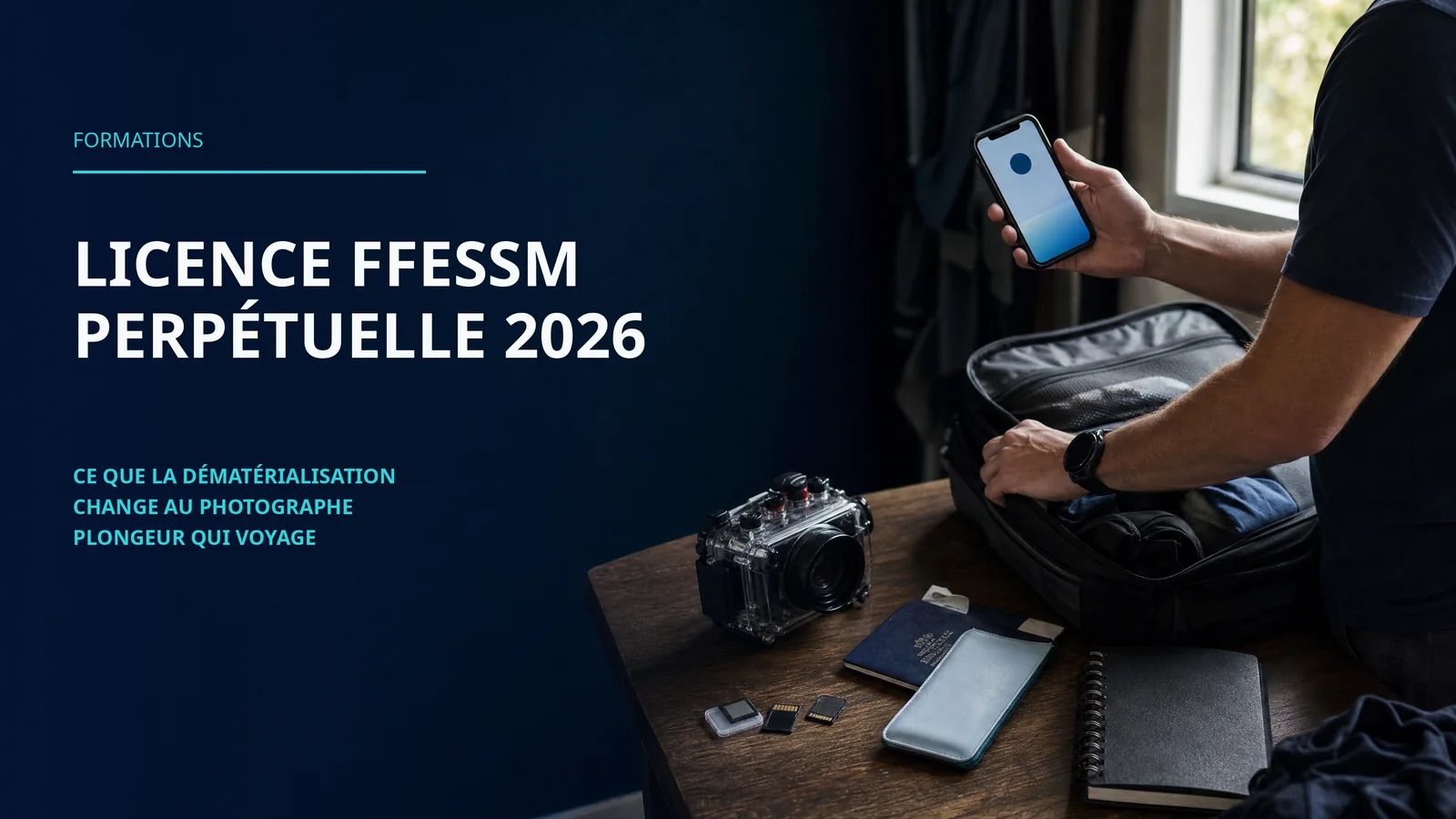
FFESSM Perpetual License 2026: What Going Digital Changes for a Photographer Diver Who Travels
The FFESSM goes digital in 2026 with a perpetual license, catching up with PADI and SSI. Good news, except for one critical gap: offline access. Practical reading for the photographer diver who travels.
Does "perpetual" mean the FFESSM license is valid for life?
No. The license still needs to be renewed each year (membership fee and insurance). The word "perpetual" means that the physical card no longer has a printed expiry date and that it no longer changes every season. The up-to-date information lives in the QR code, not on the card.
Is my old FFESSM card still valid in 2026?
Yes, for the validity period printed on it. But in practice, as soon as you renew your license for the 2026 season, you switch to the digital system and the QR code becomes your official reference. Prepare your phone, not your wallet.
What happens if I have no internet connection abroad to verify the QR code?
That is the critical point. Unlike PADI eCard or SSI MyDiveGuide, which work natively offline in their official apps, the FFESSM 2026 system has not yet deployed a fully integrated offline eCard. The workaround is to download the official PDF certificate from your member area before each trip. That PDF is accepted during checks and works without network access. Do it systematically. It is your safety net until the FFESSM offline app matches PADI and SSI.
Do foreign dive centres accept the digital license?
Centres accustomed to francophone divers (Mediterranean, Egypt, Maldives, Caribbean) know the system. For less common destinations, always keep a PDF copy of your certifications on your phone and on a cloud drive (Google Drive, iCloud), in addition to the digital FFESSM license.
Is the CACI still required with the new license?
Yes for diving in France beyond certain conditions (competition, depth, supervised diving). The QR code on the new license can integrate your current CACI, which avoids having to present two separate documents on French boats. Check the integration in your member area.
Will this digitalisation also apply to PADI or SSI?
PADI has had its digital card (eCard) for several years already, and SSI uses an official mobile app for its certifications. The FFESSM is therefore joining a movement already established among the private agencies. For a photographer who holds multiple cards, the challenge is to consolidate everything in the same digital wallet.
To learn how to get the most out of your gear underwater, discover the AquaExposure training.
FFESSM Perpetual License 2026: What Going Digital Changes for a Photographer Diver Who Travels
Let us start with the international context, because that is what puts this news in perspective. For several years now, the private international agencies have already switched to digital. PADI offers its eCard and has for a long time, accessible in the official app with offline download. SSI has MyDiveGuide, which brings together certifications, logbook and qualifications on your phone. NAUI, SDI, CMAS international: all of them made this move before 2026. A diver trained with any of these agencies was already travelling with their phone as a universal pass, and that had become the de facto standard.
The FFESSM (French Federation of Underwater Studies and Sports) held on to its printed plastic card, mailed each year to the member. In 2026, the federation finally joins the movement with a so-called perpetual license. In practice, this is a digital license accessible via QR code in your member area. It is good news, because it aligns the French format with what foreign centres already expect. And it is news that deserves careful reading, because it also introduces a trap that the international agencies anticipated long ago, and that the FFESSM still needs to fully solve.
This article is not an FFESSM press release. It is a reading at the level of a diver who has spent time in dive centres in France, Belgium, Cyprus, Egypt and the Maldives, and who has seen what actually happens when you present your papers to an instructor or a captain.
What Concretely Changed in 2026 Compared to Before
Before 2026, you received a new plastic FFESSM card every season, with a printed validity date. You had to present it physically, and if you left it at home, that was a problem.
Since 2026, three things have shifted.
The license is digital. You no longer receive a new plastic card every year. Your information lives in a QR code, accessible from your FFESSM member area.
It is perpetual in terms of the card. The physical card, if you still have one, no longer carries a printed date that changes each season. The actual validity date is read from the QR code, and it updates automatically when you renew your membership and insurance. You no longer risk presenting an expired plastic card when your license is current.
The QR code aggregates more information. It now contains (depending on your settings) your identity, club affiliation, validated certifications, insurance policy and potentially the CACI (medical certificate of no contraindication). In theory, you no longer need to present five separate documents to a boat captain or dive director. You present one QR code.
That is a genuine administrative simplification, and it is what PADI and SSI divers have been living with for years. For an FFESSM photographer who already travels with a lot of gear (housing, strobes, accessories, batteries), it also means a bit less space taken up and a bit less stress.
Why a Photographer Diver Should Care More Than an Average Diver
A diver without a camera dives with their club or with a pre-arranged centre, presents their papers once, and the matter is closed. An underwater photographer has a more mobile practice, and one that is more exposed to checks.
You travel with expensive equipment that, depending on the country, can trigger a customs check or a boarding question (Ikelite housing, Inon strobes, lithium batteries). That check often chains into a request for your diving level.
You regularly board boats that are not your home club (liveaboard in Egypt, day trips in the Maldives, technical dives on wrecks). Each boarding triggers a license, insurance and certification check. Multiply that by six boardings in a single liveaboard week, and this administrative friction adds up.
You sometimes access protected sites (marine reserves, MPAs) where the local authority may require proof of valid dive insurance on top of the certification. Here again, the unified QR code format of the FFESSM 2026 simplifies the presentation.
The 2026 digitalisation solves precisely that friction. But it also introduces new points of attention that I want to lay out.
Three Traps of Going Digital for the Travelling Photographer
I have seen three problem situations repeat since the switch to the digital license. None is serious if you anticipate it. All can ruin a day if you discover them on the jetty.
Trap 1: the desynchronised CACI. If you update your medical certificate off-season without re-uploading it to your FFESSM member area, the QR code may return outdated information. Solution: after every new medical visit, upload the scan to your member area as soon as you get home. Not the night before a liveaboard departure.
Trap 2: the dead or lost phone. The risk is real after a day of diving, transport, photos, videos. Solution: supplement the online access with a paper printout slipped into your toiletry bag or your dive backpack. Thirty seconds at travel time, and you avoid missing a boarding because your iPhone is at one percent.
Trap 3: no internet connection at the moment of the check. This is the central trap, and it deserves its own section because it goes beyond a simple practical question. It says something about what the FFESSM still needs to align with international standards. I detail it in the final section.
These three precautions take less than five minutes of preparation per trip. They prevent virtually all the bad surprises I have witnessed on jetties.
What This Changes if You Photograph Abroad
The FFESSM is French. Its license is French. But its international recognition works across two different registers that I want to clarify, because they often get mixed up.
The first register is the license and insurance. The FFESSM 2026 license includes dive insurance valid internationally (depending on your formula). This insurance is what foreign dive centres and captains care about: they want to know that if something happens, you are covered. The QR code or the digital PDF does the job.
The second register is certification equivalence. Your FFESSM certifications (Level 1, Level 2, Level 3, etc.) have recognised international equivalences (notably with PADI and CMAS). In practice, at most foreign centres, you present your FFESSM QR code and your certifications are translated by the centre into their own grid. For less common destinations or technical dives, keep a copy of your paper certifications or a PADI/SSI eCard as well, because a centre used only to PADI may read the FFESSM QR code more slowly.
My Personal Setup for Travelling Light With My Papers
Here is what I now do before every dive trip, and what I recommend to my photography students heading to a liveaboard or a course.
On my phone, in a local Files app, I keep four PDF files: - Digital FFESSM 2026 license (official downloaded PDF) - Dive certifications (high-quality scan) - Insurance attestation in French and English - Current CACI
In my dive backpack, I have a plastic sleeve with: - Colour printout of the FFESSM 2026 license - Paper copy of certifications - Paper copy of the CACI - Emergency contact list (DAN Europe, local embassy if travelling outside the EU)
On the cloud (Google Drive, iCloud), I have a folder called Diving Papers with exactly the same documents. If I lose both the phone AND the sleeve, I can recover everything from any computer in five minutes.
It is a bit of discipline up front. Once in place, it holds for years, and it removes a layer of stress that has no business being part of an underwater photography trip.
The Critical Point: What Still Needs to Be Fixed on Offline Access
I will close on the topic that seems most important to me, and that has not been discussed enough around the new FFESSM 2026 license.
A QR code gets scanned with a phone. And a phone, on a jetty in Fuvahmulah, on a boat in Marsa Alam, or in a Catalan marina ten kilometres from the nearest 4G tower, does not always have a signal. Sometimes no signal at all for three days straight during a liveaboard. Online verification of the QR code is useless in those conditions.
This is precisely the problem that the private international agencies solved several years ago. The PADI eCard is downloadable in offline mode within the official app: you open it without network, your certification displays, the centre checks it, done. SSI MyDiveGuide works the same way, with a local cache that survives any dead zone. No PADI or SSI diver gets stuck at embarkation because there is no 4G. The system accounts for it natively.
As I write these lines, the FFESSM 2026 has introduced the QR code but has not yet officially deployed an app that guarantees automatic, reliable offline download, recognised as such by foreign centres. There is an official PDF certificate downloadable from your member area, and that is what I recommended above as a temporary solution. But it is not the same thing as a native eCard that opens in two seconds in an app known worldwide.
That is the gap to close. Not a serious defect, but a point that deserves to be named clearly. The FFESSM made the right move by going digital. It still needs to take the step that goes with it: an official app with a reliable offline mode, deployed and communicated to international centres, so that the QR code never becomes an obstacle at the exact moment you need it most.
Until that step is taken, your personal discipline fills the gap. The PDF downloaded before each trip, the paper printout in the toiletry bag, the certification scans on the cloud. These are not paranoia. They are the reflexes that a PADI or SSI diver no longer even needs to have because their agency did the work for them. The FFESSM will get there. Until then, you get ahead of it.
The next time you show your QR code to a captain in board shorts on a jetty, you will know that it is a good administrative step, that it finally aligns France with what the rest of the diving world already does, and that one last step is still missing for the digitalisation to fully deliver on its promise. Take the opportunity to photograph what is going on below. That is what will remain long after the last plastic card has disappeared.