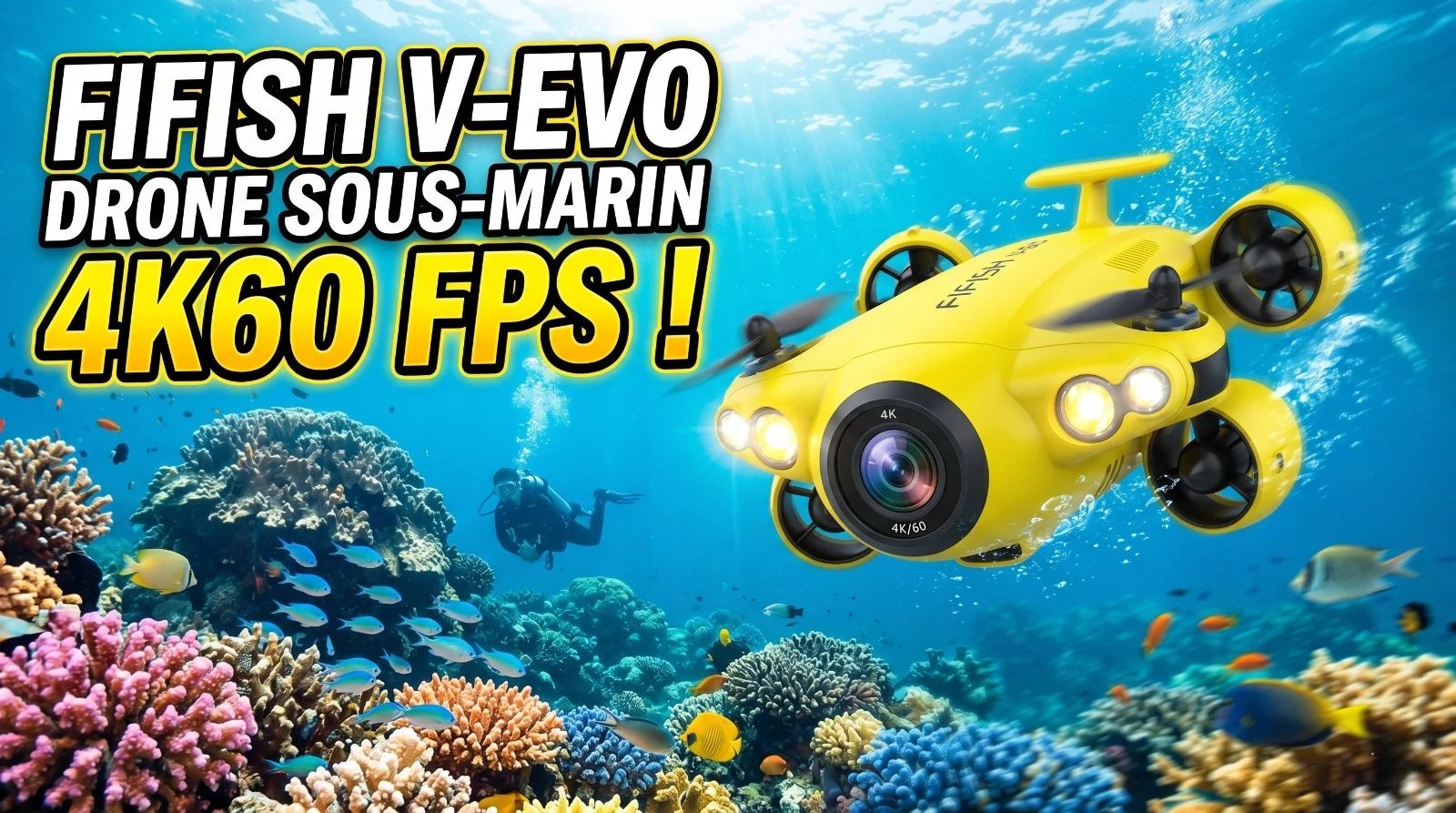
FIFISH V-EVO: the first 4K 60fps underwater drone, with omnidirectional 360° movement and automatic tracking. Analysis for underwater videographers.
There are underwater locations where even an experienced diver cannot go. Too deep, too narrow, too dangerous, or simply too far under an overhang for a human to comfortably explore. This is where underwater drones find their use, and the FIFISH V-EVO from QYSEA represents the most advanced technology in this category.
This is a first for a consumer-grade underwater drone: the V-EVO features a camera capable of filming in 4K at 60 frames per second. For underwater videographers, the difference between 30 and 60 fps is not a technical detail. In slow motion, the movements of marine animals take on a fluidity and grace that 30 fps cannot reproduce. A school of barracuda turning, the tentacles of an anemone oscillating in the current, an octopus changing color: at 60 fps, each movement reveals details invisible to the naked eye.
The V-EVO moves in six degrees of freedom: forward, backward, left, right, up, down, with a 360-degree rotation on all axes. In practice, this means that it can follow an animal that swims in a spiral, dive under an overhang and resurface, or perform a lateral tracking shot along a wall without any jarring movements.
Its 5000 lumens of 5500K LEDs provide balanced lighting up to a depth of 100 meters, where natural light has completely disappeared.
The Vision Lock feature automatically detects and tracks a moving subject, adjusting the drone's trajectory in real time to maintain the framing. This is a great help for filming animals in motion without having to simultaneously pilot and frame.
The accuracy of this system in real conditions (current, turbidity, fast subjects) remains to be evaluated over the long term. But the concept addresses a real need: when piloting an underwater drone, the coordination between navigation and framing represents the main difficulty.
The V-EVO does not replace a diver equipped with a camera. It complements it. The situations in which it excels are those where human presence is limited: inspection of deep areas before a technical dive, exploration of caves or closed wrecks, scouting subjects for underwater photographers, or simply capturing images in inaccessible locations.
For dive centers and guides, it is also a prospecting tool: to send the drone to check the conditions on a site before taking a group there. And for underwater documentary filmmakers, a 4K60 drone that descends to 100 meters opens up shooting possibilities that previously required much more expensive equipment.
The boundary between what a person can film and what remains out of reach is shifting a little each year. V-EVO helps to push it back, one virtual dive at a time.
The V-EVO descends to 100 meters, far beyond the limits of recreational diving (40 meters). Its integrated 5000 lumens of LED lighting provides the necessary illumination at these depths, where natural light has completely disappeared. This ability to film where a diver cannot go is what makes underwater drones so interesting.
Vision Lock detects a moving subject within the camera's field of view and adjusts the drone's trajectory in real time to maintain the framing. You control the overall direction, and the drone handles fine framing. This is particularly useful for tracking a moving animal without having to coordinate navigation and framing simultaneously.
No, it complements. The drone excels in situations where human presence is limited or impossible: very deep areas, caves, sunken wrecks, and site reconnaissance before a dive. A photographer diver remains superior for macro photography, close interactions with wildlife, and responding to spontaneous opportunities.
60 fps allows for smooth slow-motion, revealing details that are invisible at normal speed: the movement of an anemone's tentacles, the color change of an octopus, the choreography of a school of fish. In underwater video, slow-motion is a powerful storytelling tool, and 4K ensures sufficient resolution even after cropping.
Do you want to progress in underwater video, using a drone or any other equipment? Our training covers the techniques for shooting and editing that make a difference.
The V-EVO descends to 100 meters, well beyond the limits of recreational diving (40 meters). Its 5,000 lumens of integrated LEDs provide the necessary lighting at those depths where natural light has completely disappeared.
Vision Lock detects a moving subject in the camera's field of view and adjusts the drone's trajectory in real time to maintain the framing. You control the general direction, and the drone handles the fine framing.
No, it complements one. The drone excels in situations where human presence is limited or impossible: zones that are too deep, caves, closed wrecks, site scouting before a dive. A diver photographer remains superior for macro, close interactions with wildlife, and reactivity.
60 fps allows smooth slow motion that reveals details invisible at normal speed: the movements of an anemone's tentacles, a color change on an octopus, the choreography of a fish school. 4K guarantees sufficient resolution even after cropping.