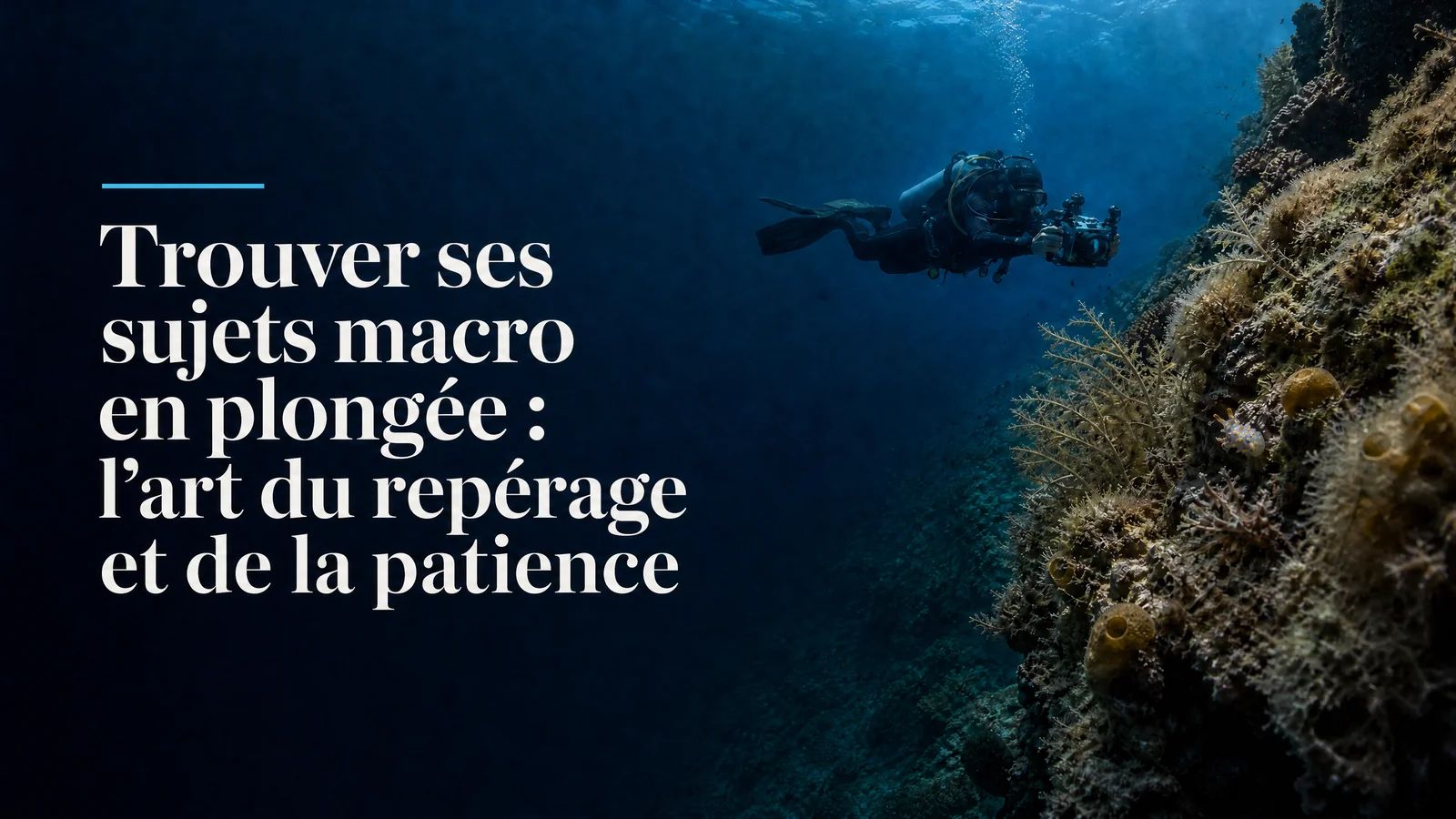
Finding Your Macro Subjects on a Dive: the Art of Spotting and Patience
The macro subject does not come to you, you must find it. Spotting techniques, micro-habitats and animal associations so you never surface empty-handed.
How do I find macro subjects on a dive when I see nothing?
Slow down and scan the wall at a constant speed, following the structures that hold life: sponges, hydroids, algae, overhangs. Macro subjects hide in those micro-habitats, rarely on bare ground.
Where do I find nudibranchs and other macro subjects?
On food-rich zones: hydroids, bryozoans, sponges, and along shaded overhangs. Many nudibranchs feed on specific organisms, so spotting their food means spotting the animal.
Do I need to know marine biology to find macro subjects?
Not in depth, but knowing a few associations helps enormously: shrimps on anemones, gobies on coral, crabs on crinoids. Knowing where a subject lives divides your search time by ten.
Can the dive guide help me find macro subjects?
Enormously. A good local guide knows the resident subjects and their habits. Tell them before the dive that you are hunting macro, and respect their pace. They are often the ones who spot the unspottable.
Why is patience a photographic skill?
Because most good macro images come after the wait: the subject emerges, opens its crown, turns toward the light. Whoever stops and observes surfaces with images the rushed diver will never see.
How long should I stay on a macro subject?
Often several minutes. Long enough for the subject to accept you, resume its natural behaviour, and offer you the moment. In macro, two well-worked subjects beat twenty glanced at.
How do I avoid damaging the reef while hunting macro subjects?
By mastering your buoyancy and propulsion, and never resting a hand on living substrate. Spotting is done with the eyes, never the fingers. A subject never justifies harming its habitat.
To learn how to get the most out of your gear underwater, discover the AquaExposure training.
The macro subject does not come to you, you have to go and find it. The key is not luck but method: scan the wall at a constant speed, target the micro-habitats rich in life, know the animal associations, and accept the wait. This guide gathers the spotting techniques that make all the difference between an empty dive and a dive full of images.
During a course in the Mediterranean, a student asked me how I found so many subjects when she, on the same wall, saw nothing. I offered her an experiment: we redid the same drop-off, but this time I showed her where to set her eyes, sponge by sponge, overhang by overhang. In a single dive she spotted two shrimps, a nudibranch and a goby. Nothing had changed in the sea, everything had changed in her gaze.
The subject does not come to you
That is the first thing to accept. In wide-angle, you wait for the scene to compose in front of you. In macro it is the opposite, you set off hunting a detail a few millimetres across that, most of the time, is hiding. Most divers swim past a wall covered in life without seeing a tenth of it, simply because they move too fast and look too far ahead.
Spotting is a skill in its own right, on par with framing or managing light. It is, to my mind, the one that most clearly separates the beginner from the accomplished photographer. And once you know what to photograph, the article on hidden macro subjects beyond nudibranchs gives you the full list of targets to hunt.
Scanning the wall at a constant speed
The basic technique fits in one sentence: move slowly, at a steady pace, sweeping the wall up and down rather than racing straight ahead. Your eye should follow the structures, not open water. A good spotting pace is almost always too slow for the rest of the group, which is normal.
Master your buoyancy and trim first, because you spot nothing while fighting not to hit the bottom. Body stable, breath calm, you free your whole attention for the search. That is exactly the posture of erasure I describe in the article on the scenography of erasure.
Hunting the micro-habitats
Macro subjects do not live just anywhere. They concentrate in precise micro-habitats, and learning to recognise them divides your search time.
Sponges shelter shrimps, squat lobsters and worms. Hydroids and bryozoans feed countless nudibranchs. Algae and seagrass hide seahorses, pipefish and juveniles. Shaded overhangs, finally, are whole refuges, because many species flee direct light. When you arrive on a new site, do not hunt the subject, hunt its habitat first. The rest follows.
Knowing the animal associations
Nature is full of fixed relationships, and knowing them means knowing in advance where to look. Cleaner shrimps hold stations on anemones and corals. Gobies live on specific corals, sometimes in pairs. Some crabs are found only on crinoids. Clownfish always guard their anemone.
This logic of association turns the search into deduction. You see an anemone, you look for the shrimp. You see a crinoid, you look for the crab. This knowledge is gained in the field and fed by naturalist guides. If you want to put it to good use, the article on ethical underwater photography and citizen science shows how your observations can even serve research.
The role of the dive guide
A good local guide is your best macro ally. They know the residents of the site, their habits, and often the exact spot of a rare subject. Tell them before the immersion that you are hunting macro and that you will dive slowly. Most love sharing these markers, because they see subjects that rushed groups ignore. Respect their pace and their knowledge of the site, and they will take you where it matters.
Adapting spotting to the night
At night, the reef changes tenants, and so does spotting. Many daytime subjects hide, but others come out: shrimps, crabs, octopuses, coral polyps that open to feed. Your beam then becomes the main search tool, and how you use it matters as much as how you look.
Sweep gently, without aiming the light straight into the animals' eyes, and favour a raking beam that brings out relief without aggressing. Many eyes reflect light in the dark, which helps locate shrimps and fish several metres away. The night dive is, in a way, a second library of subjects open to those who accept diving differently.
Patience as a skill
Here is the truth few people say: most good macro images come after the wait. You spot a retracted fan worm, you stay still, and after a minute its crown unfolds again. You find a wary mantis shrimp, you wait, and it eventually lifts its head. Whoever stops and observes surfaces with images the rushed diver will never see.
In macro, two well-worked subjects beat twenty glanced at. That is also why this discipline is, to my mind, the best school of underwater photography. It teaches you what everything else demands: slow down, observe, respect. The same mindset I pass on for nudibranch macro photography, where patience makes all the difference.
"What is a scientist after all? It is a curious man looking through a keyhole, the keyhole of nature, trying to know what's going on." Jacques-Yves Cousteau
Going further
Spotting and patience cannot be bought, they are trained. If you want to learn to read a wall and find your subjects without damaging the reef, the AquaExposure underwater photography course builds that skill dive after dive, from the gaze to the shutter.
Next time you descend, forget the race for the rare subject. Slow down, choose a sponge, and really look. The reef was waiting for you.
Finding Your Macro Subjects on a Dive: the Art of Spotting and Patience | AquaExposure