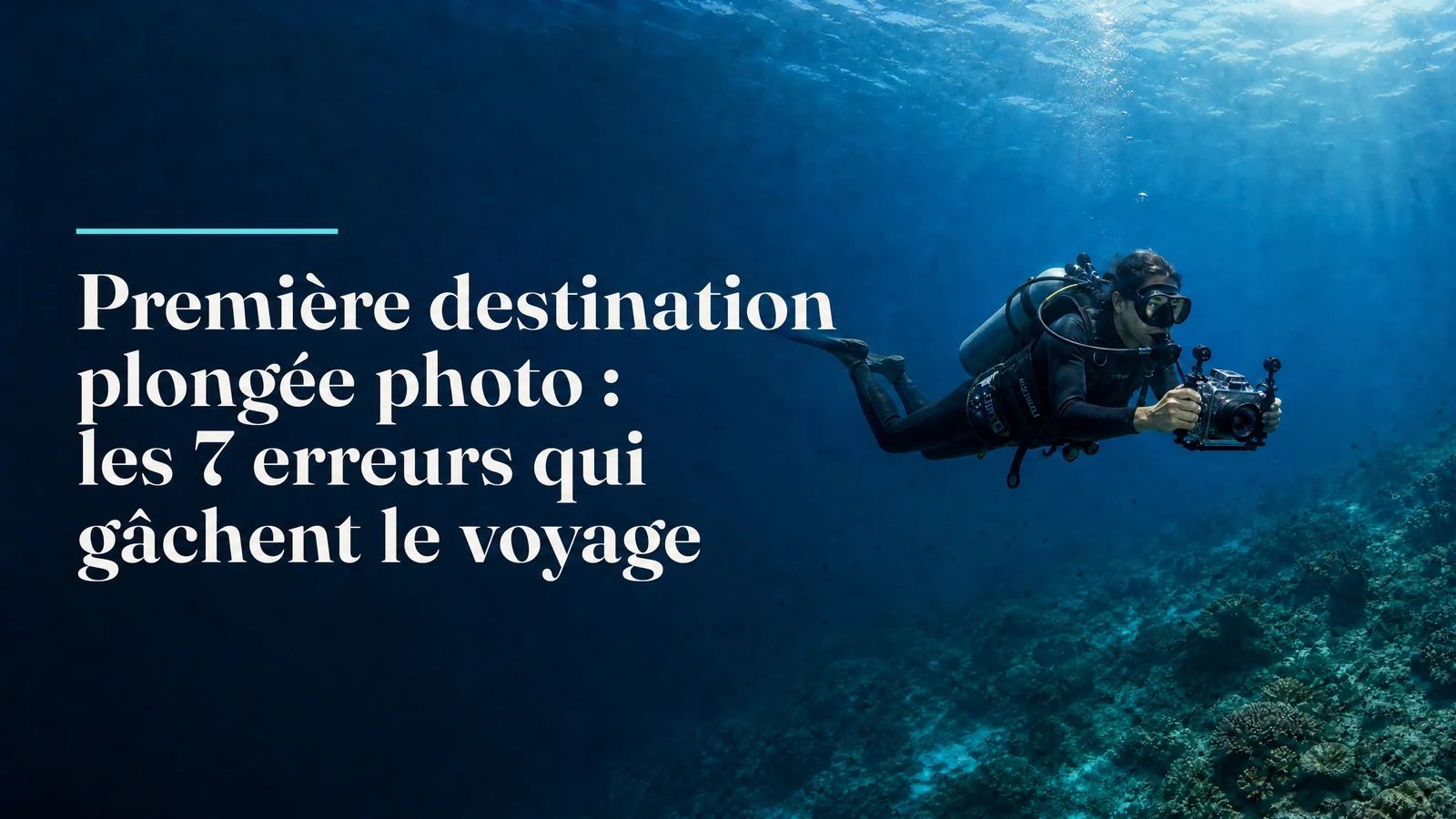
First dive photography trip: the 7 mistakes that ruin the journey
Planning your first dive photography holiday. Here are the 7 beginner mistakes that ruin the images, and the decision grid that helps you avoid every one.
What is the worst mistake on a first dive photography trip?
Choosing the destination on price instead of visibility. Murky water ruins every image whatever your gear. It is better to pay a little more for clear stable water than to come home with green blurry photos.
Do I need to travel in high season to get good photos?
Not necessarily the tourist high season, but the right photo window for the destination. Visibility, currents and species change month by month. Check the local diving season before booking, not just the air weather.
How much camera gear should I bring on a first trip?
The minimum that already works for you. A smartphone in a housing or a GoPro, a spare battery, a way to recharge. Too much gear creates mental overload underwater and makes you miss the simple moments.
Should a beginner aim for wide angle or macro?
The two conditions are not booked the same way in the same trip. Decide before you leave. A macro destination and a wide angle destination call for a different site, a different approach and a different setting.
Is current a problem for underwater photography?
Yes, and it is often underestimated. A site with strong current requires a confident diving level before you even think about the image. Holding your position always comes before framing.
Resort or liveaboard for a first photo trip?
For a beginner, a resort with a jetty or a boat close to the reef makes everything simpler. A liveaboard offers more sites but demands rhythm and autonomy. Logistical comfort leaves more energy for the photography.
Should I plan days without diving?
Yes. Decompression and flying impose a delay without immersion before the return flight. Forgetting that surface day risks decompression sickness or a cut short trip. Always count at least 24 hours before take off.
To learn how to get the most out of your gear underwater, discover the AquaExposure training.
People often ask me which destination to choose for a first dive photography trip. The real question lies elsewhere. Before choosing where to go, you need to know which mistakes keep you from coming home with disappointing images: choosing on price rather than visibility, travelling out of season, packing too much gear, ignoring macro or wide angle conditions, underestimating current, picking the wrong lodging, and forgetting surface days.
I remember a diver I was guiding in the Maldives on her first trip with a housing. She had spent six months saving, read dozens of guides, bought a camera I would not have recommended at that stage. On the first day she surfaced in tears. Not because of the marine life, which was stunning. Because of her images, all missed, because she wanted to do everything at once. That trip taught me something I repeat in every course: the gear and the destination matter less than the mistakes you avoid.
This article is not a destination guide. If you are looking for where to go, I have already written the guide to the best underwater photography destinations. Here I take the problem from the other end: the seven classic beginner traps, and how each one is defused before departure.
Mistake 1: choosing the destination on price instead of visibility
This is the mistake I see most often, and the most expensive in the literal sense. A cheap ticket to a destination with murky water will cost you more in frustration than slightly pricier clear water.
Visibility is the one parameter your gear will never fix. A particle suspended between the lens and the subject bounces light back and drowns the image in a milky haze. No setting and no edit recovers water with three metres of visibility.
Before booking, look up the average visibility of the site for the month you are travelling. Not the annual average, the specific month. The same destination can offer thirty metres in the dry season and five metres after the rains.
Mistake 2: travelling out of season without knowing it
The season changes everything underwater, far more than the surface weather suggests. A destination can be sunny above the water and disastrous below it at the very same moment.
Migratory species are only there for a few weeks. Currents reverse. Visibility follows the cycle of rain and plankton. I detailed all of this in the guide to seasons by destination, because it is the most profitable calculation you will make before leaving.
The habit to build: check the local diving season, not just the tourist season. The two do not always line up, and that is exactly where beginners get caught.
Mistake 3: packing too much gear
I understand the urge. You have invested, you want to bring everything, try everything. And that is precisely what sabotages the first dives.
Underwater, every accessory adds one more thing to manage. One more thing to watch, one more thing that can flood, one more thing pulling attention away from the dive itself. A beginner already focused on buoyancy and air consumption has no mental bandwidth left to run a complex setup.
My advice fits in one sentence: bring the minimum that already works. A smartphone in a housing or a GoPro, a spare battery, a way to recharge in the evening. If you are still unsure about the camera, my smartphone, GoPro and waterproof compact comparison will save you the unnecessary purchase.
Mistake 4: not checking macro or wide angle conditions
Here is a mistake that stays invisible until it is too late. You book a destination, you arrive, and you find the site is built for macro when you were dreaming of large schools of fish in open water.
Macro and wide angle photography call for a different site, a different approach and a different mental preparation. A reef of small hidden subjects will never deliver an image of a manta ray in open water, and the reverse is just as true.
Decide before you leave what you want to bring back. If it is wide angle and light, look toward clear water and large structures, as in my backlit silhouette technique. If it is macro, choose a site known for its small fauna. But do not let chance decide for you.
Mistake 5: underestimating current for your level
Current is the most dangerous trap on this list, and the least discussed in the brochures. A site that is wonderful for photography can be off limits to a beginner because of the current.
When you are fighting to hold your position, you are not photographing. You are surviving. Stability always comes before framing, because a drifting photographer is a photographer in danger, both for themselves and for the reef they might strike.
Before booking a site known for its currents, ask yourself an honest question about your real level, not your dream level. And if you are also just starting diving itself, my guide to getting started with scuba diving will help you lay the foundations before adding the camera.
Mistake 6: booking poorly placed lodging
A resort with no jetty or boat close to the reef turns every dive into an expedition. You lose time, energy, and often the best morning light.
The logistics of your lodging decide how many dives you will really make, and at what time. The most beautiful light comes early in the morning and late in the day. If reaching the site takes two hours of travel, those windows slip away.
For a first trip, favour ease of access. A resort with direct entry or a well organised liveaboard leaves more energy for the photography. I compared the two formats in my article on liveaboard versus resort stay in Egypt, and the answer really depends on your temperament.
Mistake 7: forgetting surface days
This is the mistake that does not forgive, because it touches safety before the image. You plan dives right up to the last day, then board a plane a few hours later.
Flying too soon after a dive exposes you to decompression sickness. The cautious rule calls for at least twenty four hours without immersion before a flight. That surface day is not a loss, it is an insurance.
Use it to sort your images, recharge your batteries, scout the marine life from the surface. A well prepared dive photography trip always includes that no dive day in its calendar, right from the booking.
The AquaExposure decision grid
To bring all of this down to a simple method, here is the grid I give my students before a first trip. Five questions, in order, before booking anything.
First, does the average visibility for the specific month of departure exceed fifteen metres. Then, does the season match what I want to photograph, macro or wide angle. Next, is the current of the site compatible with my real diving level. Then, does the lodging give me access to the reef early in the morning. Finally, have I blocked a surface day before the return flight.
If a single answer is no, change that parameter before you pay. This grid costs nothing and will spare you the disappointment that pushes so many beginners to shelve their housing after a single trip.
Underwater photography, as I teach it, rests on natural light and respect for living things. No aggressive flash on the fauna, no race for gadgets, no red filters that lie about colour. A successful first trip is above all a trip where you avoided the traps, not a trip where you bought everything.
If you want to prepare that first trip with a complete method, light, composition and ethics together, I train beginner photographers step by step in my underwater photography course.
First dive photography trip: the 7 mistakes that ruin the journey | AquaExposure