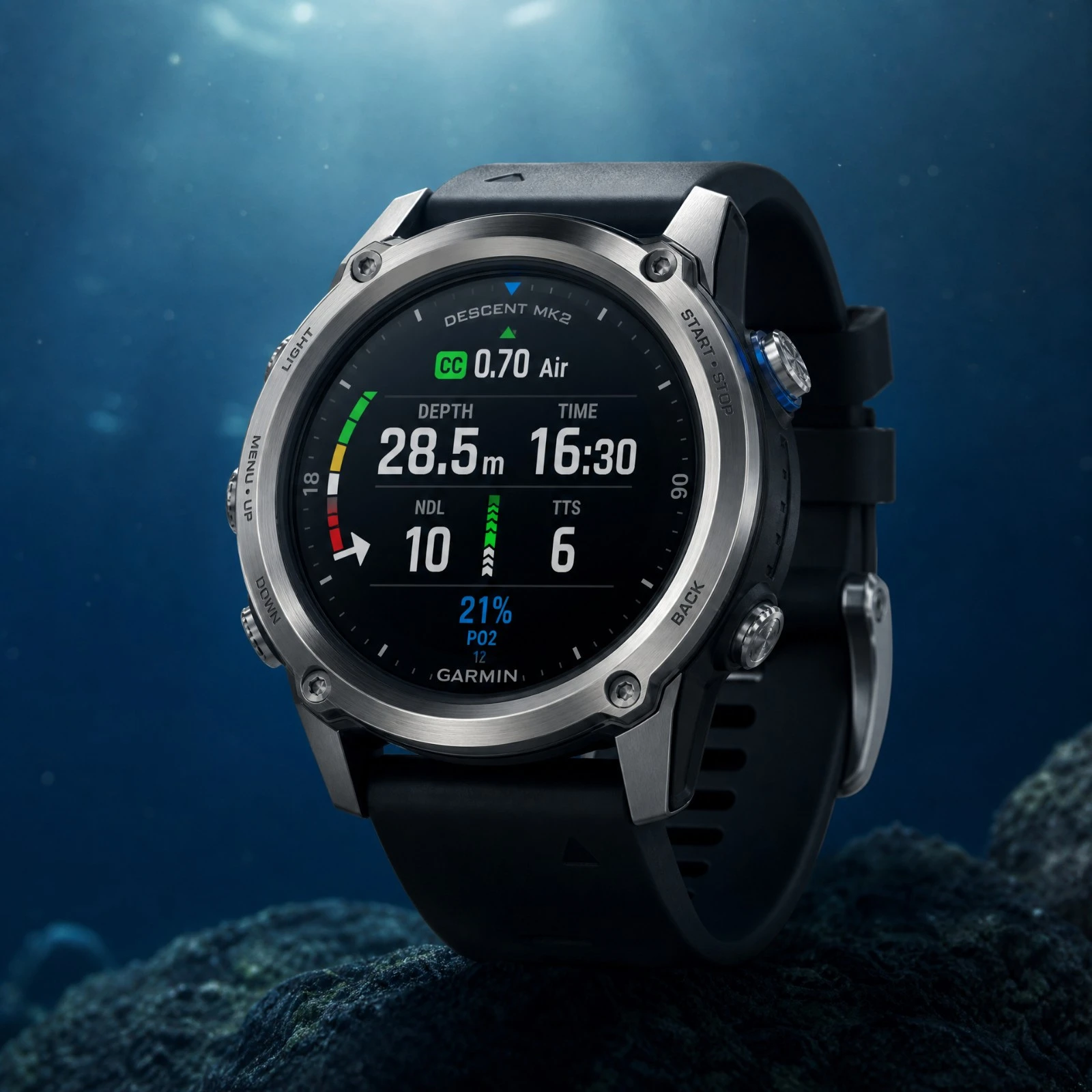
Discover our comprehensive review of the Garmin Descent Mk2. A large-format Trimix dive computer with a 1.4" screen and exceptional battery life.
To learn how to get the most out of your gear underwater, discover the AquaExposure Training.
1. Introduction
The quest for the perfect equipment is often akin to a complex personal journey. We spend hours comparing specifications, scrutinizing specialized forums, and asking our diving buddies for their opinions.
This meticulous approach reflects a fundamental need for trust that lies beneath the surface. A dive computer is not just a simple electronic accessory that one proudly displays on the boat deck.
It is the silent partner that watches over our physiology, calculates our safety margins, and dictates our climbing rhythm. It demands reliability, clarity, and consistency.
Today, we are taking a close look at the Garmin Descent Mk2 in its standard 47mm version. This model makes a bold choice by not including air integration capabilities.
It focuses on the essentials with such a straightforward approach that even the most demanding divers will find it satisfactory. Let's analyze together what this machine truly has to offer.
2. The Verdict in Summary
Here is our quantified assessment according to the AquaExposure framework.
| Criterion | Score | What this means in practice |
|---|---|---|
| O1 Algorithm | 5.0/5 | The Bühlmann ZHL-16C engine is completely unlocked and customizable. |
| O2 Air & multi-gas | 5.0/5 | From basic nitrox to heavy trimix, it handles absolutely all profiles. |
| O3 Screen & ergonomics | 3.9/5 | The 1.4-inch color MIP screen offers a very generous display area. |
| O4 Battery life | 4.6/5 | The promised 80 hours will make you forget about your charger for weeks. |
| O5 Connectivity | 4.5/5 | The smartphone application is extremely well-designed, and the synchronization is smooth. |
| O6 Compass & instruments | 5.0/5 | The integrated 3-axis compass is remarkably accurate and reliable. |
| O7 Robustness | 4.6/5 | The sapphire glass and certification to 100 meters guarantee exceptional durability. |
| O8 Price & customer service | 4.1/5 | An investment justified by the quality of manufacture and software support. |
Overall score: 4.6/5
3. Detailed Analysis
O1 Algorithm and Milestones
The mathematical core of a computer dictates our safety at every moment. The Garmin Descent Mk2 is powered by the Bühlmann ZHL-16C algorithm. This choice earns it the maximum rating of 5.0 out of 5.
You are not locked into a proprietary and obscure system. The configuration of the Gradient Factors gives you complete control over your decompression profile.
This freedom allows you to adjust your safety margin based on your level of fatigue, the water temperature, or the difficulty of the dive. The display is comprehensive.
You have continuous visual access to the Time To Surface (TTS), depth limits, and decompression ceiling. The alerts are comprehensive, and the reliability of this engine is well-established.
The transparency of the algorithm is a fundamental factor for technical divers. Knowing exactly how the machine calculates tissue saturation allows divers to anticipate decompression stops.
The Garmin Descent Mk2 excels in its presentation of information. It doesn't just give you instructions, it provides you with the raw data to understand your situation.
It's a pedagogical approach that empowers the diver. You become an active participant, aware of your decompression process, rather than simply following instructions.
The management of microbubbles by Gradient Factors represents a significant advancement in personalized safety. You can choose to increase the sensitivity of your profile if you experience unusual fatigue before launching.
This algorithmic flexibility is a sign of a machine designed to adapt to the user. The computer doesn't force a single, predefined decompression method upon you.
O2 Air and Multi-Gas
Versatility is the key feature of this model, which earns another score of 5.0 out of 5. It can measure up to 12 different gases.
Whether you're diving with air, Nitrox, or Trimix, it delivers. It also features a native mode for closed-circuit rebreathers (CCRs).
The defining characteristic of this standard version is the complete lack of air integration. It is technically impossible to connect it to a pressure sensor.
This hardware choice allows you to reduce the cost by several hundred euros compared to the higher-end model. This is a very, very, very pragmatic approach for those who trust their mechanical pressure gauge.
The gas management during a dive is remarkably smooth. Switching from the bottom gas to the decompression gas can be done with just a few button presses.
The interface guides you without overwhelming you with complex menus. It's an ergonomics designed by divers, for divers.
The planning of successive dives using different gas mixtures is managed with a high degree of mathematical precision. The Garmin Descent Mk2 leaves no room for approximation.
The integration of a native CCR (Cardiopulmonary Resuscitation) mode demonstrates the technical ambition of this device. It is capable of managing constant setpoints (PO2) for users of rebreathers.
Even if you are only diving with air today, this reserve of computing power provides peace of mind. The computer will evolve with your level of experience without ever limiting you.
O3 Screen and Ergonomics
The visual interface scores 3.9 out of 5. With a diagonal measurement of 1.4 inches (or 35.5 millimeters), the screen perfectly utilizes the space within the 47-millimeter case.
This is a MIP (Memory in Pixel) transflective color display panel. Under the bright tropical sun, readability is absolutely perfect.
In the depths of a dark lake or during a nighttime dive, you will need to rely on backlighting. The backlighting works very well.
The interface is based on 5 physical buttons. This standard ensures easy operation, even when wearing thick waterproof gloves. The data fields are fully configurable according to your preferences.
The absence of a touchscreen when diving is a real blessing. Saltwater and gloves often make touch interfaces unreliable and unpredictable.
The buttons on the Garmin Descent Mk2 offer a clear and reassuring mechanical feedback. You know exactly which action you have just confirmed.
Structuring the menus requires a short adaptation period during initial use. Once the logic is understood, navigation becomes intuitive and fast.
The transflective screen technology of the MIP display uses ambient light to illuminate the pixels. The stronger the sunlight on the surface, the more readable the screen becomes.
It's a definite advantage during decompression stops in the three-meter depth range. You don't have to squint to decipher your vital parameters.
O4 Autonomy and Power Supply
Energy management is a definite strength, with a score of 4.6 out of 5. Garmin claims up to 80 hours of battery life in dive mode.
It's a colossal capacity for a color computer equipped with a rechargeable lithium-ion battery. It surpasses many competitors in this specific segment.
The percentage gauge is accurate, and the device proves to be very reliable even in cold waters. You can set off on your cruise with peace of mind.
The anxiety of battery failure at the dive site completely disappears with such a large energy reserve. You can string together multiple dives without nervously checking the battery level indicator.
The proprietary charging cable securely attaches to the back of the housing. It ensures a fast and secure transfer of energy between dives, if necessary.
This extended autonomy is a real source of mental comfort. It allows you to focus fully on your surroundings and on your partner.
The battery thermal management is also excellent. Prolonged dives in water close to zero degrees Celsius do not drastically reduce the lifespan of the battery.
It's a technical detail that becomes very important during winter explorations in quarries or under ice.
O5 Connectivity and Application
The software ecosystem fully justifies the score of 4.5 out of 5. The Garmin Descent Mk2 integrates Bluetooth and Wi-Fi.
Synchronization with your phone is instantaneous as soon as you return to the boat. Your GPS data for launch and retrieval are recorded without any effort on your part.
The Garmin Dive application is extremely comprehensive. System updates are performed wirelessly (over-the-air) with great ease. Data export remains open for third-party software.
Post-dive analysis becomes a real pleasure thanks to the wealth of graphs provided. You can dissect your depth profile, temperature, and ascent rate.
The digital dive log automatically fills itself with surgical precision. It is a valuable tool for tracking your progress and analyzing your underwater habits.
The Garmin community also allows users to share their explorations with other enthusiasts. This social aspect enriches the overall user experience.
Updating the firmware via your home Wi-Fi ensures that your device always benefits from the latest improvements. You no longer need to connect your computer to a PC with potentially unreliable software.
This software fluidity greatly contributes to a pleasant user experience on a daily basis. The computer tool fades into the background, allowing you to focus solely on analyzing your dives.
O6 Compass and Instruments
The embedded sensors perform flawlessly, achieving a score of 5.0 out of 5. The three-axis compass (compensated 3D compass) is remarkably accurate.
It will guide you reliably during your complex navigation sessions. The device also integrates a barometric altimeter and a continuous temperature sensor.
A dedicated apnea mode is available for enthusiasts of this discipline. It's a true, miniaturized instrument station on your wrist.
The digital compass is displayed as an overlay on the main screen without obscuring vital data. You can keep an eye on your heading while monitoring your depth and time.
The heading lock is intuitive, and the deviation indicators are clear. This is a major advantage for finding the anchor in conditions of poor visibility.
The barometric altimeter automatically adjusts decompression calculations during dives at high altitudes. This provides an extra layer of safety for those who enjoy diving in mountain lakes.
The temperature sensor reacts quickly to changes in thermal layers. You can precisely visualize the thermal strata during your post-dive analysis.
The apnea mode offers specific displays with surface recovery times calculated down to the second. This versatility is highly appreciated by practitioners who engage in multiple disciplines.
07 Robustness and Depth
The build quality is excellent, with a score of 4.6 out of 5. The polymer case is topped with a stainless steel bezel.
The screen is protected by a highly scratch-resistant sapphire glass. The device has a water resistance certification of up to 100 meters according to the EN13319 standard.
These documented characteristics guarantee exceptional durability against the corrosive effects of the marine environment.
The Garmin Descent Mk2 is designed to withstand the shocks inherent in technical diving. It's not afraid of tight spaces in wrecks or caves.
The chosen materials are perfectly resistant to salt corrosion and extreme temperature fluctuations. This is a long-term investment that will last for many years.
The assembly is of absolute precision. There is no play in the buttons, and the finishes exude the quality characteristic of high-end products from this brand.
The stainless steel bezel effectively protects the edges of the sapphire crystal. This design choice significantly reduces the risk of scratches during handling on the boat's deck.
The 100-meter certification covers the vast majority of needs for technical divers. It is an operational depth that provides a comfortable safety margin for deep exploration dives.
O8 Price and Customer Support
The pricing and customer support receive a rating of 4.1 out of 5. Initially launched at around €1300, this computer is now priced between €900 and €1100.
It's a substantial price, justified by the high-end finishes and software support. The quality-to-price ratio is very good for a machine of this caliber.
The manufacturer's warranty is for 2 years. The after-sales service network is extensive and well-organized.
The depreciation of this device on the second-hand market remains relatively low. This is a strong indicator of the confidence that divers place in this specific model.
The lack of air conditioning allows us to offer a significantly more affordable price compared to the higher-end version. This is a very relevant financial compromise for many users.
The initial investment is offset by the device's longevity and the availability of free, regular software updates.
The current pricing positions it as an extremely competitive option compared to the established players in the technical diving market. Garmin has managed to maintain its quality standards at a reasonable price.
Acquiring this equipment represents a significant financial investment that should be carefully considered in relation to your long-term goals for progress.
4. Who is this computer for?
The Garmin Descent Mk2 is designed for technical divers or regular divers who demand high performance. It's ideal for those who want a wide and comfortable display on their wrist.
It's the ideal tool for divers who exclusively use a mechanical pressure gauge and don't feel the need to see their pressure on a screen. Its advanced Trimix functions will delight deep-sea explorers.
Scuba diving instructors will particularly appreciate the screen's readability when monitoring their students. The clarity of the information allows for quick and unambiguous reading.
On the other hand, this computer is not the optimal choice for divers who absolutely want a wireless air integration system. If you desire this feature at some point, you will need to sell the device.
Furthermore, with its imposing 47-millimeter case, it may not be suitable for individuals with very small wrists. Those individuals would likely find more compact models to be a better fit.
You need to be prepared for the size of this device on a daily basis if you plan to wear it like an everyday watch. It's an aesthetic choice that won't leave anyone indifferent.
5. Customer Service and Support
The after-sales service of Garmin is that of a multinational consumer electronics company. This status implies a highly structured, but sometimes impersonal, organization.
In case of a failure covered by the warranty, replacement with a new unit is standard practice. This is an extremely reassuring factor for such a significant investment.
However, the customer journey can sometimes be frustrating. You will often deal with people who are not specialists in the field of scuba diving.
Processing times and return shipping costs are factual elements to consider. These aspects do not negatively impact the overall rating of the device, but it is important to be aware of them before making a purchase.
The brand's robust logistics ensure that any material issues are resolved. However, it is important to be patient when communicating with the centralized technical support team.
The online documentation and user forums largely compensate for any potential shortcomings in the basic phone support. The community is very active and readily shares its solutions.
6. Nutrition
Choosing a sealed, factory-assembled rechargeable lithium-ion battery changes our diving habits. No more annual battery replacements on the edge of a table before heading out.
This design guarantees perfect sealing upon leaving the factory. With its advertised 80 hours of battery life, energy management in daily use is incredibly simple.
During a week-long cruise with three dives per day, you probably won't need to take out the charging cable. This is an undeniable convenience that reduces the mental load when preparing your equipment.
It will simply be necessary to accept the idea that a return to the workshop will be required on the day when the battery shows signs of weakness after several years of good and faithful service.
Lithium-ion technology offers a very stable discharge curve. The computer will not abruptly shut down underwater without first warning you multiple times.
The interface visually and repeatedly alerts you when the energy level becomes critical. You have ample time to plan a recharge before your next launch.
7. Links to other models from the same brand.
The Garmin range is extensive and worth exploring in its entirety. If the lack of air management is a drawback for you, I encourage you to discover our review of the higher-end model.
You can read our complete review of the Garmin Descent Mk2i to understand the benefits of the SubWave technology.
This acoustic technology redefines the transmission of pressure data underwater. It represents a major advancement for those who want to consolidate all information on a single screen.
If the 47-millimeter size seems too large for your body type, the brand offers a more discreet alternative.
Feel free to check out our review of the Garmin Descent Mk2S, which offers the same capabilities in a 43mm case.
The brand's ecosystem allows each diver to find the configuration that perfectly matches their physical and technical needs.
8. CTA Comparator
Mastering decompression is an art that requires rigor, patience, and humility. The equipment is only a tool to facilitate your own learning.
To compare this computer with other models, check out our diving computer comparison tool.
© 2026 AquaExposure. All rights reserved. Reproduction prohibited without authorization.
Share
Table of Contents
- 011. Introduction
- 022. The Verdict in Summary
- 033. Detailed Analysis
- 04O1 Algorithm and Milestones
- 05O2 Air and Multi-Gas
- 06O3 Screen and Ergonomics
- 07O4 Autonomy and Power Supply
- 08O5 Connectivity and Application
- 09O6 Compass and Instruments
- 1007 Robustness and Depth
- 11O8 Price and Customer Support
- 124. Who is this computer for?
- 135. Customer Service and Support
- 146. Nutrition
- 157. Links to other models from the same brand.
- 168. CTA Comparator
Questions about the Journal
Can I use the photographs from this journal?
All images are protected by copyright. For any commercial or editorial use, please contact us via our form.
How can I be notified of new articles?
Follow us on social media or join the Sentinels Circle to receive our immersion stories before anyone else.
Do you offer hands-on workshops?
Yes, we organize masterclasses and field expeditions for members of our school. Check the Training page for details.


