Garmin Descent X50i Dive Computer Review: The Large-Screen Computer Designed for Technical Exploration
Detailed review and test of the Garmin Descent X50i. Explore its 3-inch color screen, DiveView mapping, SubWave network, and Bühlmann ZHL-16C algorithm.
What is the main difference between the Garmin Descent Mk3i and the X50i?
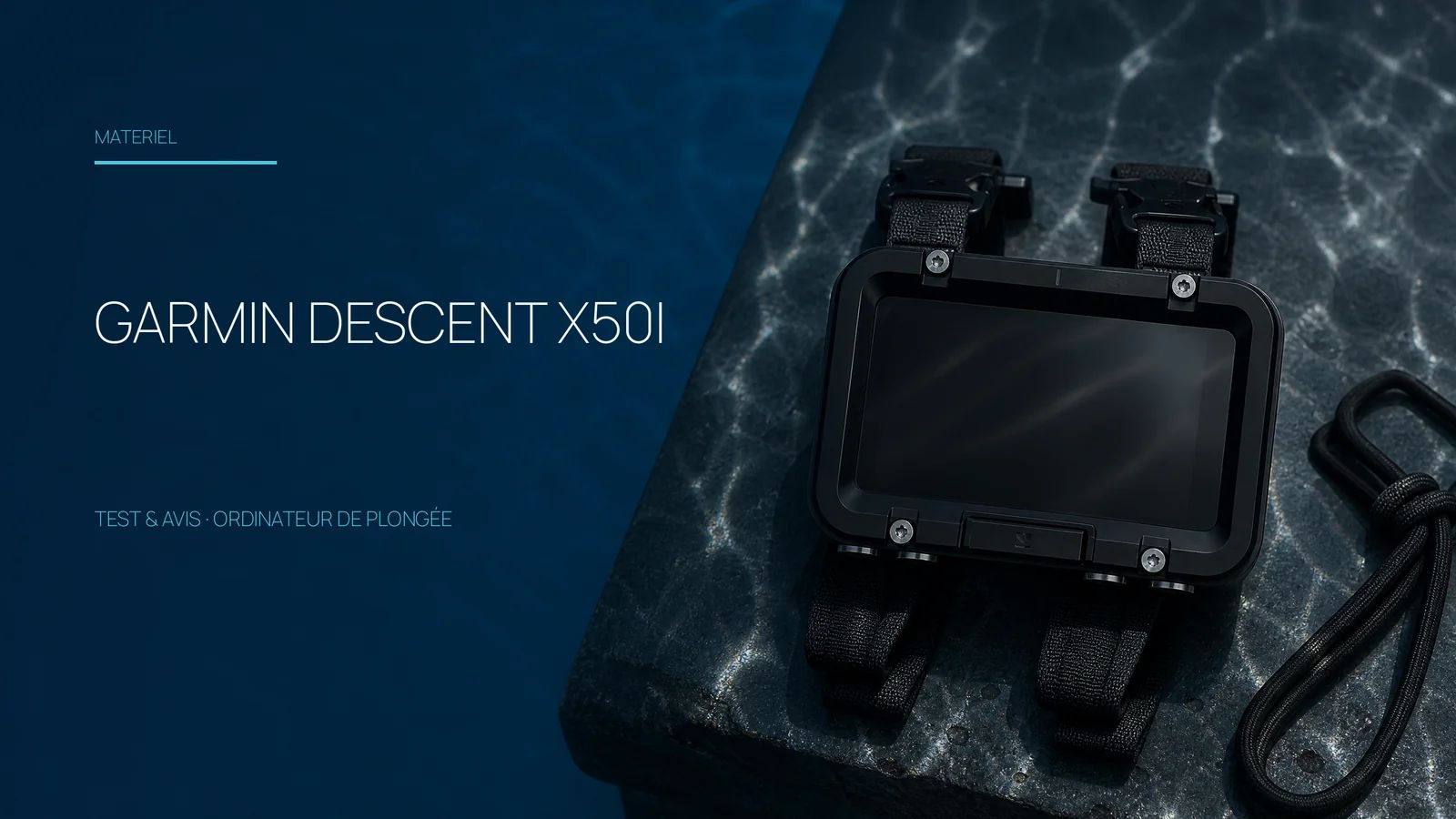
The Descent X50i is designed as a large-format wrist or console computer with a 3-inch screen and a built-in flashlight. It is purely dedicated to diving, unlike the Mk3i which maintains a multisport connected watch format.
Does the touchscreen work underwater?
No, the X50i touchscreen is active on the surface for easy configuration but locks underwater. Navigation is done exclusively via the large waterproof metal buttons, which is essential for drysuit glove use.
Can the Descent X50i communicate with other divers?
Yes, thanks to SubWave technology and T2 transmitters, you can exchange predefined messages up to 30 meters away and monitor the pressure of 8 divers simultaneously within a 10-meter radius.
Does this computer manage Trimix dives?
Absolutely. It supports air, Nitrox, Trimix and offers a dedicated closed-circuit rebreather (CCR) dive mode, with full customization via Gradient Factors.
To learn how to get the most out of your gear underwater, discover the AquaExposure training.
Introduction
With the Garmin Descent X50i, the American navigation giant makes a radical turn. Gone is the compromise of the daily-wear smartwatch format: this is a true exploration console designed for technical diving and heavy engagement. In difficult environments where readability of parameters is a safety requirement, the X50i delivers with a giant 3-inch color display. But under the hood is where the offering impresses most: DiveView bathymetric mapping, SubWave underwater communication network, full multi-gas management, and even a real LED flashlight integrated into the chassis. Let's see if this technological colossus keeps its promises against the technical world's historical leaders.
Summary Verdict
Global Score: 4.8/5
Criterion
Score
What this means
Algorithm & stops
5.0/5
Pure Bühlmann ZHL-16C of total transparency with adjustable Gradient Factors.
Air & multi-gas
5.0/5
Trimix support, CCR, and up to 8 T2 transmitters via sonar network.
Screen & ergonomics
4.8/5
Sublime 3-inch panel, touch on surface, button-operated underwater.
Battery & power
4.5/5
16 hours of diving with a large, very bright screen, rechargeable battery.
Connectivity & app
5.0/5
Surface GPS integration, DiveView maps, and Bluetooth to the Garmin Dive app.
Compass & instruments
5.0/5
Ultra-fluid 3D compass and unprecedented integration of a backup LED flashlight.
Major investment, but justified by an unmatched ecosystem of features.
This computer is suitable for: The technical diver (Sidemount, Trimix, CCR) or the passionate explorer looking for the largest possible screen combined with network air management technology (SubWave).
This computer is not ideal for: The purely recreational summer diver who will prefer the discreet, daily watch format of a Descent G1 or Mk3.
Detailed Analysis
O1 Algorithm & stops (5.0/5)
Garmin relies on the absolute reference in decompression planning. The software offers surgical precision without any ambiguity.
Algorithm: Bühlmann ZHL-16C. (Score: 5/5)
Gradient Factors: Fully customizable by the diver. (Score: 5/5)
Deco display: Ultra-clear Ascent Dive Profile screen allowing visual anticipation of the ascent curve. (Score: 5/5)
Ascent alert: Graphic and powerful vibrating alerts. (Score: 5/5)
O2 Air & multi-gas (5.0/5)
The X50i pushes logical limits by allowing tracking of not only one's own decompression cylinders, but also those of the entire team.
Number of gases managed: Up to 11 customizable gases (Air, Nitrox, Trimix). (Score: 5/5)
CCR Mode: Full support with Setpoint (PO2) management. (Score: 5/5)
Air integration: Outstanding. Pair it with T2 transmitters (sold separately) to manage up to 8 cylinders thanks to the SubWave sonar wave network. (Score: 5/5)
O3 Screen & ergonomics (4.8/5)
The rupture with previous models is striking. The large display size completely changes the consultation experience underwater.
Screen type: 3-inch high-resolution color touchscreen LCD. (Score: 5/5)
Readability: Exceptional, even in environment loaded with particles. (Score: 5/5)
Navigation: Touch disabled in dive (safety). Manipulation is done by large waterproof metal buttons perfectly spaced for use with dry gloves. (Score: 4.5/5)
Mounting: Comes with robust double elastic straps, perfect for adjusting to drysuit compression at depth. (Score: 5/5)
O4 Battery & power (4.5/5)
Despite the imposing size of the bright color screen, Garmin has optimized energy management.
Battery type: Internal Li-Ion battery rechargeable via USB-C/Clip. (Score: 3.5/5)
Announced battery life: 16 hours in standard dive mode (13h in high brightness, 20h in night dive mode). (Score: 4.5/5)
Materials: Reinforced housing and metal "leakproof" buttons specifically optimized against abrasion and salt. (Score: 5/5)
O8 Price & service (4.2/5)
Such technological density represents a substantial cost, but the investment is durable.
Value for money: Expensive (around €1399 alone, €1769 in pack with T2 transmitter), but unique in its segment thanks to messaging and the giant screen. (Score: 4/5)
Service availability: Garmin's global network offers impeccable support in Europe. (Score: 4.5/5)
What to know before buying
Bulk: The X50i is imposing. Its dimensions (approx. 98 x 62 mm) require organizing your forearm if you superimpose an external mechanical compass or slate.
SubWave Ecosystem: To exploit the famous messaging between divers and cross-monitoring of cylinder pressures, your entire team must be equipped with compatible hardware (Descent Mk3i or X50i and T2 probes).
Button usage: Do not be surprised, the beautiful touch fluidity experienced on the surface disables as soon as you enter the water, forcing menu navigation solely by mechanical pressure.
Safety Reminder
The omnipresence of information on the screen, no matter how rich (depth graphs, buddy pressure, bathymetric mapping), must never distract you from the fundamentals underwater. A high-performing computer serves to follow a rigorous mathematical decompression to optimize your safety. Under no circumstances should it encourage risky profiles by attempting to manipulate algorithms at the margins. Underwater, the gold rule is invariable: stay connected to your immediate environment, and ensure your regulator remains in your mouth from descent to the surface, even during prolonged screen consultation or messaging use. Wireless air integration is a great comfort but never dispenses with carrying a backup mechanical pressure gauge.
Our Verdict
The Garmin Descent X50i is not just a simple evolution, it is a formidable planning tool designed for the heaviest configurations. By combining a giant screen of magistral clarity, the reliability of the Bühlmann ZHL-16C algorithm, and the power of the SubWave network, Garmin delivers a spectacular control center. This computer is intended without contest for demanding technical divers who wish to push their operational limits while maintaining total and permanent reading comfort.
Power Source
The computer runs on an internal Lithium-Ion rechargeable battery via a waterproof clip-on USB-C connector. Despite its oversized color screen and SubWave sonar sonar sensors, battery life reaches approximately 16 hours of continuous diving (extendable to 20 hours by configuring moderate brightness).