Giant squid in Australia: The environmental DNA reveals the invisible
A giant sea slug detected using environmental DNA off the coast of Australia. How environmental DNA is revolutionizing the inventory of marine biodiversity in 2026.
Giant Squid in Australia: The environmental DNA reveals the invisible
It is a technique that detects the genetic traces animals leave in the water. You can confirm a species is present without ever seeing or disturbing it.
Can you photograph a giant squid while diving?
In practice, almost never. It lives in the deep, far beyond recreational diving. Environmental DNA is often the only proof of its presence.
Why does this interest an underwater photographer?
Because it reminds us the ocean holds invisible giants, and that documenting life is not always about the image. Sometimes science tells what the lens cannot reach.
Does environmental DNA replace photography?
No, it complements it. The photo shows and moves, the DNA detects and proves. Both serve the same cause, knowing better to protect better.
How can a diver contribute to this kind of science?
By reporting observations to citizen science programs and photographing what they encounter precisely, with date and location.
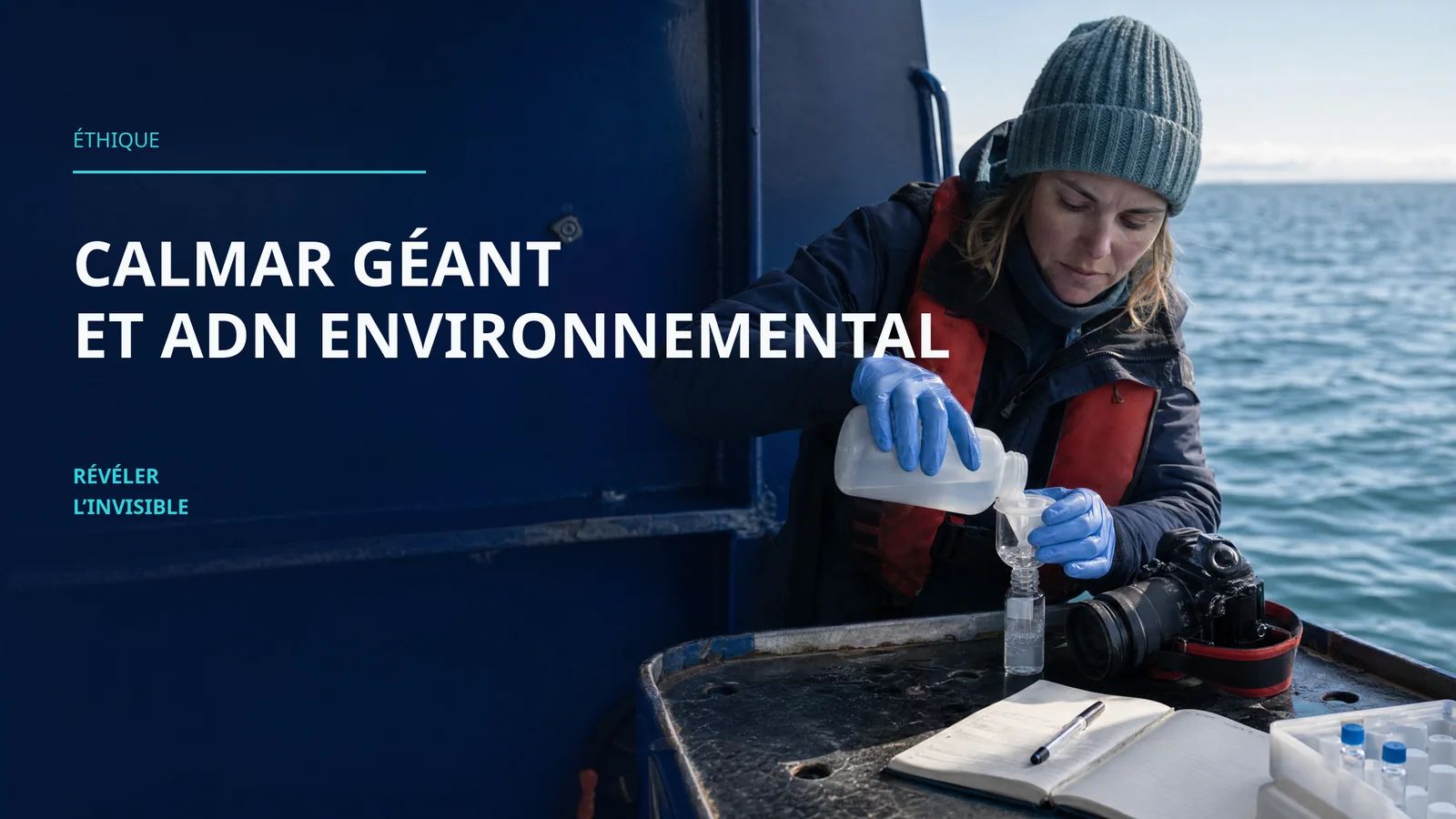
Off the northwest coast of Australia, where the continental shelf plunges into canyons that descend to over 4500 meters, a team of researchers posed a simple question. Not "What lives here?" but "Who has passed through here recently?". The difference between the two formulations is immense. The first requires seeing, filming, and capturing. The second simply asks for a little water.
And in this water, there was the trace of a giant squid.
The study, published in May 2026 in the journal Environmental DNA and led by researchers from Curtin University, explored the canyons of Cape Range and Cloates, in the Ningaloo region of Western Australia. The results go far beyond a single mythical creature. But it is Architeuthis dux that has captured attention. And for good reason. It is the first time its presence has been detected by environmental DNA in this part of the world.
For those of us who spend our time trying to photograph what lives underwater, this story deserves our attention. Not just for the octopus. For the method.
What they found in the canyons
Researchers collected 178 water samples at five different depths, up to 4540 meters. No camera, no submersible, no robot. Just Niskin bottles that can be closed at the desired depth and bring up one liter of seawater. One liter that contains thousands of DNA fragments.
The overall total: 226 species identified, distributed across 126 families. Among them, 83 represent new observations or extensions of their known geographical distribution. In other words, 83 species that were previously unknown to live there.
The giant squid was detected in six separate samples. Six different water samples, taken at different depths. This is not an ambiguous signal or a laboratory contamination. It is a confirmed presence. And it is the northernmost record ever recorded for Architeuthis dux in the eastern Indian Ocean.
But the octopus was not alone. A sleeping shark was identified at a location that extends its known distribution. The faceless eel (Typhlonus nasus), an animal that resembles what you would get if you asked a child to draw a fish and forget the head, was detected for the first time in Western Australia.
How does the environmental DNA work?
For divers who are reading this article (and I imagine that's the majority), the principle is both simple and a little daunting.
Each living organism constantly loses cells. Mucus, skin fragments, and microscopic excretions. This material dissolves in the water and persists for a few hours to a few days, depending on the temperature and currents. Collect a water sample, filter it, extract the DNA, and compare it to a reference database. And you will obtain a list of the species that have recently been in the area.
It's like reading the footprints on a dirt path, except that the path is the ocean, and the footprints are invisible to the naked eye.
This technique has its limitations. It does not indicate how many individuals are present, nor for how long. It does not indicate whether the animal is alive or dead (a dead animal also leaves behind DNA). And it depends entirely on the quality of the reference genetic databases. If a species has never been sequenced, its DNA remains an unnamed code.
But what she does, she does remarkably well: detecting the presence of species in areas where no human observer can ever routinely access.
226 species without a single photo
This is the figure that I find most striking in this study. 226 confirmed species, and not a single image. Not a single portrait. Just sequences of genetic data aligned in a table.
For someone who spends their life teaching underwater photography, there's something deeply humbling about it. We build watertight chambers, we perfect our white balance settings, and we descend to 40 meters with equipment that can sometimes cost more than a used car. And in the meantime, a liter of water taken at 4000 meters says more about the local biodiversity than all the dives in the world.
This is not a failure of photography. It is a repositioning. ADNe makes the inventory. The photo gives a face. The two complement each other. A Latin name on a list does not produce the same reaction as an image of a living animal in its environment. And the researchers know this. The species that receive attention (and funding for their protection) are almost always those that have images.
For taxonomy, the implications are staggering. If 83 species out of 226 were unknown in this area with only 178 water samples, how many discoveries await in the canyons that have never been sampled? According to the study authors, the answer is probably "much more than we have the resources to sequence".
What this means for us, underwater
Most divers will never descend to 4540 meters. Even the most daring ones are limited to a few dozen meters (and that's perfectly fine). However, the ADNe technique also works at a depth of 5 meters, in a Mediterranean cove or on a Red Sea reef.
Projects of participatory science are starting to use ADNe in shallow water. Recreational divers who collect water samples at the end of their dives, send them to a laboratory, and receive a list of the species detected on their site a few weeks later. This is a protocol that transforms each dive into a scientific contribution without touching anything.
For underwater photographers, the connection is direct. ADNe can reveal the presence of a rare species on a site. And this information directs the gaze. Knowing that a sleeping shark frequents a canyon is knowing where to point the camera. The invisible becomes photographable.
And then there's the ethical dimension. The ADNe doesn't disturb anyone. No flash, no contact, no stress for the animal. Just a water sample that leaves the environment intact. This may be the most respectful form of marine exploration ever invented.
Frequently Asked Questions
What is environmental DNA (eDNA)?
Environmental DNA is a biological detection technique that analyzes the genetic traces left by organisms in their environment (water, sediment, soil). A simple seawater sample can identify species that have recently been present, without the need to observe or capture them. This is the method used by Curtin University to detect the giant squid off the coast of Western Australia in May 2026.
How can a giant squid be detected without being seen?
Architeuthis dux, like all living organisms, constantly loses cells (mucus, skin, waste). These fragments of DNA are dispersed in the water and can be captured through filtration. In the Ningaloo study, the DNA of the giant squid was found in six distinct samples collected at different depths in the Cape Range and Cloates canyons, confirming its presence in an area where it had never been documented.
Can ADNe replace underwater photography for species identification?
No. Both approaches complement each other. ADNe excels in detection (knowing that a species is present) but does not provide images or information on the individual's behavior, size, or health status. Photography remains irreplaceable for visually documenting biodiversity, raising public awareness, and providing scientists with behavioral and morphological data that DNA alone cannot provide.
Can recreational divers contribute to research on ADNe?
Yes, and increasingly so. Citizen science programs allow divers to collect water samples at the end of their dive using simple equipment (sterile sampling kits). These samples are then analyzed in the laboratory. This is a way to contribute to the inventory of marine biodiversity without impacting the environment, compatible with any certification level.
Original French Text:
La composition est essentielle. Pensez à la règle des tiers, à la profondeur de champ et à la gestion de la lumière. Utilisez des accessoires tels que des stroboscopes ou des flashs pour améliorer la visibilité. N'oubliez pas d'utiliser des filtres rouges pour réduire les reflets sur la lentille. Un trépied peut également être utile pour stabiliser l'appareil.
The AquaExposure training teaches you how to photograph marine life with respect and method. Because giving a face to the species that science detects in the water is the role of the underwater photographer.