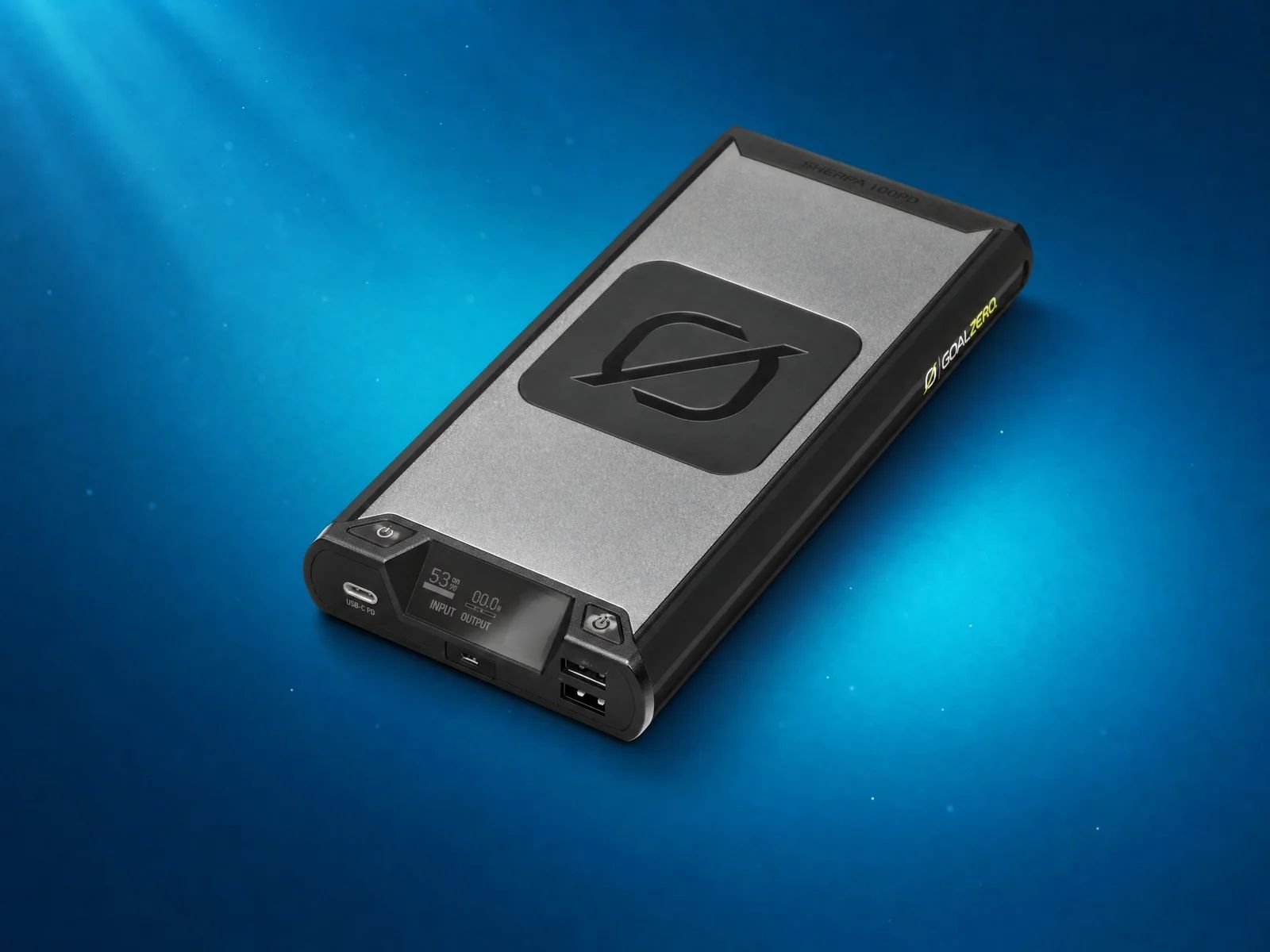

Discover our review of the Goal Zero Sherpa 100PD. This rugged and powerful 94.7 Wh battery is perfect for underwater photographers on the go.
To improve your mastery of your equipment and optimize your procedures while diving, discover our specialized training modules on AquaExposure training.
Between the residual moisture in a dive bag, the jolts of a transfer in a Zodiac boat, and the need to maintain a consistent workflow for processing your images, choosing an external battery quickly becomes a critical decision. For an underwater photographer, power is not just a matter of comfort, but a fundamental requirement to avoid missing any light or any encounter during the next dive. The fourth-generation Goal Zero Sherpa 100PD offers a robust and versatile solution to these field constraints [1].
When preparing for a long trip, regulations regarding lithium battery transport become a central consideration. The Sherpa 100PD has an energy capacity of 94.7 Wh, which is 25,600 mAh at 3.7 V. This strategic design places the device just below the 100 Wh limit set by IATA for transport in the cabin without prior authorization [3].We consider this capacity to be the ideal balance point, offering the maximum allowed reserve while facilitating safety checks. Please remember that transporting the battery in the cargo hold is strictly prohibited. The battery must travel with you. While the 100 Wh threshold is a global standard, each carrier may apply stricter restrictions or limit the number of units. Checking with your airline before departure remains essential [4].
In the field, the Sherpa 100PD acts as a true hub. Its USB-C Power Delivery port provides 100W of output, a power level sufficient to run a MacBook Pro or a high-performance PC while also processing your images. This responsiveness is invaluable during surface intervals, where charging time for equipment is limited.
Two 12W USB-A ports complement the system for accessories such as focus lights or dive computers. The major innovation is the integrated 15W Qi wireless charging surface on the top. Simply placing your smartphone on the aluminum casing is enough to restore its power, a convenient solution that reduces cable clutter on a workspace that is often limited.
For remote expeditions, integration with the Goal Zero solar ecosystem is a major advantage. The battery is compatible with Nomad solar panels. Using a suitable USB cable, it can be recharged by the sun, providing valuable power on the deck of a sailboat to ensure you can capture your next shots.
This model is designed for image creators who refuse to compromise between power and portability. If your workflow requires a laptop and hybrid cameras, the 100W output justifies the investment. It is ideal for traveling photographers on liveaboards where charging space is limited.
It also provides peace of mind thanks to its robustness and clear display. However, for needs limited to a smartphone or action camera, more compact options are available. The Sherpa 100PD remains a workstation dedicated to sustained daily production.
Although robust, the battery is not waterproof. It must be protected from splashes, especially using the dedicated protective cover to prevent short circuits. Finally, its operating temperature range is between 0 and 40 °C. Prolonged exposure to direct sunlight on a deck can trigger a thermal safety feature and interrupt the power supply to your devices.
When packing for a new destination, the reliability of the equipment takes precedence over all other considerations. The Goal Zero Sherpa 100PD is not just a power bank, it is a fundamental component of the underwater photographer's logistics. It provides the peace of mind needed to focus on the essential: capturing the moment beneath the surface.Its ability to power multiple devices simultaneously, its durability in the face of travel challenges, and its compatibility with solar charging make it a worthwhile investment for both professionals and demanding enthusiasts. By respecting its usage limits and anticipating power cable needs, it quickly becomes an essential piece of equipment. Once the technical aspects fade into the background, all that remains is to enjoy the light and silence of the depths.
<!-- PROPOSITIONS DE VISUELS : Premier visuel : La Goal Zero Sherpa 100PD posée sur une table en bois clair à côté d'un MacBook Pro et d'un boîtier photo hybride, avec l'écran LCD allumé indiquant une charge en cours. Ambiance lumineuse de fin de journée. Texte alternatif : Batterie Goal Zero Sherpa 100PD alimentant un ordinateur portable et un appareil photo sur une table de travail.
Second visuel : La batterie Sherpa 100PD reliée à un panneau solaire Goal Zero Nomad déplié sur le pont d'un bateau de plongée sous un soleil éclatant, avec la mer en arrière-plan. Texte alternatif : Recharge solaire de la batterie Goal Zero Sherpa 100PD sur le pont d'un bateau de plongée. -->
To compare this model with all available options on the market, consult our external battery power bank comparison tool as well as our complete selection of diving equipment.[1]: https://goalzero.com/products/new-sherpa-100pd-wireless-power-bank "Goal Zero Sherpa 100PD Product Page" [2]: https://cdn.shopify.com/s/files/1/0520/1156/5225/files/2022-05_Sherpa_100PD_User_Guide_CL050522V6_TR_WEB.pdf?v=1663099719 "Goal Zero Sherpa 100PD User Guide" [3]: https://www.iata.org/en/youandiata/travelers/batteries/ "IATA Passenger Standards - Lithium Batteries" [4]: https://www.faa.gov/hazmat/packsafe/lithium-batteries "FAA PackSafe - Lithium Batteries"
Here are some essential considerations for underwater photographers, especially when it comes to power. Underwater photography equipment, particularly cameras and strobes, consumes a significant amount of energy. Therefore, having a reliable power source is crucial.
* Power Banks: Power banks are a popular solution for extending battery life. The Goal Zero Sherpa 100PD [1] [2] is a good option, offering wireless charging and multiple USB ports. However, it's important to be aware of airline regulations regarding lithium batteries [3] [4]. Always check with your airline before including lithium batteries in your checked or carry-on luggage.
* Battery Management: Proper battery management is key. Always use high-quality batteries specifically designed for your equipment. Avoid using cheap or generic batteries, as they may not provide sufficient power or could be unreliable. Store batteries properly when not in use, keeping them in a cool, dry place.
* Charging Options: Consider the availability of charging options at your dive location. Some resorts or liveaboards may offer charging stations, but it's always a good idea to have a backup power source.
* Power Consumption: Be mindful of your equipment's power consumption. Turn off features you're not using, such as the LCD screen or video recording, to conserve battery life. Consider using a lower power setting for your strobes if possible.
* Benjamin Coste and AquaExposure offer excellent resources and workshops for underwater photographers. Their expertise can help you optimize your power management strategies.
With an energy output of 94.7 Wh, this battery falls below the general 100 Wh limit set by IATA. However, final acceptance depends on the rules of each carrier and local authorities. It is essential to transport it exclusively in carry-on baggage and to verify the specific conditions of your airline before departure.
Yes, the USB-C Power Delivery port on the Sherpa 100PD provides up to 100W of output. This power is sufficient to power and charge most modern laptops, including MacBook Pros, as well as power-hungry hybrid housings between dives.
The Sherpa 100PD is designed to seamlessly integrate with the Goal Zero ecosystem. It can be recharged using the Nomad solar panels in the Goal Zero range, using a compatible USB cable. This makes it a valuable solution for expeditions in remote areas or on boats with limited power.
Metalsub Inox Tech 1.5 mm Stainless Steel Reel with Stainless Snap - Review, Features, and Scuba Diving Opinions (2026)
Metalsub 1.5mm Dive Reel with Brass Snap Spool: Review, Features, and Scuba Diving Opinions (2026)
Mares XR Regular SMB Deco Buoy: Review, Visibility, and DSMB Parachute Opinions (2026)