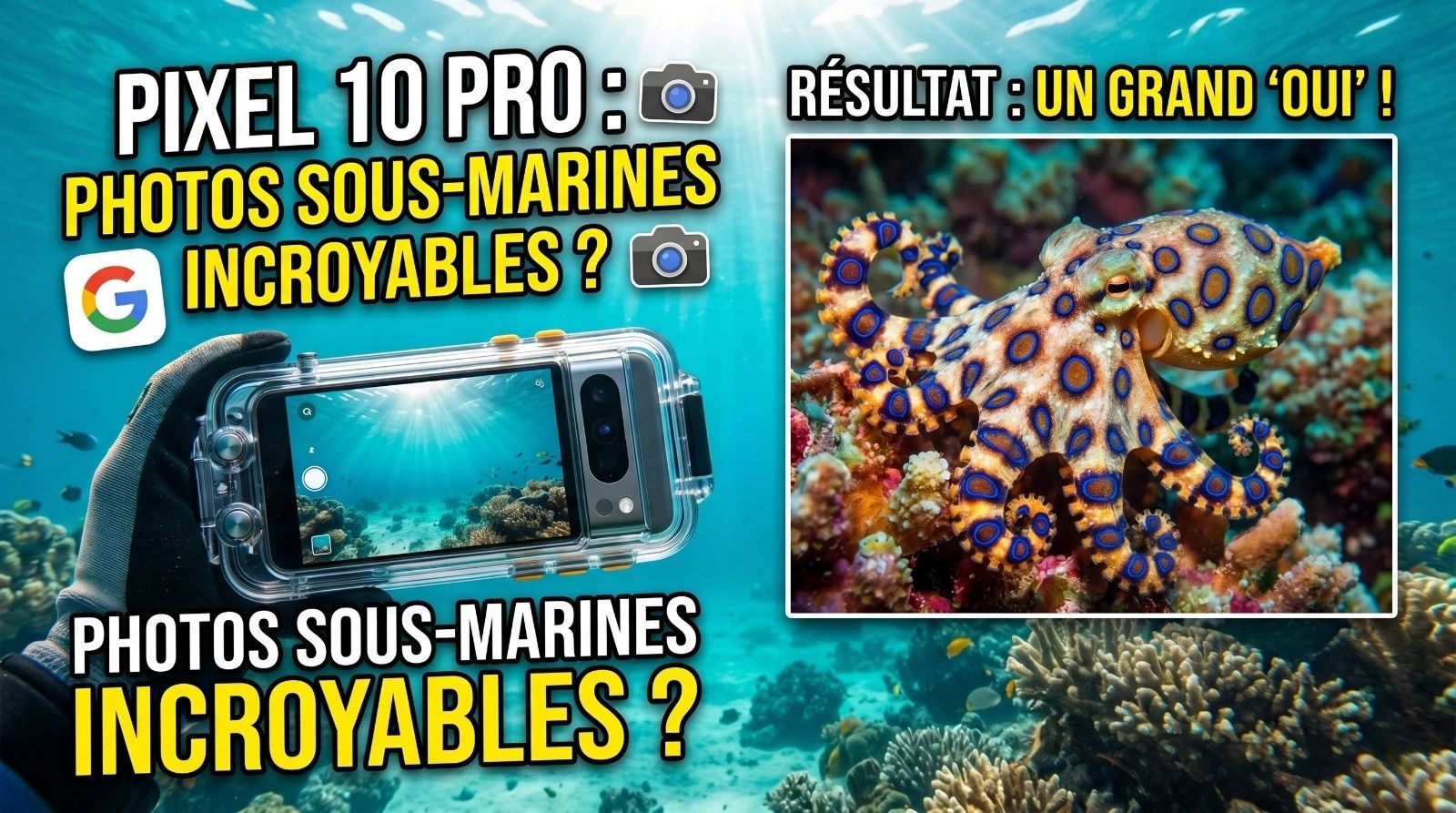
Does the Google Pixel 10 Pro have an underwater mode?
The Pixel 10 Pro does not have a dedicated "underwater mode" in the sense of a separate app like Samsung Ocean Mode. However, its white balance algorithm via Tensor G5, its Macro Focus (ultrawide autofocus down to a few centimetres from the subject) and Night Sight work very well underwater, without complex manual settings. The camera does the work, not a separate mode.
What is the purple reflection on photos taken with a Pixel 10 inside a housing?
The purple reflection appears when the Pixel 10's infrared sensor (face unlock, proximity sensor) reflects its light onto the housing's lens port. The fix is simple: before installing the phone in the housing, cover the infrared area (the upper bar on the back) with a small piece of opaque black tape. This does not affect the lens or photo quality.
Pixel 10 Pro or Samsung Galaxy S26 for underwater photography?
Both are excellent. The Samsung S26 with Ocean Mode offers more active colour correction and a more complete ecosystem in Europe. The Pixel 10 Pro has the advantage in macro (Macro Focus ultrawide with autofocus), stabilised video (Video Boost 8K), and a more "transparent" photography experience (the camera calculates, you compose). If macro and video matter, the Pixel. If you want a turnkey solution with Ocean Mode, the Samsung.
Can the Pixel 10 Pro be used in a DiveVolk housing?
Yes, with the right inner adapter. The DiveVolk SeaTouch 4 Max is compatible with the Pixel 10 Pro and Pro XL via the dedicated adapter. The touchscreen remains functional underwater, allowing access to all camera functions (Macro Focus, Night Sight, manual settings) down to 60 metres depth.
Where to learn to photograph underwater with a flagship smartphone?
The AquaExposure training covers underwater photography from smartphone to hybrid camera systems. Module 2 focuses on equipment selection and settings for your gear.
There is something paradoxical about Google's approach to underwater photography. Other manufacturers - Samsung, OPPO - chose to name their solutions, to package them in a dedicated mode with a commercial label. Google took the opposite path: don't name it, don't package it, just make the camera smart enough to work naturally underwater as it does on land. That is either the most humble strategy on the market, or the most confident. After looking at the Pixel 10 Pro results underwater, I lean toward the second option.
What the Pixel 10 Pro actually changes for underwater photography
No underwater mode in settings. What you get instead is a triple sensor system where each lens contributes something useful underwater, all processed by the Tensor G5 chip that handles images faster than any classic colour correction algorithm.
The main sensor is 50MP at F/1.68, on a 1/1.3" sensor. Large aperture combined with a large sensor means better light capture in the low-light zones that define most dives. The signal is there before any processing begins.
The ultrawide runs at 48MP, F/1.7, with autofocus. This is where the Pixel truly separates itself from competitors for underwater use. Macro Focus on this ultrawide allows very close focus - on subjects just centimetres from the housing port. A nudibranch, the fine detail of a gorgonian, coral textures. Everything other smartphones miss for lack of ultrawide autofocus, the Pixel 10 Pro photographs.
The telephoto sits at 48MP, F/2.8, with 5x optical zoom and Pro Zoom reaching up to 100x. You will not use 100x underwater. But 5x optical allows photographing a wary fish from a respectful distance, without disturbing the animal to close the gap.
Tensor G5 - the invisible difference
Spec sheets never convey processing speed well. And underwater, that speed changes everything. Marine subjects move. Light shifts in seconds. A school of fish passes and disappears. In this environment, a phone that focuses in 200ms rather than 600ms produces radically different images from one that lags.
Tensor G5 runs Night Sight (low-light exposure), multi-zone LDAF autofocus across all three sensors, and the video stabilisation that lets the Pixel 10 Pro film readable sequences even when current is moving everything. Not a figure on a spec sheet. It is what you feel when watching the videos back after the dive.
Video - 8K, Video Boost, Night Sight Video
8K video at 24 and 30fps via Video Boost is not a marketing number. It gives you considerable reframing latitude in post-production: you can pull a 4K shot by reframing freely within the image, with no quality loss. For educational sequences, diving documentaries, or simply choosing the right frame after the fact, this is a real working tool.
4K at 60fps with Fused Stabilisation handles the tremors caused by currents or fin movements without artefacts. Night Sight Video is particularly useful for deep dives or wreck shadow zones. The algorithm maintains readable exposure where other phones produce noise or motion blur.
The Super Actua screen, reaching 3300 nits peak brightness, lets you read the actual image in the housing even when surface sun is raking across the water. This detail - being able to read the screen underwater - matters more than it seems when you are actually composing a shot at depth.
The purple reflection - the one thing to know
The Pixel 10 Pro, like most modern smartphones, carries an infrared sensor on the upper back bar. This sensor handles Face Unlock and the proximity sensor. Inside a closed housing, the infrared light from this sensor can reflect off the port glass and be captured by the main lens as a purple dot or cast.
The fix is simple and definitive. Before installing the phone in the housing, cover the infrared area with a small piece of opaque black tape. Face Unlock will not work during the dive. Nobody needs that at 20 metres. The lens, exposure, and focus are not affected. Test at the surface before entering the water.
Pixel 10 Pro vs competitors underwater
vs Galaxy S26 Ultra: the Pixel is stronger on macro (the ultrawide autofocus has no direct Samsung equivalent) and stabilised video (Video Boost). Samsung wins with Ocean Mode - more marked automatic colour correction - and a more complete European ecosystem for accessories and housing compatibility.
vs OPPO Find X9 Pro: the Pixel has the advantage in European availability and a simpler workflow. OPPO has the advantage with Hasselblad colour science, which often produces superior colour fidelity in complex lighting at depth.
vs iPhone 17 Pro: both are close in video quality. iPhone wins on ProRes and ProRAW for professional post-production workflows. The Pixel is more direct to use, without the learning curve that comes with mastering ProRAW.
vs Olympus TG-7: the TG-7 is natively waterproof to 15m, has a unique microscope mode, and needs no housing for snorkelling. The Pixel 10 Pro surpasses it in image quality in natural light and stabilised video. These are different tools, not different levels of the same use.
In a DiveVolk housing - the complete system
IP68 certification follows the same rules as for all other comparison smartphones: fresh water, laboratory conditions, limited time. For real sea diving with pressure and salt, a housing is essential.
The DiveVolk SeaTouch 4 Max with the Pixel 10 Pro adapter protects to 60 metres. The touchscreen stays functional underwater, meaning full camera access - sensor choice, Macro Focus, Night Sight, zoom, manual settings. A real advantage over button housings that expose only a fraction of camera functions.
One thing to do before the first dive in this setup: test for the purple reflection (see above), check the seal, run a surface test. The basics - but worth repeating every time.
For the diver who appreciates a camera that works for them rather than demanding configuration at every dive. The Pixel's strength is precisely that: the capture mechanics are good enough that attention stays on the subject, not the settings.
For the video content creator who wants stabilised, readable, and reframeable underwater video without spending an hour in post-production. Video Boost 8K with Fused Stabilisation is the most complete combination available on the smartphone market for this workflow.
And for the diving photographer working with macro subjects. The ultrawide autofocus with Macro Focus is the function missing from every other flagship smartphone when it comes to small subjects close to the port.
The sea stays the same whatever the phone. What the Pixel 10 Pro changes is that you come back to the surface with less waste: fewer missed focus shots, fewer underexposed images, fewer unusable sequences. Not because the phone does magic. Because it does correctly what it is supposed to do.