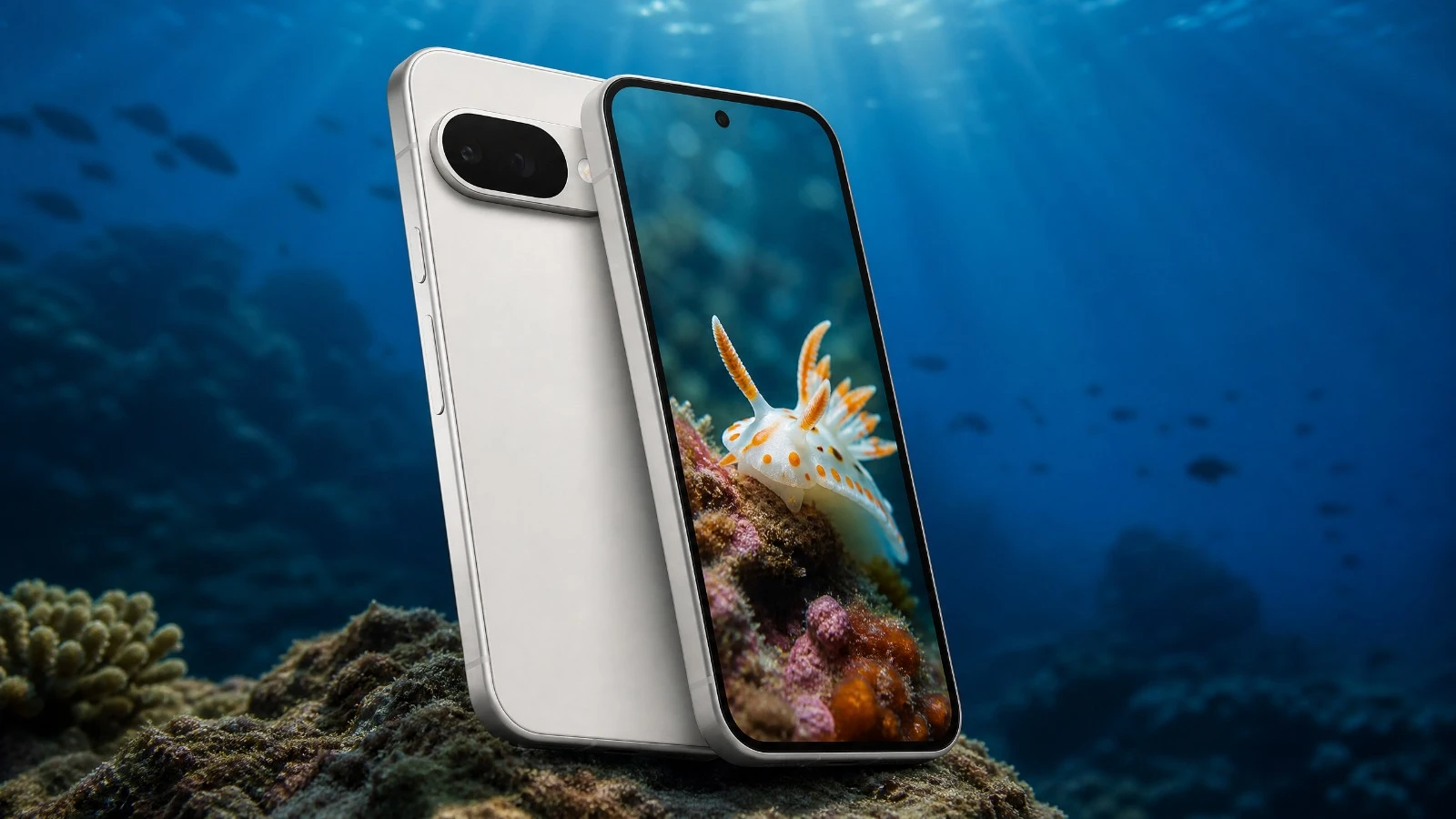
Is the Google Pixel 9 good for underwater photography? Full test, B1-B7 rating, compatible housing, and price in July 2026.
To learn how to get the most out of your gear underwater, discover the AquaExposure Training. schema: type: Article speakable: true ---
Introduction
In 2024, Google launched the Pixel 9 at a starting price of over €700. In July 2026, the same device is available refurbished for around €440, and even new for under €400 on some comparison websites.
For a diver looking for a smartphone that performs well in natural light underwater, this is an interesting option.
The question isn't "is it better than the Pixel 9 Pro?" - the answer is no, the Pro has the telephoto lens. The real question is: for the price asked in 2026, does the base Pixel 9 offer a compelling value/quality ratio for underwater photography?
This is what this test aims to determine, following our comparison chart for smartphone cameras used underwater.
Summary of Findings
| Criterion | Weight | Score |
|---|---|---|
| B1 Optics | 20% | 3.5/5 |
| B2 RAW and colorimetry | 25% | 3.8/5 |
| B3 Storage | 15% | 3.5/5 |
| B4 Thermal performance | 15% | 3.5/5 |
| B5 Battery | 10% | 3.5/5 |
| B6 Autofocus | 10% | 3.5/5 |
| B7 Waterproofing | 5% | 3.0/5 |
| Overall score | 3.6/5 |
Designed for: - Recreational divers who want a well-optimized camera without paying the Pro price. - Wide-angle natural light photography (no need for a telephoto lens in this case). - Purchasing refurbished or bundled units with a Divevolk.
Not ideal for: - Remote macro photography (no telephoto lens, only ultrawide macro) - Budget-conscious buyers comparing it to the Samsung Galaxy A56 or the Motorola Edge 60 Fusion - Divers who want a native Log video workflow.
B1 - Optics (20%): 3.5/5
The base Pixel 9 features two sensors. The main sensor is a 50 MP wide-angle lens with a 1/1.31-inch sensor and an f/1.7 aperture, optically stabilized. This is a very good sensor for an entry-level Pixel model.
The ultra-wide angle lens features a 1/2.55-inch sensor with 48 MP and an f/1.7 aperture, also offering a macro mode usable at approximately 1.5 cm. Underwater, this ultra-wide angle macro mode can be useful for subjects at close range.
The only real drawback of this lens is the lack of a telephoto zoom. For a diver who works exclusively with natural light and at reasonable distances, this is an acceptable compromise.
The 1/1.31" sensor of the main wide-angle lens is identical to that of the Pixel 9 Pro in this regard. It has the same light-gathering surface area. What changes with the Pro is the addition of the telephoto lens, not the quality of the wide-angle lens.
B2 - RAW format and colorimetry (25%): 3.8/5
B2a - Native RAW: 4/5
The Pixel 9 offers a 10-bit DNG RAW format that can be enabled directly within the official camera application. This is a compressed, multi-frame computational RAW, not a pure sensor RAW. The distinction is important for technically advanced photographers.
The product file is usable in Lightroom or Darktable, with good latitude for recovering highlights. Google's ZSL (Zero Shutter Lag) pipeline shows its limitations after approximately 15 to 20 rapid consecutive RAW shots, as the processing time creates a buffer.
With a Divevolk touch-screen enclosure underwater, the native RAW format is accessible without any limitations. Activation occurs before diving within the camera app settings.
B2B - MotionCam Pro (Android GMS): 4.5/5
This is one of the key advantages of the Pixel 9 in an underwater environment. Because it runs on Android with Google Mobile Services (GMS), MotionCam Pro works natively. This app produces video RAW files that can be used with complete manual control over exposure.
For underwater photography using natural light, this is an option that iPhones and Android devices without Google Mobile Services (GMS) simply cannot replicate.
MotionCam Pro on the Pixel 9 with Divevolk SeaTouch: all touch controls remain accessible through the gel membrane. This is the cleanest workflow available on a mid-range Android smartphone in 2026.
B2c - Color processing for Tensor G4: 3/5
The Pixel's color science is entirely based on Google's computational photography. There are no optical partnerships (no Leica or Zeiss). The default rendering often looks pleasing in normal conditions, but it can be difficult to control when trying to preserve the natural palette of underwater blues and greens.
The manual white balance setting in Kelvin is not available in the native app. You need to use either Blackmagic Camera or MotionCam Pro to access this control.
Under water, Google's automatic processing tends to oversaturate the image. To work with natural light and achieve accurate colors, using RAW format or an app like MotionCam Pro is essential from the very first dive.
B3 - Storage (15%): 3.5/5
The Pixel 9 is available in 128GB and 256GB versions. On the 128GB version, approximately 110GB of storage remains free after installing the operating system.
The internal storage uses the UFS 3.1 standard, with read speeds of around 1,000 to 1,200 MB/s and write speeds of around 500 to 700 MB/s. This is acceptable for 2024, but slightly behind the Pro models which offer UFS 4.0.
There is no microSD card slot. The USB-C 3.2 connector allows for fast transfers to a computer or external SSD between dives.
For a day of intensive RAW photography, the 256GB version is recommended. DNG files from the Pixel 9 weigh between 20 and 35 MB depending on the scene and shooting mode.
B4 - Thermal (15%): 3.5/5
The Pixel 9 introduces a vapor chamber, which was absent in the Pixel 8. This is a significant improvement for extended shooting sessions, especially when recording video.
The aluminum frame with a Gorilla Glass Victus 2 back dissipates heat reasonably well. In an underwater housing, thermal dissipation is naturally favored by the water temperature.
The Tensor G4 chip runs hotter than competing Snapdragon chips under heavy load. This isn't a showstopper for photography, but it can slow down burst processing of RAW files during extended shooting sessions.
[WARNING] Silica gel: mandatory in cold water environments. The Pixel 9 shares the same aluminum profile + vapor chamber as the Pixel 10. Condensation is possible below 15°C without a silica gel protocol. A packet inside the housing before each use in cold water is essential.
Tropical overheating: Despite the recognized heating of the Tensor G4, the lack of a very demanding video codec limits the temperature increase during photo use. Software overheating occurs after approximately 30 minutes of continuous shooting in water at 28°C. This is acceptable for standard underwater clips.
In cold water (below 15°C), the thermal aspect becomes secondary. The enclosure provides protection, and the water passively cools it. It is on the surface, between dives, that the Tensor G4 may show its limitations during data import and processing.
B5 - Battery (10%): 3.5/5
The battery has a capacity of 4,700 mAh and is designed to retain 80% of its capacity after 1,000 charging cycles. This is an excellent documented lifespan.
Under heavy photographic use (RAW format, screen on, GPS enabled), a full day of battery life remains achievable. In very cold temperatures (below 10°C), a sudden drop in the displayed percentage is possible – this is typical behavior for lithium-ion batteries.
The Pixel 9 doesn't offer particularly fast charging compared to some Android competitors, but the battery capacity makes up for it.
Ensure a full charge the day before each session. If the dive lasts longer than 4 hours with continuous use, an external battery for the surface interval is a reasonable precaution.
Before each diving session, remember to check your external battery. Use our portable battery comparator tool to choose the right power bank for your dive equipment and desired battery life.
B6 - Autofocus (10%): 3.5/5
The AF system combines a Dual Pixel PDAF and a laser AF sensor. Subject tracking using AI is one of the strengths recognized in the Pixel: it effectively locks onto subjects with high contrast.
The shutter lag measured by DxOMark is less than 70ms thanks to the Zero Shutter Lag feature. In practice, the shutter responds very quickly.
The limitations in an underwater environment are well known: Google's autofocus system struggles with faces and strong contrasts. In water filled with particles, backscatter (illuminated particles) can interfere with the autofocus. Manually locking the focus before taking a picture remains essential.
The Focus Peaking feature is not available in the native app. You need to use Blackmagic Camera to access this focusing aid, which is useful when shooting in slightly murky water.
B7 - Box (5%): 3.0/5
There is no dedicated housing available for the Google Pixel 9 from any specialized underwater equipment manufacturer (no Ikelite, no Nauticam, no specific SeaFrogs product).
The chosen solution is the universal touchscreen enclosure: the Divevolk SeaTouch 4 Max Plus with the internal DAF303 adapter (specifically designed for the Pixel 9 and Pixel 9 Pro). The enclosure is certified to 60 meters, and the capacitive gel membrane transmits touch commands without restriction. MotionCam Pro and Blackmagic cameras function fully within it.
The Weefine WFH07 is an alternative for depths up to 80 meters, but it uses its own proprietary software via Bluetooth, which blocks third-party applications.
When purchasing the Divevolk enclosure, make sure that the DAF303 adapter is included or ordered separately. The Pixel 9 sometimes requires internal alignment adjustments. Be sure to address this before your first dive.
What you need to know before buying.
The Enclosure
The Divevolk SeaTouch 4 Max Plus remains the benchmark for this smartphone format in 2026. Compatible with other models in the Pixel range and popular alternatives, it represents an investment of around €300 to €350, which sometimes exceeds the price of the device itself when purchased used.
This is the economic reality of underwater smartphones: the waterproof casing often has more value than the phone itself.
The Post-Dive Workflow
The DNG files from the Pixel 9 can be imported directly into Lightroom (desktop or mobile) and Darktable. The color profile applied by Google in its computational raw processing may require adjustments to the demosaicing process within Lightroom.
For MotionCam Pro files (RAW video), processing is done in the dedicated app, or the footage can be exported as individual DNG frames for more granular processing.
Current Prices (July 2026)
New: - Starting from €390 (128 GB) through comparison websites (Idealo.fr, July 2026) - Estimated retail price at the Google Store in France upon launch in 2024: approximately €799.
Refurbished: - Back Market France (July 2026): starting from €439 (perfect condition) / €444 (very good condition) / €500 (good) - 12-month warranty - Idealo.fr - used: starting from €320 (July 2026)
Sources consulted on July 1, 2026: [idealo.fr](/en/blog/backmarket.fr, Google's computational color processing which requires adjustments, and the absence of a dedicated waterproof housing, forcing users to rely on a universal solution.
In July 2026, with refurbished prices around €440, the Pixel 9 enters a category where it's hard to ignore for a photography enthusiast who wants a high-performing Android smartphone without spending the price of a "Pro" model released in the same year.
It doesn't replace a dedicated underwater device. But for those who want to get started seriously or complement an existing setup, it does the job.
Compare this device with others.
Are you hesitant? Use our underwater photography equipment comparison tool to compare this camera with other tested models.
To learn more about condensation and overheating, read our dedicated article: Overheating and condensation on smartphones in underwater housings.
Learn underwater photography.
The quality of the smartphone only goes so far. Natural light underwater has its own rules: angles of incidence, absorption of wavelengths, and real-time interpretation of conditions.
These techniques can be learned. And they transform any device, even a Pixel 9, into a serious creative tool.
Discover the underwater photography course using natural light on aquaexposure.com
Share
Table of Contents
- 01Introduction
- 02Summary of Findings
- 03B1 - Optics (20%): 3.5/5
- 04B2 - RAW format and colorimetry (25%): 3.8/5
- 05B2a - Native RAW: 4/5
- 06B2B - MotionCam Pro (Android GMS): 4.5/5
- 07B2c - Color processing for Tensor G4: 3/5
- 08B3 - Storage (15%): 3.5/5
- 09B4 - Thermal (15%): 3.5/5
- 10B5 - Battery (10%): 3.5/5
- 11B6 - Autofocus (10%): 3.5/5
- 12B7 - Box (5%): 3.0/5
- 13What you need to know before buying.
- 14The Enclosure
- 15The Post-Dive Workflow
- 16Current Prices (July 2026)
- 17Compare this device with others.
- 18Learn underwater photography.
Questions about the Journal
Can I use the photographs from this journal?
All images are protected by copyright. For any commercial or editorial use, please contact us via our form.
How can I be notified of new articles?
Follow us on social media or join the Sentinels Circle to receive our immersion stories before anyone else.
Do you offer hands-on workshops?
Yes, we organize masterclasses and field expeditions for members of our school. Check the Training page for details.