All images are protected by copyright. For any commercial or editorial use, please contact us via our form.
How can I be notified of new articles?
Follow us on social media or join the Sentinels Circle to receive our immersion stories before anyone else.
Do you offer hands-on workshops?
Yes, we organize masterclasses and field expeditions for members of our school. Check the Training page for details.
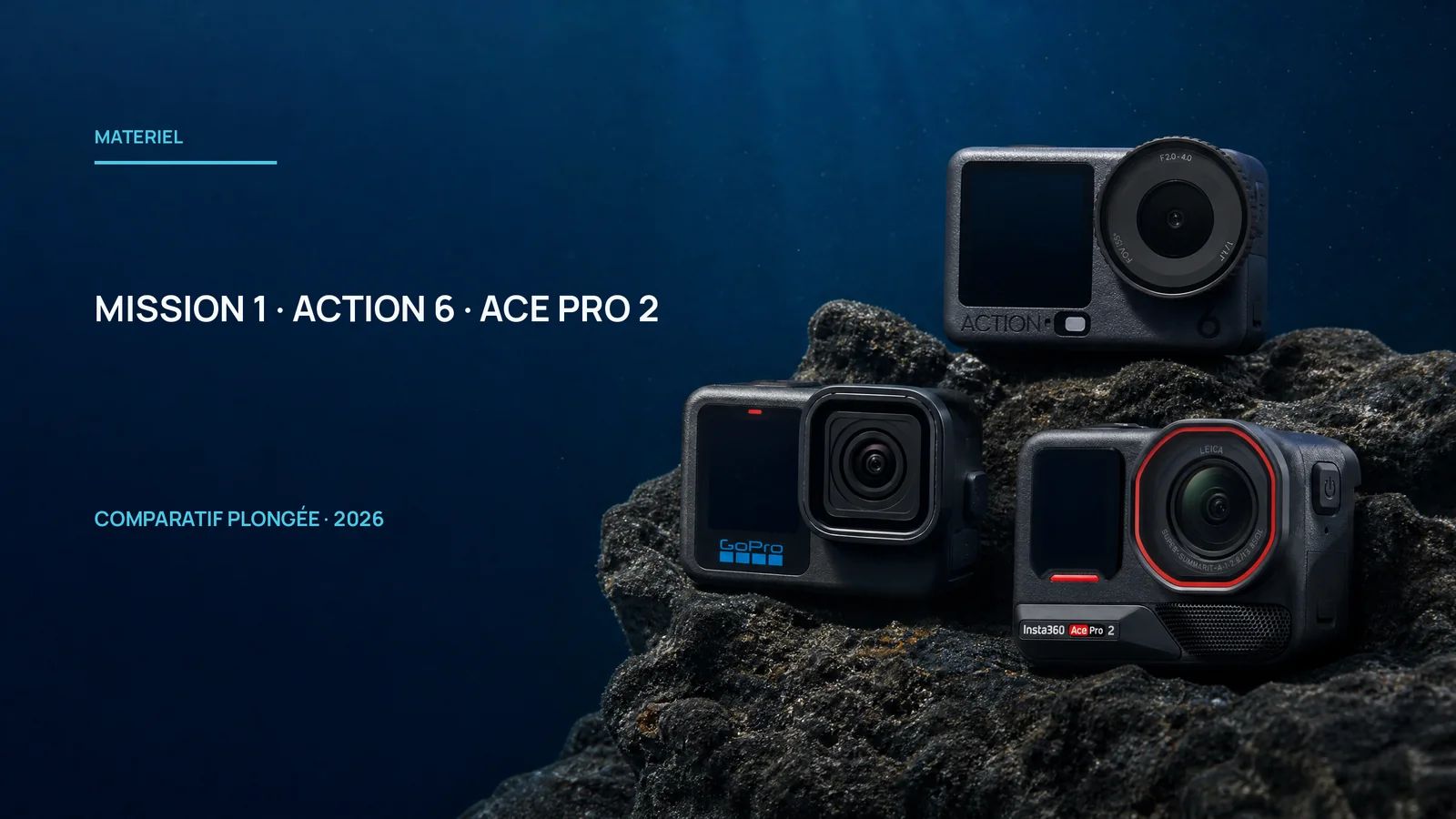
GoPro Mission 1 vs. DJI Osmo Action 6 vs. Insta360 Ace Pro 2: The 2026 Underwater Camera Comparison.
Since the Insta360 X6 was released this month, a question keeps coming up: "X6 or Mission 1?" The short answer is that the question doesn't really make sense. The X6 is a 360-degree camera designed to capture an entire environment without framing during the dive. This comparison focuses on the three front-facing action cameras that are actually competing for the diving market: the GoPro Mission 1, the DJI Osmo Action 6, and the Insta360 Ace Pro 2.
Three different philosophies, prices ranging from €350 to €600, and use cases that don't always align as well as one might think.
Only one figure in this table requires immediate explanation: the minimum focal length of the GoPro Mission 1.
The GoPro Mission 1: A sensor that impresses, a limitation that surprises.
Let's start with what's impressive. The 1-inch sensor in the Mission 1 is the largest of the three. When diving, a larger sensor captures more light with depth, which results in less noisy images in challenging conditions. The GP3, GoPro's in-house processor, adds 14 stops of dynamic range and a Dive mode (which activates automatically when entering water) that adjusts color profiles and white balance in real time.
Add 8K resolution at 60 frames per second, a waterproof housing rated to 20 meters, and you have a camera that, on paper, is the most powerful of its kind.
The problem is the minimum focus distance, which is approximately 60 centimeters. On an action camera, this is a significant limitation. For underwater macro photography, such as nudibranchs, small crustaceans, and organisms on the seabed: for everything that lives less than half a meter away, the Mission 1 produces a blurry image without an additional lens. For a diver who primarily photographs large subjects or reefscapes, this limit is secondary. However, for someone doing macro photography or wreck diving with close-up subjects, it's a dealbreaker.
The DJI Osmo Action 6: Technology that simplifies life.
The Action 6 did something clever that no one had really managed to do before: it integrated a dedicated color temperature sensor that adjusts the white balance in real-time underwater. In clear tropical water, the result is impressive. In green or murky water, the limitations become apparent, but the starting point is still better than a camera without correction.
The variable aperture of f/2.0 to f/4.0 is another practical advantage. In shallow water with sunlight, f/4.0 provides sharpness across the entire field of view. In a dark shipwreck or during deep dives, f/2.0 captures the maximum available light. This level of exposure flexibility was not found on action cameras before this model.
The square sensor, with a size of 1/1.1 inch, adds flexibility to the mounting process: by filming in a square format, you can reframe it to 16:9, 4:3, or 9:16 without losing resolution, which is a real advantage for producing multi-format content from a single camera output.
A point of attention noted on the forums: at least one case of flooding in the native housing of the Action 6 camera has been reported. This is not specific to DJI (it happens with all manufacturers), but it serves as a reminder that systematically checking the seals before each dive is not optional, regardless of the brand.
The Insta360 Ace Pro 2: A versatile option at €350.
The Ace Pro 2 is the camera in this comparison that we tend to underestimate because it costs less than the other two. This would be a mistake. The 1/1.3-inch sensor, combined with the Leica optics, produces sharp and contrasty images in most recreational diving conditions. The native waterproofing reaches 12 meters (IPX8), which is sufficient for snorkeling and shallow dives, but the dedicated housing extends this to 60 meters for standard recreational diving.
The AI color correction works well in clear and shallow water. Beyond 10 meters or in murky water, manual white balance at 5000K remains more accurate. This is not a criticism of the Ace Pro 2, it's simply the reality of automatic color correction underwater, regardless of the camera.
The 4K at 120 frames per second is perfect for creating usable slow-motion footage of marine subjects in motion. And for 250 euros less than the Mission 1, it's the option that offers the best value for on-location performance for many divers.
The Verdict by Profile
You primarily shoot macro or similar subjects: Mission 1 eliminated due to its focus. Choose between the Ace Pro 2 or the Action 6, depending on your priority between price and automatic color correction.
If you're looking for the best raw image quality in challenging conditions (low light, depth of field): The Mission 1 is the clear choice, provided its price and limited focusing capabilities don't pose a problem for you.
You hate color post-processing: Action 6 is the top choice. Its color temperature sensor is the most advanced solution among those listed, allowing you to produce images directly usable without further processing.
You have a tight budget and want a camera that covers 90% of situations: The Ace Pro 2. The €250 you save can easily pay for one or two training modules that will improve your images more than any sensor upgrade could.
You are documenting training sessions or producing multi-format social media content: Action 6 for the flexibility of the square sensor and color correction, or Ace Pro 2 for its price/performance ratio. Mission 1 is here overspecified.
Frequently Asked Questions (FAQ)
Why isn't the Insta360 X6 included in this comparison?
The X6 is a 360-degree camera. It doesn't directly compete with these three front-facing action cameras. Comparing an X6 to a Mission 1 is like comparing two tools designed for fundamentally different uses. The X6 captures the entire environment without framing, while standard action cameras allow you to compose a specific subject. Choosing between the two is primarily about choosing your intention.
Which of these three is best for underwater photography?
For large subjects in low light or at a distance, use Mission 1. For close-up shots or macro photography, use Ace Pro 2 or Action 6. To minimize color correction in post-production, use Action 6. There is no single "best" camera, the best camera is the one that suits your specific needs.
Is the Insta360 Ace Pro 2 sufficient for professional diving?
Yes, in most cases. It produces high-quality images suitable for training materials, social media, and on-site reporting. The Mission 1 has an advantage in low-light conditions, but the difference doesn't always justify the extra 250 euros.
Are you still hesitating between these three cameras? Our underwater photography and videography training course helps you choose the right tool for your needs and learn how to get the best results in real-world conditions.