Is the GoPro Mission 1 waterproof without a housing?
GoPro has not yet confirmed the exact native depth rating of the Mission 1 for diving. For snorkelling and shallow immersions, it should work without additional protection. For recreational diving beyond 10 metres, a third-party housing (AOI, Seafrogs, Ikelite) will likely be necessary.
How does the 1-inch sensor improve underwater photos?
A larger sensor captures more light, which reduces digital noise in dark areas and improves colour reproduction at depth. Between 15 and 30 metres, where older GoPros produced uniformly blue images, the 1-inch sensor should retain far more usable detail and colour nuance.
What is the difference between the Mission 1 and Mission 1 Pro for diving?
The Mission 1 (430 euros) offers the 1-inch sensor and the improved underwater mode, more than enough for filming in 4K underwater. The Pro (610 euros) adds 8K60, a low-light mode in 4K60, and a Log profile for post-production colour grading. The Pro is aimed at content creators who want maximum flexibility.
Does the GoPro Mission 1 replace a compact camera with a housing?
For video, the 1-inch sensor closes much of the gap with compact cameras. For still photography, a compact still offers more control over exposure and focus. If you mainly shoot video, the Mission 1 becomes very competitive against a compact plus housing, for a much smaller footprint.
When is the interchangeable lens version coming out?
The Mission 1 Pro ILS (Interchangeable Lens System) is expected in the third quarter of 2026. It will allow switching from wide-angle to macro without changing cameras, which could transform how action cams are used for underwater macro photography.
GoPro Mission 1 underwater: complete guide before launch
There are ads that make you raise an eyebrow, and others that make you pause to check if you've read correctly. The GoPro ad definitely belongs to the second category. With the Mission 1, the Californian brand not only releases a new action camera - it changes category, and underwater photographers like us have a lot to be very interested in.
Now that pre-orders are open and the first deliveries begin on May 28th, here's what you need to know.
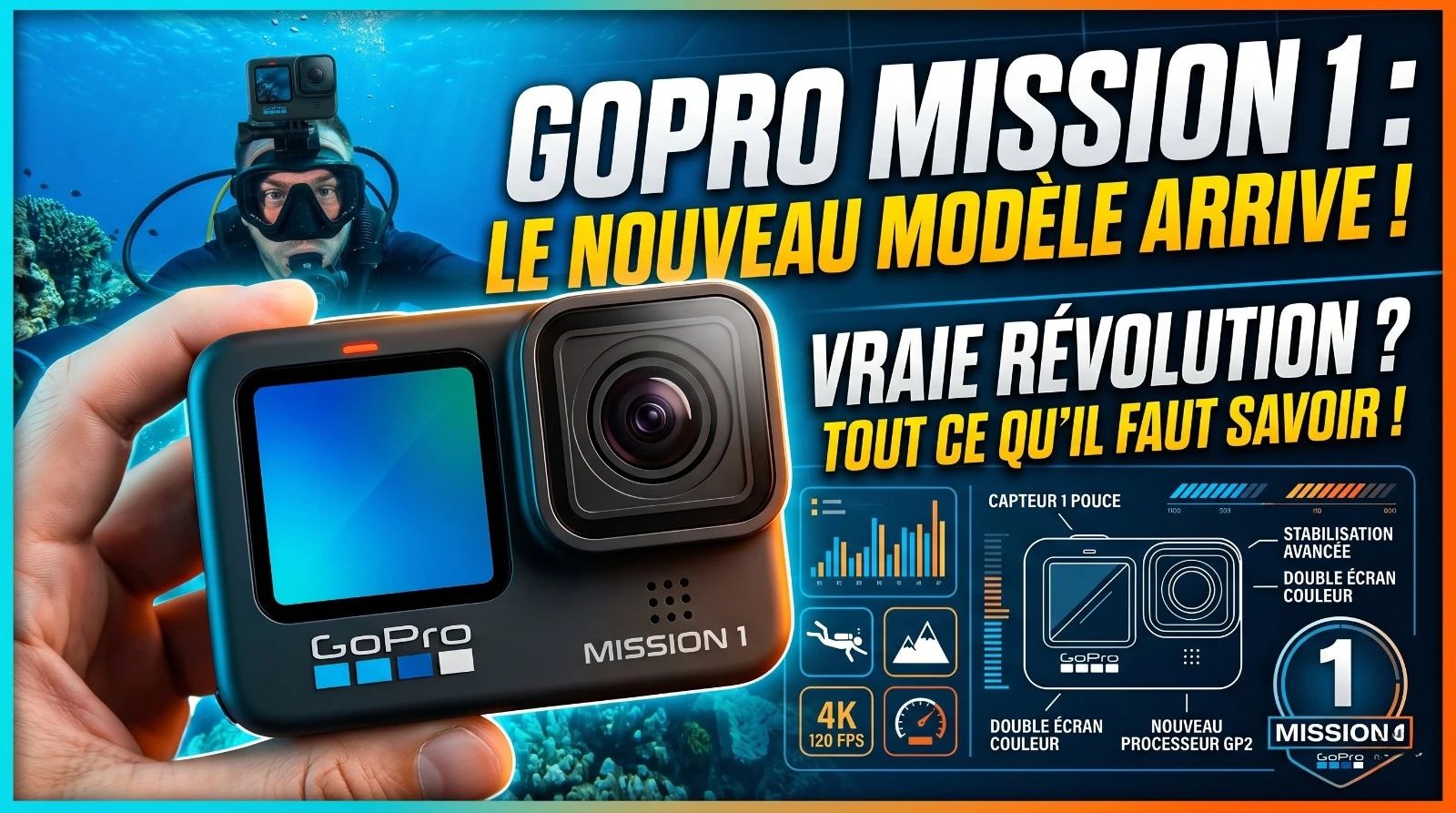
A 1-inch sensor that's changing the game underwater
The fundamental difference between the Mission 1 and everything else GoPro has produced so far lies in its sensor. One inch. For those accustomed to the tiny sensors of action cameras, it's like going from a flashlight to a dive light.
In practice, this means more light captured, less noise in dark areas, and a color dynamic that should finally do justice to the deep blues and subtle nuances found between 15 and 30 meters. Where older GoPro cameras turned everything into a blue sludge beyond 10 meters, the 1-inch sensor promises to retain detail where it matters.
The Mission 1 Pro takes things even further with 8K resolution at 60 frames per second. For underwater video, this combination offers a significant amount of cropping in post-production, which is particularly valuable when filming an unpredictable subject (and underwater, they all are).
Two models, two approaches
GoPro offers two versions at launch, and a third one later.
The Mission 1 to 430 euros (for GoPro subscribers, 520 euros without subscription) represents the entry-level of the new generation. It features the 1-inch sensor, the new improved underwater mode, and the updated stabilization. For most divers who film in 4K, it is probably the best value for money on the market.
The Mission 1 Pro at €610 adds the 8K60, a dedicated low-light mode that works in 4K60, and Log for those who perform color grading in post-production. It's the option for underwater content creators who want maximum flexibility without switching to an underwater housing for their mirrorless camera.
The Mission 1 Pro ILS (Interchangeable Lens System) will arrive in Q3 2026. Interchangeable lenses on an action camera – this is unprecedented, and for underwater photographers, the ability to switch from a wide-angle to a macro lens without changing cameras could be a game-changer.
Improved Underwater Mode
GoPro has specifically worked on underwater rendering for this generation. The new mode includes a color temperature correction adapted to depth, improved white balance management in both blue and green water, and noise processing optimized for the low-light conditions commonly encountered during diving.
It will be necessary to wait for the first feedback in real conditions to assess the effectiveness of these improvements. But on paper, this is the first time that GoPro treats underwater mode as a priority of development rather than as a secondary feature.
Dates, availability and confirmed waterproofness
Pre-orders are open from May 21, 2026. Worldwide shipping begins on May 28. Accessories will arrive gradually between May and the third quarter of 2026.
Good news for divers: GoPro has confirmed a native 20-meter waterproof rating without a housing for the Mission 1 and Mission 1 Pro. This is sufficient for most shallow recreational dives and snorkeling. To go deeper, the official Protective Housing extends the depth to 60 meters for €50, a reasonable price that makes the complete system accessible.
Third-party manufacturers (Seafrogs, AOI, Ikelite) should announce their own housings in the coming weeks, potentially with options for ports for macro photography.
What it means for underwater photographers
Mission 1 likely represents the most significant generational shift we've seen in underwater action cameras. The 1-inch sensor bridges the gap between action cameras and serious compacts, and for many divers, it could make investing in a compact + housing difficult to justify.
The question that every underwater photographer asks remains: does the theory hold true at 25 meters of water, with current, turbidity, and a nudibranch that refuses to cooperate?
We will be following this closely once the first units are in the water. In the meantime, if you are unsure whether to choose the Mission 1 or a classic compact camera for your next dives, the answer may arrive on May 28th, in a small housing that fits in the palm of your hand.
Frequently Asked Questions
Is the GoPro Mission 1 waterproof without a housing?
GoPro has confirmed a native 20-meter waterproof rating for the Mission 1 and Mission 1 Pro. This is sufficient for snorkeling and shallow dives. For standard recreational diving (30 to 40 meters), the official Protective Housing reaches 60 meters for €50. The Mission 1 Pro ILS (interchangeable lenses) is only weather-resistant and will require a dedicated housing for any underwater use.
How does a 1-inch sensor improve underwater photos?
A larger sensor captures more light, which reduces digital noise in dark areas and improves color reproduction at depth. Specifically, between 15 and 30 meters, where older GoPro cameras produced uniformly blue images, the 1-inch sensor should retain more detail and more usable color nuances.
What is the difference between the Mission 1 and the Mission 1 Pro for diving?
The Mission 1 (430 euros) offers the 1-inch sensor and improved underwater mode, which is more than sufficient for 4K underwater filming. The Pro (610 euros) adds 8K60, a 4K60 low-light mode, and the Log profile for post-production grading. The Pro is aimed at content creators who want maximum flexibility in post-processing.
Does the GoPro Mission 1 replace a compact with a housing?
For video, the 1-inch sensor bridges a large gap with compact cameras. For still photography, a compact offers even more control over exposure and focus. The choice depends on your primary use: if you primarily film, the Mission 1 becomes very competitive compared to a compact + housing, for significantly less bulk.
When will the version with interchangeable lenses be released?
The Mission 1 Pro ILS (Interchangeable Lens System) is scheduled for the third quarter of 2026. It will allow you to switch from a wide-angle to a macro lens without changing cameras, which could transform the use of action cameras for underwater macro photography.
Are you looking to improve your underwater video, regardless of your equipment? The "Mastering Your Camera" module of our course teaches you the techniques that make a real difference, far beyond the equipment.