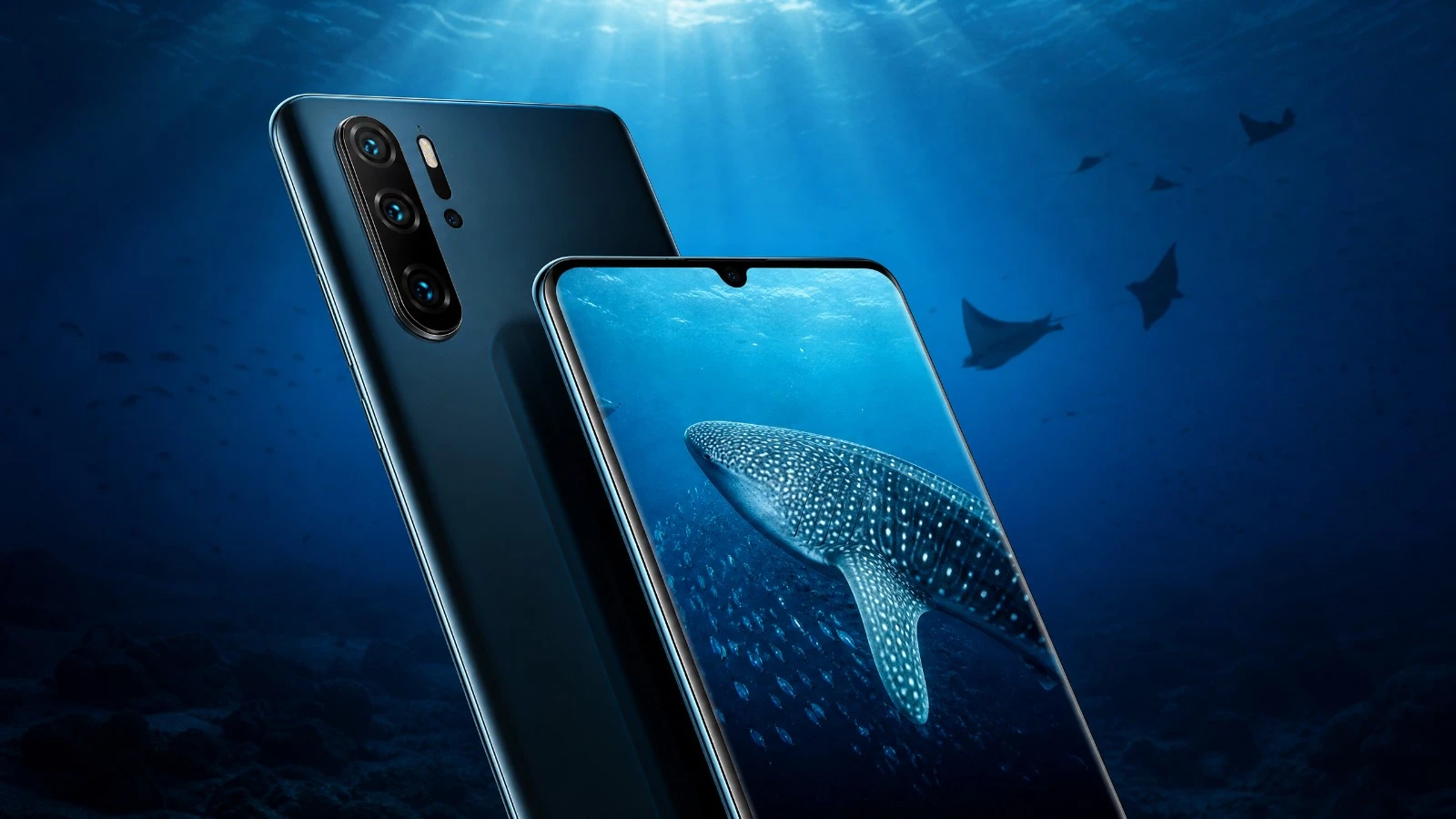
Huawei P30 Pro underwater camera test: 2.5/5. Good Leica optics, but limited RAW features due to HarmonyOS. Full review for natural light photography.
To learn how to get the most out of your gear underwater, discover the AquaExposure Training. ---
Introduction
When we talk about underwater photography using natural light with a smartphone, the question of equipment always comes first. That's normal. But behind the debate between the latest flagship phones and recent models, there is a second-hand market that deserves attention. The Huawei P30 Pro is one such example.
Released in 2019, this phone made a splash with its Leica optics and its innovative RYYB sensor. Today, it can be found on Back Market France for between €50 and €120. At that price, the temptation is real for a diver who wants to try underwater photography without investing in a 2025 flagship model.
However, by 2026, the context has changed dramatically. Huawei now runs on HarmonyOS without Google Mobile Services, which closes important doors in terms of workflow. This doesn't make the phone useless, but it fundamentally changes what we can expect from it.
Here you will find our complete evaluation based on 7 criteria, calibrated specifically for underwater photography in natural light only.
Find all the compared models in our comparison guide for underwater photography smartphones 2026.
Summary of Findings
Overall score: 2.5/5
| Dimension | Note | Weight | Comment |
|---|---|---|---|
| B1 Optics | 3.5/5 | 20% | Solid Leica quad cam, RYYB flare in backlight |
| B2 RAW and colorimetry | 1.8/5 | 25% | HarmonyOS = B2b at 0, native DNG partially saves the day |
| B3 Storage and transfer | 1.5/5 | 15% | Limited USB, very slow RAW transfer after submersion |
| B4 Thermal | 2.5/5 | 15% | Passive heat pipe, risk of throttling in prolonged 4K recording |
| B5 Battery | 3.5/5 | 10% | 4200 mAh, be careful with cold water |
| B6 Autofocus | 2.5/5 | 10% | Hybrid PDAF+ToF, HarmonyOS penalty applied |
| B7 Housing | 3/5 | 5% | Universal Divevolk SeaTouch 4 Max, no dedicated housing |
Designed for: - Beginner divers who want to try underwater photography with natural light on a small budget. - Users who are satisfied with the native DNG Pro mode without using third-party applications.
Not ideal for: - Photographers who want an advanced RAW workflow (HarmonyOS blocks MotionCam Pro and Blackmagic). - Divers who do long dives in 4K (the Kirin 980 processor and the post-dive transfer process are limiting factors).
B1 - Optics: Leica, a brand that stands the test of time.
The P30 Pro features four sensors developed by Leica Vario-Summilux. The main sensor, a 40 MP RYYB 1/1.7-inch sensor with an f/1.6 aperture, remains generous for a device from 2019. In natural underwater light, this wide aperture performs well in average conditions, between 5 and 15 meters with good visibility.
The setup is completed with a 20 MP ultrawide lens at f/2.2 and an 8 MP periscope telephoto lens with 5x zoom. In practice, when underwater, you'll mostly use the main sensor. The macro ultrawide can be used for subjects less than 5 cm away, which is a great option for nudibranchs. The characteristic purple-magenta flare of the RYYB sensor in backlight remains a documented weakness: avoid pointing towards the surface with strong direct light.
Main sensor: 40MP RYYB, 1/1.7", f/1.6, OIS + AIS Ultrawide: 20MP, 1/2.7", f/2.2, macro at 2.5 cm Telephoto: 8MP periscope 5x, 1/4.0", f/3.4, OIS Burst mode: approximately 10 frames/second | RAW buffer: 5 to 8 shots before slowdown
B2 - RAW and Colorimetry: The HarmonyOS Wall
This is where the P30 Pro loses the most points. Not because of the hardware, but because of the software.
In 2026, HarmonyOS will operate without Google Mobile Services. A direct consequence is that MotionCam Pro and Blackmagic Camera cannot be installed. These two applications are the benchmarks for advanced RAW workflows on smartphones. Their absence forces users to remain within the native Huawei application.
The native Pro mode offers features that are not without value: it allows exporting DNG files in 10-bit format, adjustable white balance in Kelvin, and manual ISO settings up to 3200. This is functional for a basic approach. However, without a Log profile for video (the Master AI mode oversaturates by default), and without the granular control tools offered by third-party applications, the workflow remains limited.
The RYYB color science used underwater also introduces hue shifts that require time-consuming corrections in post-production for native DNG files.
RAW Format: DNG Adobe Digital Negative, 10 bits Available Third-Party RAW Apps: None (HarmonyOS without GMS in 2026) White Balance: Adjustable in Kelvin, manually lockable Log Video: Not available | Master AI Mode: Defaults to saturated colors.
B3 - Storage and Transfer: The Bottleneck
The transfer of files after a dive is often overlooked in testing. With the P30 Pro, it becomes a concrete problem.
The USB Type-C connector has a limited actual data transfer rate in everyday usage conditions. For a session of 100 RAW DNG files (each file between 25 and 40 MB), the transfer to a computer can take 20 minutes or more, depending on the cable and the destination storage device. When traveling or in field conditions, this is a real bottleneck between two dives.
Huawei's proprietary Nano Memory card doesn't help matters: the NM format is not designed for high-speed data transfer and requires a specific card reader that will be unavailable in 2026. Internal storage of 128 or 256 GB remains the only viable option. Wi-Fi transfer (via HiSuite or local network sharing) or using a USB-C to external SSD adapter are the preferred workarounds.
See also our guide to waterproof housings for underwater photography for information on connectivity in real-world conditions.
Internal Storage: 128 GB or 256 GB (UFS 2.1) Connector: USB Type-C, with limited practical speed. Memory Card: Proprietary Nano Memory (NM), not recommended for file transfer. Recommended Alternative: Wi-Fi transfer or USB-C to external SSD adapter.
B4 - Thermal: Be mindful of long sessions.
The Kirin 980 in the P30 Pro is a chipset from 2018. It features a passive cooling system with heat pipes and a graphene film, which was respectable for its time. When taking underwater photos in natural light, the thermal performance is rarely critical.
The problem arises during extended 4K recording. After 15 to 20 minutes of continuous video, thermal throttling may occur and reduce the frame rate. The limited depth naturally restricts the duration of sessions (battery life, dive time), which mitigates the impact in practice. Note: A thermal shock between a warm phone and cold water can cause internal condensation. Allowing the phone to return to room temperature before immersion is a common-sense precaution.
[!WARNING] Silica gel: mandatory. Standard aluminum frame - high water condensation profile in cold water. The Kirin 980 chip, from 2018, generates more heat than current generations, which intensifies the thermal shock during immersion. Silica gel must be placed inside the housing before every dive below 15°C.
Tropical overheating: The Kirin 980 is less thermally efficient than the 2024-2025 chips. Software-related overheating occurs after approximately 15 minutes of continuous 4K recording in water at 28°C - the lowest threshold in the comparison. In practical diving situations, short clips are standard anyway. For photography only, the risk is low.
Chipset: Kirin 980 (7 nm, 2018) Cooling: Passive, heat pipe + graphene film 4K Risk: Thermal throttling after 15-20 minutes of continuous recording. IP Certification: IP68 (2 m, 30 min) - not guaranteed under prolonged pressure housing.
B5 - Battery: Comfortable with a cool reserve.
With a 4200 mAh capacity, it offers a respectable battery life that covers a full dive session (90 to 120 minutes) without any worries. The 40W SuperCharge technology allows for quick recharging between dives.
The point of vigilance concerns cold water. Lithium-ion batteries experience a significant drop in voltage below 10°C. In the Mediterranean Sea during winter or in the North Atlantic, the battery may prematurely fail if the phone has been exposed to cold water without insulation. Placing the phone in an inner pocket or an insulated pouch between dives helps maintain the correct operating temperature.
Capacity: 4200 mAh Li-Ion Fast charging: 40W SuperCharge (wired) Estimated photo session duration: 90 to 120 minutes (in moderate temperatures) Cold water alert: noticeable voltage drop below 10°C
Before each diving session, remember to check your external battery. Use our portable battery comparator tool to choose the right power bank for your dive equipment and desired battery life.
B6 - Autofocus: Penalized by HarmonyOS
The AF system on the P30 Pro combines PDAF (phase detection), laser AF, and ToF (Time of Flight). This is a robust hybrid configuration that, on other platforms, would allow for fine-grained control through third-party applications offering features like focus peaking or assisted manual focus.
Under HarmonyOS without GMS, third-party applications that utilize these advanced features are not available. The native Pro mode provides access to basic manual focus, but lacks focus peaking. For small subjects moving slowly (nudibranchs, cephalopod eggs), the lack of focus peaking is noticeable. The shutter lag is estimated to be between 100 and 150 ms, which is acceptable but not top-of-the-line. A -1 point penalty applies here for the HarmonyOS restrictions on third-party autofocus functionality.
AF Technology: hybrid PDAF + Laser AF + ToF Focus peaking: not natively available, inaccessible via third-party apps (HarmonyOS) Manual focus: available in native Pro mode (touch ring) Estimated shutter lag: 100 to 150 ms
B7 - Housing and accessories: universal solution only.
As of 2026, there are no dedicated rigid housings available for the Huawei P30 Pro. Manufacturers like Isotta or Nauticam have not developed specific housings for this model, and there is currently no commercial reason to do so.
The only serious option is the universal Divevolk SeaTouch 4 Max housing. Its patented touch membrane allows you to use the P30 Pro's native screen underwater, giving you access to all of the camera app's features. The certified depth rating is 60 meters, well beyond standard uses for natural light underwater photography.
Consult our guide to waterproof phone housings for details on assembly and accessory compatibility.
Dedicated housing: None available in 2026. Recommended solution: Divevolk SeaTouch 4 Max (universal, underwater touchscreen). Divevolk certified depth: 60 meters. Approximate price of Divevolk SeaTouch 4 Max: approximately €200-€250.
What you need to know before buying.
The Enclosure
The Divevolk SeaTouch 4 Max accepts most smartphones up to a certain width. Please check the exact dimensions of the P30 Pro (158.3 x 73.4 mm) against the tolerances specified in the front housing manual. Allow about twenty minutes for the initial assembly and leak tests. A universal housing requires more attention than a dedicated housing: a freshwater test is mandatory before any immersion in seawater.
The Post-Dive Workflow
The limited USB transfer rate is the main bottleneck. For a session of 100 photos in DNG format, prefer transferring via Wi-Fi using local network sharing or HiSuite (compatible with HarmonyOS) rather than using a cable. If you have access to a USB-C hub with a fast SSD, the result will be better than connecting directly to a PC with a cable. Schedule the transfer during equipment cleaning and dive log writing.
Current Prices (July 2026)
New: Discontinued product - The P30 Pro has not been available for sale as a new device for several years.
Used Condition on the French Back Market: €50 to €120 depending on condition (Good / Very Good / Excellent). Source: Back Market France, July 2026 estimate based on the range provided in the reference specifications.
Used angle grinder
At a price of €50-120, the P30 Pro remains a possible entry point for those who want to try underwater photography with natural light without making a significant financial commitment. The Leica optics are truly above average for this price range. However, the HarmonyOS situation in 2026 represents a concrete limitation: no MotionCam Pro, no Blackmagic support, and no evolution of the RAW workflow through third-party applications. If the goal is to seriously improve your skills, this phone will quickly become limiting. If the goal is to take a few underwater photos and see if you enjoy the discipline, it's an honest option.
Our Verdict
The 2019 Huawei P30 Pro retains something that many recent smartphones lack for its equivalent price range on the used market: a Leica lens that actually works. The 1/1.7-inch RYYB sensor with an f/1.6 aperture produces DNG files that can be recovered in post-processing, and the hybrid AF system holds up well for relatively static subjects.
But we are in 2026, and HarmonyOS changes the game. The absence of Google Mobile Services blocks access to the entire layer of advanced applications that currently form the core of a serious underwater photography workflow. Add to that the slow USB transfer speed after each dive, and the Kirin 980, which is showing its age in 4K resolution.
For a curious diver who wants a first underwater photography experience using natural light on a small budget: acceptable. For a photographer who wants to build a practice and an evolving workflow: look elsewhere.
Final score: 2.5/5.
Compare this device with others.
Are you hesitant? Use our underwater photography equipment comparison tool to compare this camera with other tested models.
To learn more about condensation and overheating, read our dedicated article: Overheating and condensation on smartphones in underwater housings.
Learn underwater photography.
The best equipment cannot replace technique. Discover the training at aquaexposure.com
Share
Table of Contents
- 01Introduction
- 02Summary of Findings
- 03B1 - Optics: Leica, a brand that stands the test of time.
- 04B2 - RAW and Colorimetry: The HarmonyOS Wall
- 05B3 - Storage and Transfer: The Bottleneck
- 06B4 - Thermal: Be mindful of long sessions.
- 07B5 - Battery: Comfortable with a cool reserve.
- 08B6 - Autofocus: Penalized by HarmonyOS
- 09B7 - Housing and accessories: universal solution only.
- 10What you need to know before buying.
- 11The Enclosure
- 12The Post-Dive Workflow
- 13Current Prices (July 2026)
- 14Used angle grinder
- 15Our Verdict
- 16Compare this device with others.
- 17Learn underwater photography.
Questions about the Journal
Can I use the photographs from this journal?
All images are protected by copyright. For any commercial or editorial use, please contact us via our form.
How can I be notified of new articles?
Follow us on social media or join the Sentinels Circle to receive our immersion stories before anyone else.
Do you offer hands-on workshops?
Yes, we organize masterclasses and field expeditions for members of our school. Check the Training page for details.