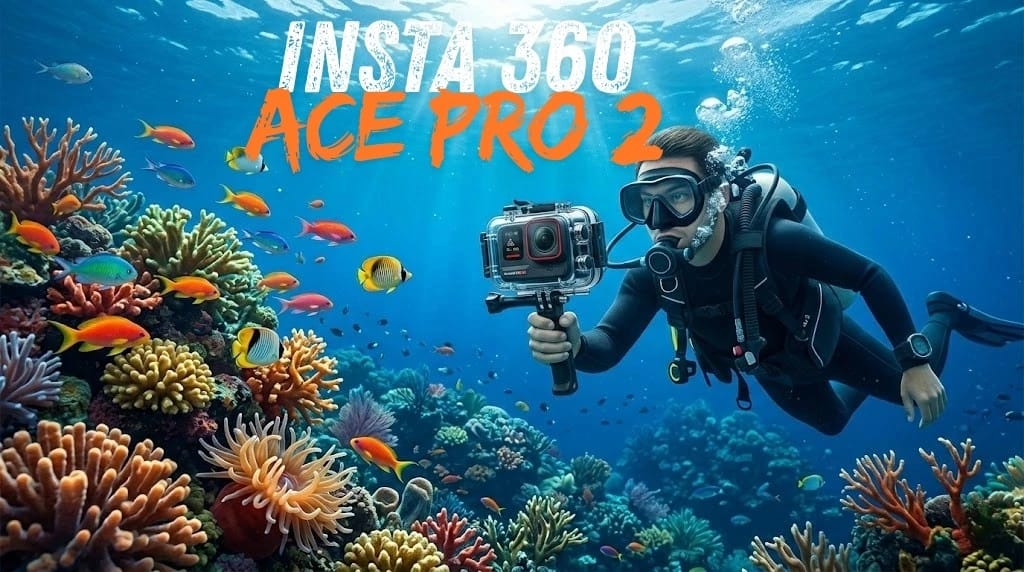
Insta360 Ace Pro 2: Underwater AI testing and limitations
Test of the Insta360 Ace Pro 2 underwater: AI color correction, stabilization, 8K and real limitations. Comparison of the GoPro Mission 1 and the DJI Action 6.
Is the Insta360 Ace Pro 2 waterproof without a housing?
The Ace Pro 2 is IPX8-rated to 12 metres without any additional accessory. For real diving beyond that depth, the dedicated Insta360 housing is essential and reaches 60 metres.
How good is the Ace Pro 2 AI colour correction underwater?
The underwater mode effectively corrects the blue cast in clear, shallow water. In turbid water or beyond 10 metres, results become less reliable. Manual white balance at 5000K remains more accurate in challenging conditions.
Insta360 Ace Pro 2 or GoPro Mission 1 for diving?
The Ace Pro 2 excels in low light thanks to its 1/1.3-inch sensor and costs 350 euros. The GoPro Mission 1 offers a 1-inch sensor, 8K at 60 frames per second, and a dedicated Dive Mode. The choice depends on your priority between low-light performance and resolution.
Does the AI stabilisation work well underwater?
Stabilisation is excellent for normal diving movements. However, fast or abrupt movements can cause slight jittering in the image. For standard underwater video, the result remains very convincing.
Insta360 Ace Pro 2: AI underwater testing and limitations
That morning, I was checking the seals on a dive case on the terrace, with a still-warm coffee, when a message from a student caught my attention: "Benjamin, the Insta360 Ace Pro 2 claims to automatically correct underwater colors using AI. Is that true?" The question is legitimate. The answer, as often happens when a manufacturer uses the term "AI" in a technical specification, deserves a closer look.
Because the Ace Pro 2 is a truly professional action camera. 1/1.3-inch sensor, optics signed by Leica, 8K at 30fps, 4K at 120fps, IPX8 waterproof up to 12 meters. All for €350. But it's the software layer, which no one can verify in a showcase, that makes the most ambitious promise.
What AI really does in this camera
The underwater mode of the Ace Pro 2 relies on several automatic processes that run in real-time. The color correction analyzes the color dominance of the image and attempts to restore the reds and oranges that are absorbed by the water with depth. The FlowState stabilization, enhanced by an algorithmic processing, compensates for the diver's movements and the fin's roll. The AI Highlights Assistant automatically identifies the best moments in your footage to create a concise edit. And PureVideo applies a noise reduction designed to smooth images shot in low light.
On paper, each of these functions addresses a real problem that every underwater filmmaker knows. Color correction should eliminate hours of post-processing. Stabilization should compensate for our natural inability to remain perfectly still at fifteen meters. And PureVideo should save these rushes shot in the dim light of a cave where natural light penetrates only in patches.
What works well underwater
The 1/1.3-inch sensor changes the game compared to previous generations of action cameras. In clear water, between 5 and 15 meters, with decent lighting, the Ace Pro 2 produces sharp, colorful images with a quality that rivals some compact cameras. The low-light performance is noticeably better than on smaller sensors, and that's where the large sensor does its job: the dark areas retain detail instead of being lost in digital noise.
The FlowState stabilization delivers on its promise in slow, regular movements. If you gently move along a reef, or film a turtle drifting, the result is smooth, almost aerial. The Leica optics, even though the mention partly falls under marketing, provide a corner-to-corner sharpness that makes cropping in post-production easier.
And the 8K, frankly, even if you never broadcast in 8K, it offers a considerable cropping margin. To film wide and then crop in later, that's exactly what we need when the subject refuses to pose.
The weaknesses that no one talks about
The FlowState stabilization, while effective during slow panning, struggles with sudden movements. Rapid approach to a school of fish, a turn to follow a subject that changes direction, compensation for a sudden current: the algorithm introduces a slight jitter, a micro-tremor that reveals the software nature of the stabilization. This is not prohibitive, but it is visible in the footage.
The native 12-meter waterproofness is sufficient for snorkeling and surface dives. For real recreational diving, you need the dedicated chamber that allows you to descend to 60 meters, and this is an additional purchase that needs to be budgeted for. Twelve meters, when diving, is a safety limit, not a working depth.
Automatic color correction works well in well-lit tropical blue water. However, as turbidity increases and suspended particles diffuse the light, the algorithm loses its bearings. In temperate green water, in a lake, or in an estuary with a current, the colors shift to hues that do not exist in nature. Green becomes an artificial cyan, and skin tones take on a mauve tint. This type of correction is best turned off to regain control in post-production.
And the 8K battery drains like an ice cube in a tropical aquarium. Expect forty minutes of continuous recording, sometimes less if the water temperature is low. In 4K, the battery life returns to more comfortable levels, but it's a constant trade-off between quality and duration.
Facing the Competition: GoPro Mission 1 and DJI Action 6
The Ace Pro 2 doesn't evolve in solitude. The GoPro Mission 1, with pre-orders opening on May 21st with shipping on the 28th, arrives with a 1-inch sensor (larger), 8K at 60fps (smoother), and an underwater mode developed in collaboration with divers. Its price starts at €430 for the base version. The Mission 1 Pro goes up to €610 and adds the Log profile for color grading. What GoPro promises is a third-party dive computer ecosystem that should follow quickly, and the future possibility of interchangeable lenses with the ILS version expected in the third quarter.
On the other hand, the DJI Osmo Action 6 plays a different card. Its 1/1.1-inch square sensor, slightly larger than that of the Insta360, offers unique cropping flexibility. Native waterproofing to 20 meters without a housing is a real advantage for divers who want to descend without additional accessories. And its dedicated color temperature sensor, which works in real time, tackles the same color correction problem but through hardware rather than software.
The Ace Pro 2 offers the best value for money at €350. The DJI Action 6 offers the best native waterproofing. The GoPro Mission 1 promises the best sensor and the highest resolution. The choice depends less on the specifications than on your actual use.
Who is this camera for
The Ace Pro 2 is suitable for divers who are looking for a serious first action camera without breaking the bank. If you regularly engage in snorkeling, shallow diving in tropical waters, and want to bring back clean images without spending hours on post-processing, it's a solid choice at €350.
If you regularly dive beyond 20 meters in temperate waters, with professional quality requirements, the Ace Pro 2 will reach its limits. AI does not replace light or technique, and automatic correction promises work only in ideal conditions that the sea does not always provide.
And if you're unsure whether to invest in a more expensive camera or in training that teaches you how to make the most of what you already have, the answer hasn't changed since I train underwater photographers. The equipment doesn't make the photographer. A diver who masters their buoyancy, their approach, and their light will take better pictures with a smartphone in a dive, than a beginner with the best action camera on the market.
Do you want to learn how to get the best out of your underwater camera, whatever it may be? The Module 2 of our training will guide you from settings to post-production, with filmed exercises in real conditions.
Frequently Asked Questions
Is the Insta360 Ace Pro 2 reliable for deep diving?
The native 12-meter seal covers snorkeling and surface dives. For recreational diving beyond 12 meters, the dedicated chamber is essential and extends the seal to 60 meters. The chamber adds volume and cost, but it's the price of reliability at depth. Always check the seals before each dive.
Does AI color correction work in green water?
In well-lit tropical blue water, the correction produces usable results. In green, murky or particle-filled water, the algorithm loses reliability and introduces artificial tones. In these conditions, it is better to film without automatic correction and take control in post-production using software such as DaVinci Resolve.
Ace Pro 2 or GoPro Mission 1 for underwater video?
The Ace Pro 2 costs €85 less and offers remarkable image quality at this price. The Mission 1 has a larger sensor (1 inch versus 1/1.3 inch), 8K at 60 fps, and a more developed accessory ecosystem. If the budget is tight, the Ace Pro 2 is an excellent choice. If you are aiming for the best raw quality, wait for the initial feedback on the Mission 1 at the end of May.
Should you film in 8K underwater with the Ace Pro 2?
8K offers a valuable cropping margin, but consumes the battery in about forty minutes and generates large files. At 4K at 120 frames per second, you gain in battery life, in the fluidity of slow motion, and in the ease of editing. For most underwater uses, 4K120 is the best compromise.
Can AI replace underwater video post-production?
The onboard AI reduces post-processing work in ideal conditions (clear water, good light, slow movements). It does not replace a real color grading for footage shot in difficult conditions. Post-production remains the step where you transform a correct image into a remarkable image, and no algorithm knows your artistic intention.