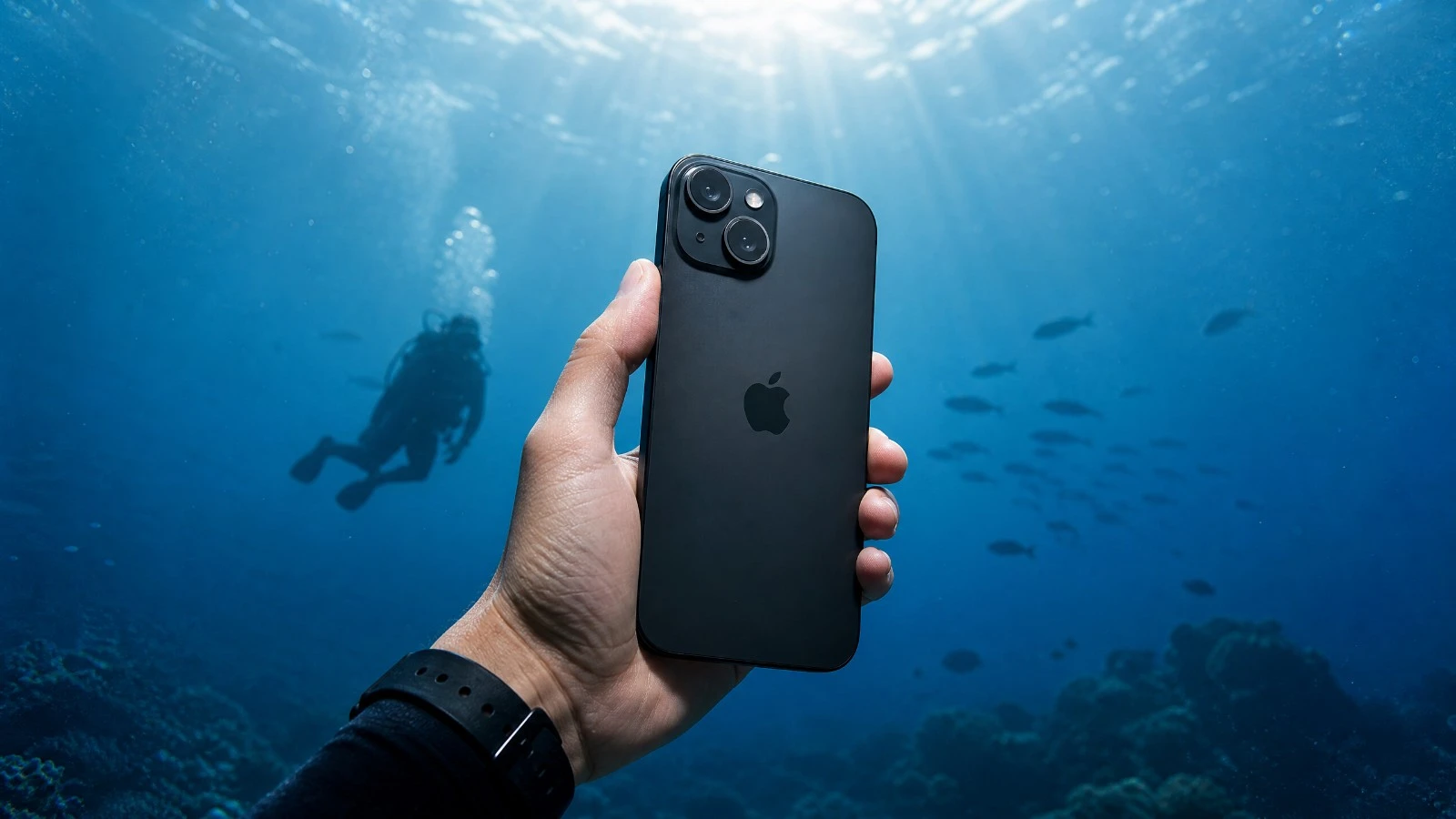
iPhone 15 underwater camera test: AquaExposure 3.0/5. No native ProRAW, limited USB-C 2.0, aluminum body. Read our review before buying used.
--- # Underwater Photo Test of the iPhone 15: Our Score for 2026
The Context Before the Specifications
There's a question I often get asked in training sessions: "I already have an iPhone 15, do I really need to buy another device specifically for diving?"
The honest answer is nuanced. The iPhone 15 was never designed for underwater photography. It doesn't have the ProRAW feature of its more expensive Pro counterpart, nor does it have LiDAR, and its USB-C port still operates at 2.0 speed. However, with over two years having passed, and a used market that has driven down its price, the real question is no longer "is it the best choice," but rather "is it sufficient to get started seriously?"
This test aims to show what the iPhone 15 truly delivers underwater, in natural light, without any artificial enhancements.
The Verdict in Summary
Overall AquaExposure score: 3.0/5
| Criterion | Score | What it means |
|---|---|---|
| Optics & sensor | 3.0/5 | Good main sensor with f/1.6 aperture, but no dedicated macro lens |
| RAW & color | 3.5/5 | No native ProRAW, DNG 12MP available via Halide as an alternative |
| Storage & transfer | 2.0/5 | USB-C, but limited to 2.0: a real weak point |
| Thermal performance | 3.2/5 | Aluminum without vapor chamber, moderate risk in cold water |
| Battery | 3.0/5 | 3349 mAh, adequate for 2 dives, just enough for 3 |
| Autofocus | 3.2/5 | Reliable PDAF in good light, no LiDAR |
| Housing | 3.0/5 | Divevolk SeaTouch 4 Max Plus compatible via adapter |
This device is designed for: divers who already own an iPhone 15 or can find one used at a good price, and who want to capture clear footage without investing in a Pro model.
This device is not ideal for: those who want to do extensive post-production work with high-resolution RAW files, or those who film extensively during a day with three or more dives.
B1 - Optics: A decent sensor, without extras.
Score: 3.0/5
The iPhone 15 features a 48-megapixel main sensor with an aperture of f/1.6, and a secondary 12-megapixel wide-angle lens at f/2.4. Underwater, the main sensor does most of the work: the generous aperture helps capture the natural light that already struggles to penetrate beyond a few meters of depth.
Compared to the Pro models, what's missing is the macro mode. The wide-angle lens on the iPhone 15 doesn't focus below 15 to 20 centimeters, whereas the Pro models with LiDAR can focus as close as 2 centimeters. For macro photography (nudibranchs, shrimp, fish eggs), this is a significant drawback.
For more information:
Main sensor: 48 MP, f/1.6, 26 mm equivalent, 8x6 mm sensor (approximately 1/1.56"), sensor-shift stabilization. Ultrawide angle: 12 MP, f/2.4, 13 mm, 120 degrees, no dedicated macro mode. No optical telephoto lens: the 2x zoom is a digital crop of the main 48 MP sensor.
Burst RAW shooting, shutter lag, and native maximum ISO are not officially documented by Apple for this model. A conservative score was applied to these criteria in the absence of reliable public data.
The 8x6mm sensor remains smaller than that of the Pro models (1/1.28"). In low light conditions or at the end of the day when natural light decreases, this difference in size is noticeable in terms of digital noise and dynamic range.
B2 - The Raw Data: The True Limit of This Model
Score: 3.5/5
Apple has reserved ProRAW for the Pro models since their launch. The standard iPhone 15 does not have access to it. This is the main selling point that differentiates the two product lines, and it directly impacts this review.
The good news is that an alternative exists. The Halide app (iOS, paid) offers a "Process Zero" mode that captures a raw DNG file without any algorithmic processing. On the iPhone 15, this raw file is limited to 12 megapixels, regardless of the lens used, compared to 48 megapixels in ProRAW on the Pro models. This is a true entry point into raw photography, with a more modest resolution.
For more information:
Native Apple RAW (ProRAW): Not available on this model. RAW via third-party app: Halide (Process Zero), DNG 12 megapixels, single exposure capture. Maximum video codec: Dolby Vision HDR, 4K at 30 frames per second. No ProRes, no Log profile (reserved for Pro models). Color science: Apple's Photonic Engine, proprietary ISP without third-party optical partnerships.
To understand why this difference is so important in underwater photography, the article RAW vs JPEG: why it changes everything underwater details the principle of color recovery latitude.
B3 - Storage: The Real Weak Point
Score: 2.0/5
This is where the iPhone 15 disappoints the most. The USB-C port has replaced the Lightning connector, but Apple has maintained a transfer speed of USB 2.0, which translates to approximately 60 MB/s in practice. This is sufficient for JPEGs and a few DNG files. However, for a day filled with 4K video recording, emptying the phone between dives becomes a real chore.
There is no external memory slot, as with all iPhones. The internal storage (128, 256, or 512 GB depending on the model) must therefore hold all of the content.
For more details:
Connector: USB-C, but limited to USB 2.0 (480 Mbit/s, approximately 60 MB/s actual). Internal storage: 128 / 256 / 512 GB, no external slot. Quick calculation: one day of 3 dives of 45 minutes each with photos + a few 4K clips represents 15 to 25 GB. With 256 GB, there is enough space, but transferring to an external SSD will take several minutes instead of a few seconds.
The article "storage and buffering: what no one tells you before you buy", provides a detailed look at the real impact of a slow port on field workflows.
B4 - Thermal Technology: Aluminum, but without a steam chamber.
Score: 3.2/5
The iPhone 15 retains an aluminum frame, like all the non-Pro models. This is a conductive material, so it's something to be aware of in cold water. The good news is that this model doesn't have the vapor chamber found in the Pro models, which accelerates heat dissipation on the surface but can worsen condensation inside the casing in cold water. Therefore, the thermal profile of the iPhone 15 is slightly less aggressive than that of an equivalent Pro model.
It doesn't eliminate the risk. Below 15 degrees Celsius, an iPhone that hasn't had time to acclimatize can cause the inner glass of the casing to fog up.
[WARNING] Silica gel: recommended. The aluminum frame remains sensitive to temperature fluctuations in cold water. A packet of silica gel inside the housing, along with a few extra minutes of acclimation in the shade before launching, is usually sufficient in most cases.
For more information:
Chassis material: aluminum Cooling system: passive dissipation, no vapor chamber (reserved for Pro models) Certification: IP68, 6 meters, 30 minutes. No MIL-STD-810 certification. Ceramic Shield on the front.
The article "Smartphone overheating and condensation underwater: the physics of the waterproof case" details the mechanism and the silica gel protocol.
B5 - The Battery: Sufficient, but with no room for improvement.
Score: 3.0/5
The iPhone 15 features a 3349 mAh battery, using standard Li-Ion chemistry. There's no Silicon-Carbon technology here, that will arrive later in Apple's product lines. In mixed photo and video usage, two 45-minute sessions pass without issue. On a third session, with a lot of 4K video recording, the battery life becomes more limited.
For more information:
Capacity: 3349 mAh Chemistry: Standard Li-Ion Documented cycles: Approximately 1000 cycles before reaching 80% capacity (EU label) Performance in cold water: Not officially documented by Apple. Standard Li-Ion batteries generally lose 20 to 40% of their effective capacity below 5 degrees Celsius. Keeping a charging pack warm inside the wetsuit remains the best solution in winter.
For a day of diving on a liveaboard with 3 or 4 dives, an external battery pack of 10,000 mAh remains a reasonable investment.
Before each diving session, remember to check your external battery. Use our portable battery comparator tool to choose the right power bank for your dive equipment and desired battery life.
B6 - Autofocus: Reliable, without LiDAR.
Score: 3.2/5
The iPhone 15 uses a phase detection autofocus (PDAF) system on its main sensor, but it does not have LiDAR (which is reserved for the Pro models). In good natural light and with a shallow depth of field, it correctly focuses on subjects that are moving slowly.
After traveling about fifteen meters, or as soon as the light decreases, the lack of LiDAR becomes noticeable. The autofocus hesitates more, especially when focusing on small or fast-moving subjects like juvenile fish.
For more information:
Autofocus technologies present: PDAF on the main sensor, contrast autofocus on the ultrawide lens. LiDAR: Not available (reserved for Pro models). Focus peaking: Not natively supported, and absent from common third-party apps on this model.
B7 - The Enclosure: Divevolk, with adapter.
Score: 3.0/5
The Divevolk SeaTouch 4 Max Plus is compatible with the iPhone 15 (excluding the mini version) via its dedicated adapter module. The principle remains the same as with other iPhones in the range: a gel touch membrane that replicates the gestures of the screen, without any additional physical buttons.
If you already own a SeaTouch for an iPhone 12, 13, or 14, you only need to replace the internal adapter, not the entire casing.
For more information:
Compatible housing: Divevolk SeaTouch 4 Max Plus, iPhone 15 adapter module (excluding mini). Certified depth: 60 meters. Screen access: SeaTouch touch membrane. Access to third-party apps: Halide and the native Camera app are accessible from within the housing.
What you need to know before buying.
Available enclosures
Divevolk SeaTouch 4 Max Plus with dedicated iPhone 15 adapter. Certified depth of 60 meters, full touchscreen access. Available directly at divevolkdiving.com.
Current prices (July 2026)
Refurbished Market Price: Starting at approximately €390 (128 GB, in good to very good condition), the refurbished market is currently the most logical option for this three-year-old model. Source: Back Market, data collected in July 2026.
Given its age and the difference in features compared to recent models, the iPhone 15 is primarily justified for purchase on the used market, specifically for dedicated diving use. This is a typical case where the refurbished market offers ample options.
Dive trip itinerary: a day of 3 dives
With 256 GB of storage, a day of 3 dives lasting 45 minutes each with photo mode and some 4K clips represents approximately 15 to 25 GB. This fits without filling up the phone, but transferring the final files via USB-C 2.0 will require more patience than with a Pro model.
Specific points to consider for this model:
The lack of native ProRAW is the most significant limitation: it directs you to use Halide if you want RAW files, but with a reduced resolution of 12 megapixels. The USB-C 2.0 port is the second thing to be aware of before buying, especially if you plan on doing a lot of video recording. Finally, the aluminum chassis requires the same anti-condensation precautions as other non-Pro iPhones in cold water.
Our Verdict
Three out of five. That's a mid-range score, and that's exactly what the iPhone 15 represents for photography.
It's not a bad device. The main sensor performs well in natural light, the Divevolk housing is reliable, and the autofocus works well as long as the lighting is adequate. However, the three real limitations (no native ProRAW, USB-C limited to 2.0, no LiDAR) are those of a model that was never intended to achieve the best possible image quality.
If you already have an iPhone 15, there's no urgent need to upgrade specifically for underwater photography. If you're looking to buy a device solely for underwater photos, a used option at a low price might be justifiable, but I would recommend considering a Pro model (with LiDAR and ProRAW) or a recent Android phone with native RAW support within the same budget.
Compare this device with others.
Are you hesitant? Use our underwater photography equipment comparison tool to compare this camera with other tested models.
Learning Underwater Photography with this iPhone
Having the right equipment is not enough. Mastering manual settings, managing natural light effectively, and approaching animals without disturbing them are all skills that must be learned.
The AquaExposure Training is built around underwater photography using natural light, and is compatible with all devices and housings, including this iPhone 15 and the Divevolk SeaTouch.
Share
Table of Contents
- 01The Context Before the Specifications
- 02The Verdict in Summary
- 03B1 - Optics: A decent sensor, without extras.
- 04B2 - The Raw Data: The True Limit of This Model
- 05B3 - Storage: The Real Weak Point
- 06B4 - Thermal Technology: Aluminum, but without a steam chamber.
- 07B5 - The Battery: Sufficient, but with no room for improvement.
- 08B6 - Autofocus: Reliable, without LiDAR.
- 09B7 - The Enclosure: Divevolk, with adapter.
- 10What you need to know before buying.
- 11Our Verdict
- 12Compare this device with others.
- 13Learning Underwater Photography with this iPhone
Questions about the Journal
Can I use the photographs from this journal?
All images are protected by copyright. For any commercial or editorial use, please contact us via our form.
How can I be notified of new articles?
Follow us on social media or join the Sentinels Circle to receive our immersion stories before anyone else.
Do you offer hands-on workshops?
Yes, we organize masterclasses and field expeditions for members of our school. Check the Training page for details.