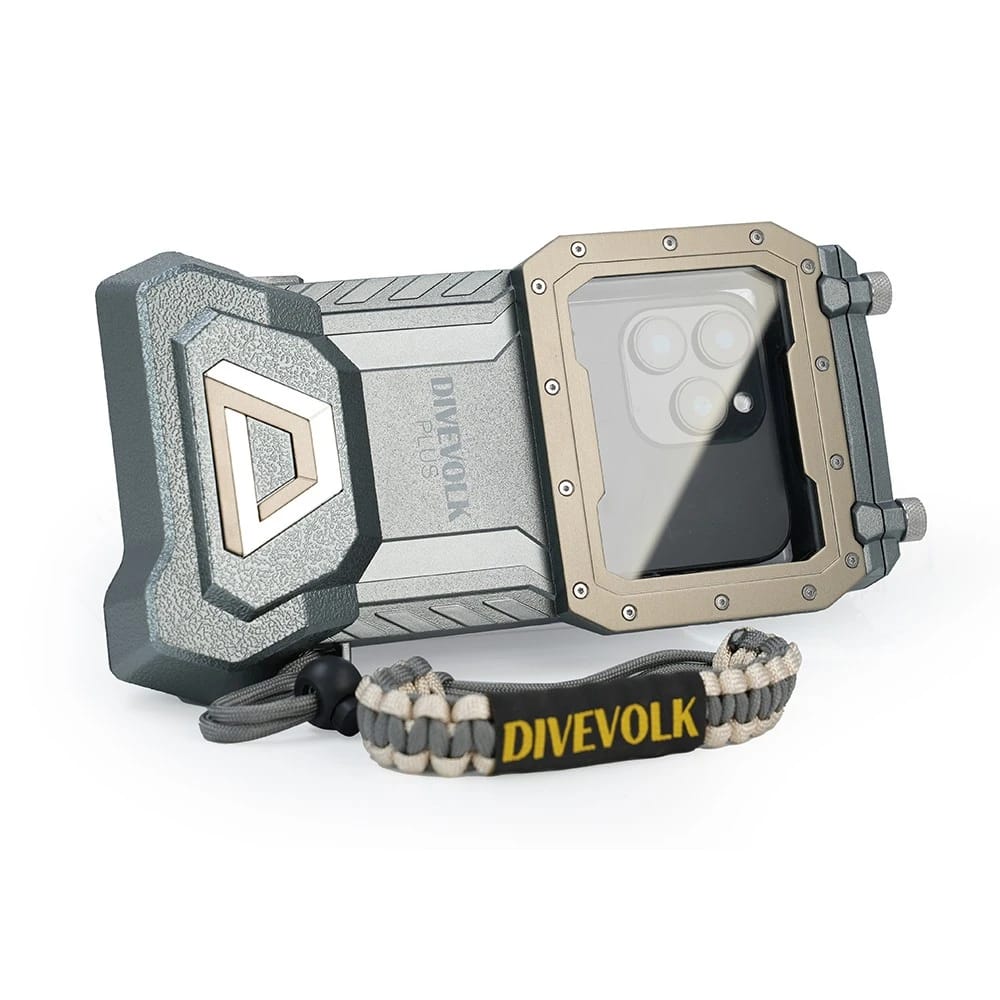
Is the iPhone really enough for professional underwater video?
Yes, provided you understand its limits. The iPhone sensor is excellent in sufficient light, it stabilises well, and it shoots in 4K with good correction latitude in post-production. For 90% of underwater photo and video content, it does exactly what is needed.
Why choose the DiveVolk over a housing with built-in electronics?
The absence of electronics in the housing removes a major failure point: seawater is corrosive and attacks connectors and components. The DiveVolk works with a mechanical seal and a passive waterproofing gel pouch, with nothing to corrode. After 1,000 dives, zero leaks.
What are the key things to watch when using an iPhone in a DiveVolk housing?
Three essentials: never dive with the housing empty (without the phone, waterproofing is not guaranteed), keep the housing in the shade on the surface to avoid overheating, and check the seal and gel pouch before every dive.
One day, I dived with my DiveVolk submersible. Without a phone inside. I leave it to your imagination the noise at 12 meters when the water starts to come in. And the look of my students on the surface. And the conversation with the DiveVolk after-sales service, which, to be honest, was remarkable.
That day should have been a disaster. It mainly confirmed something that I already knew: this submersible is designed to protect its users.
Since this incident, I have continued to dive with this setup. Counting, it's more than 1,000 dives with an iPhone inside a DiveVolk housing. Zero water ingress. Zero electronic issues. Zero regrets.
These are the 1,000 dives that I will be telling you about here. And the reason why I would not change this setup for anything in the world.
Why a Phone Instead of a Dedicated Device
I started underwater photography like many others: with an underwater compact camera. Then with a compact camera in a housing. Then with a more sophisticated, heavier, more expensive, and more difficult-to-transport system.
At each stage, the equipment took up more space in my luggage, more time to prepare, and more attention underwater. And the files required more work to get out of the device and arrive in a usable format.
The shift towards using the iPhone happened for a practical reason before being technical: When you are a diving instructor, you constantly produce content. Photos, videos, social media posts, student tracking. The files need to be immediately available, the sharing needs to be simple, and the workflow needs to be short.
An iPhone in a waterproof case solves this problem completely. I come out of the water, my photos and videos are on my phone. No SD card to transfer. No proprietary software to open. No intermediate steps. I am posting or sharing while others are still looking for their USB cable.
For travel, it's a revolution. One device for everything. One charger. One carry-on bag. And the peace of mind of not having to choose between "I take the camera equipment or not" because the camera equipment is the same object as my phone.
Why DiveVolk instead of another dive computer
There are dozens of iPhone cases. Some with integrated electronics, control screens, Bluetooth triggers, and charging ports. Some are very beautiful, very technical, and very reassuring on paper.
DiveVolk is almost the opposite. No electronics in the housing. A mechanical seal. A gel pouch that absorbs micro-pressure variations. And that's pretty much it.
That's precisely why I use it.
No electronics in the housing: a decision that deserves to be explained
Caissons with integrated electronics have an additional point of failure. Seawater is corrosive. It attacks connectors, seals around ports, and solder points. The more electronic components there are in the caisson, the more surfaces there are to protect, the greater the risk of micro-infiltration, and the more points to monitor.
A housing without electronics eliminates this problem at its source. There is nothing to corrode, nothing to short-circuit, and nothing that can malfunction independently of the phone.
This is the same logic as a mechanical watch: fewer components, fewer possible failures.
The gel pouch: the discreet innovation that changes everything
The DiveVolk's sealant pouch is the element that is talked about the least, but is probably the most important.
It fills the space between the housing and the phone. It absorbs the pressure variations that occur with each descent and ascent. It compensates for the micro-differences that thermal expansion can create between dives.
And most importantly, it offers an additional layer of protection that is entirely passive. No seal can be 100% perfect under 100% of conditions. The gel pocket, on the other hand, doesn't have a "seal" in the traditional sense: it's a continuous material that cannot open.
What I've learned after 1,000 dives
The only incident I had with the DiveVolk was the one I mentioned in the introduction: I had forgotten my phone on the boat. The case itself, without the phone to fill the space and maintain pressure on the seals, is not as watertight.
This is not a fault of the case. It is a rule of use to understand: the DiveVolk is designed to work with the phone inside. Without the phone, do not dive.
Besides that, 1000 dives. No problems. And a customer service that I had the opportunity to test, which responds quickly and takes care of its customers properly.
The questions everyone asks me
"Does the iPhone really suffice for making professional underwater videos?"
Yes. Provided that you understand its limitations and work within them. The iPhone's sensor is excellent with sufficient light. It stabilizes well. It films in 4K with a latitude of correction in post-production that few compact cameras achieve. For 90% of the underwater photos and videos I produce, it does exactly what is needed.
"How do I control the iPhone in the underwater housing?"
The DiveVolk has physical buttons that correspond to the main actions: to take a photo, to zoom, and to switch between photo and video modes. The touchscreen remains accessible in some configurations. In practice, you configure the application before entering the water, and you only need the underwater trigger.
"And the battery life?"
The iPhone consumes more power in 4K video mode than a dedicated device. Be sure to charge between dives if you are filming extensively. In pure photography mode, the battery life is very comfortable for a standard one-hour dive.
"Is it going to be a problem with the surface heat?"
Yes, this is the main point of vigilance. On the surface, in direct sunlight, an iPhone in a closed housing can quickly overheat. Keep it in the shade between dives or open the housing to ventilate.
Everything is explained in Module 2
The choice of phone, the criteria that led me to prefer the iPhone, the choice of DiveVolk compared to other dive computers on the market, the configuration settings before a dive, and the mistakes to avoid: all of this is in the free part of Module 2 of my training.
This is not a teaser. It is the complete module on equipment, accessible for free, because I believe that good purchasing decisions are made with complete information, not with half-explanations.