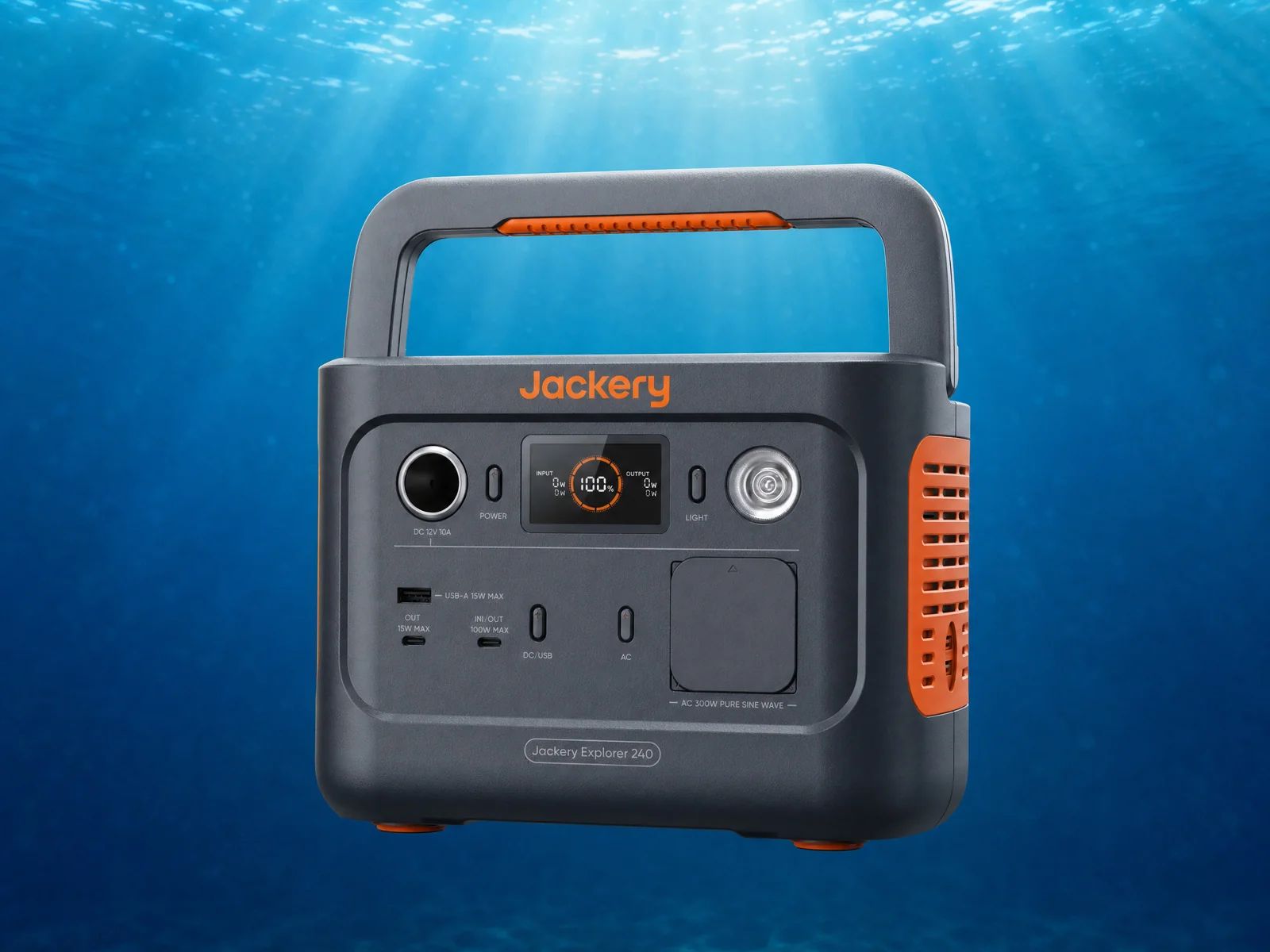
Jackery Explorer 240 v2: The compact power station for underwater photographers.
Technical review of the Jackery Explorer 240 v2- a 256 Wh power station designed to safely charge underwater camera housings and strobes during dive trips.
Can I bring the Jackery Explorer 240 v2 on an airplane?
No, with a capacity of 256 Wh, this power station exceeds the limit of 160 Wh set by international regulations such as those of the IATA. It is strictly prohibited both in the passenger cabin and in the cargo hold.
How long does it take to fully recharge the charging station?
Thanks to the Flash Charge mode, which can be activated via the Jackery app, a full recharge using a standard power outlet takes approximately one hour.
What devices can be connected to the 300W AC outlet?
This enclosure is designed for sensitive electronics such as flash battery chargers, laptops, or drones. It is not suitable for heat-generating devices like hair dryers.
To improve your mastery of your equipment and optimize your procedures while diving, discover our specialized training modules on AquaExposure training.
Jackery Explorer 240 v2: The compact power station for underwater photographers
Between the humid deck of a boat and preparing a waterproof housing in a cramped cabin, power management is a major constraint for underwater photographers. While small external batteries are sufficient for a smartphone, they quickly reach their limits when powering powerful strobes or a laptop used for downloading high-resolution footage. The Jackery Explorer 240 v2 fills this need for demanding mobility.
This portable power station offers a compromise between the volume of a small backpack and the versatility of a wall outlet. Its purpose is to secure a workflow away from any fixed infrastructure, whether on the deck of a liveaboard or during a road trip along wild coastlines.
LFP architecture and field robustness.The core of this power station relies on lithium iron phosphate (LiFePO4 or LFP) chemistry. For divers accustomed to seeing their housing batteries run out of power after just two seasons, this technical choice offers a significant improvement. The manufacturer claims over 3,000 charge cycles before the capacity drops to 80% of its initial value [1]. This translates to an estimated lifespan of around ten years with regular use.
This robustness extends to the outer casing and the folding handle. Weighing 3.6 kg, the power station remains portable with one hand, leaving the other free to carry your equipment. The integrated LCD screen provides a clear display of input and output power, allowing you to monitor the power consumption of your devices in real time.
Versatility of the AC Outlet and Connectivity
The presence of a 230 V AC outlet with a pure sine wave is a key feature. For many photographers, some high-end flash chargers do not have a native USB-C input. The Jackery Explorer 240 v2 allows you to use the original chargers without relying on unreliable adapters. The nominal power of 300 W, capable of handling peaks up to 600 W, is sufficient to power a laptop and several charging stations [1].It also features a 100W USB-C port that supports Power Delivery. This port is bidirectional, allowing it to both charge power-hungry devices and recharge the power station itself. A second 15W USB-C port and a USB-A port complete the setup, enabling simultaneous charging of four devices. The power station thus becomes the central hub of the cabin, centralizing all power needs in a single outlet.
Fast Charging and Solar Power
One of the key features of this v2 version is its charging speed. By activating Flash Charge mode via the mobile app, the power station can reach 100% battery capacity in just one hour using a wall outlet [1]. This is a valuable feature between dives. Management via Wi-Fi or Bluetooth allows you to monitor the battery status remotely, avoiding the need to return to the cabin to check the level.
For expeditions requiring complete autonomy, the solar compatibility becomes particularly relevant. With a maximum input of 80W, the power station can be paired with portable solar panels. Under optimal sunlight conditions, this allows you to maintain a constant power reserve for your electronic devices without relying on the electrical grid. This is a major advantage for stays at base camps or on sailboats with limited power options.
Who is this power station for?The Jackery Explorer 240 v2 is primarily designed for photographers who use strobes requiring a wall outlet, as well as for diving nomads who work with powerful laptops. Its compact size makes it an excellent choice for those who travel in a personal vehicle or who can ship their heavy equipment in advance. It is suitable for creating a stable charging point in the cabin of a liveaboard boat, where outlets are often poorly located.
However, if the only need is to charge a smartphone and a small action camera, a standard power bank will be more suitable. The Jackery is intended for those who are moving towards more complex image production and who cannot afford to run out of power during a week of exceptional diving.
Limitations and Restrictions on Air Travel
It is essential to address the issue of transportation, as this is where the main limitation lies. With an energy capacity of 256 Wh, the Jackery Explorer 240 v2 significantly exceeds the 160 Wh limit set by IATA for the transport of lithium batteries by passengers [2]. Therefore, this power station is strictly prohibited on commercial airplanes, both in carry-on luggage and in checked baggage.Any international travel involving commercial flights requires different logistical arrangements, such as shipping via a specialized freight service. It is essential to verify the applicable regulations with the airline and relevant authorities at the time of departure, as the acceptance of a battery on a flight is never guaranteed. You should never attempt to conceal this device in luggage, as the fire risks associated with lithium are taken very seriously by airport authorities. For air travel, it is advisable to use batteries with a power output of less than 100 Wh, which benefit from more flexible regulations, subject to verification with the carrier.
Finally, the 300 W power output is a firm limit. This unit cannot be used to power a hairdryer or a kettle. It is designed for precision electronics.
When the equipment no longer demands your attention thanks to efficient power management, there remains what brought you here: a change in the light on the horizon, a silence that settles before entering the water, and that simple desire to return and explore the underwater world.