Table of Contents
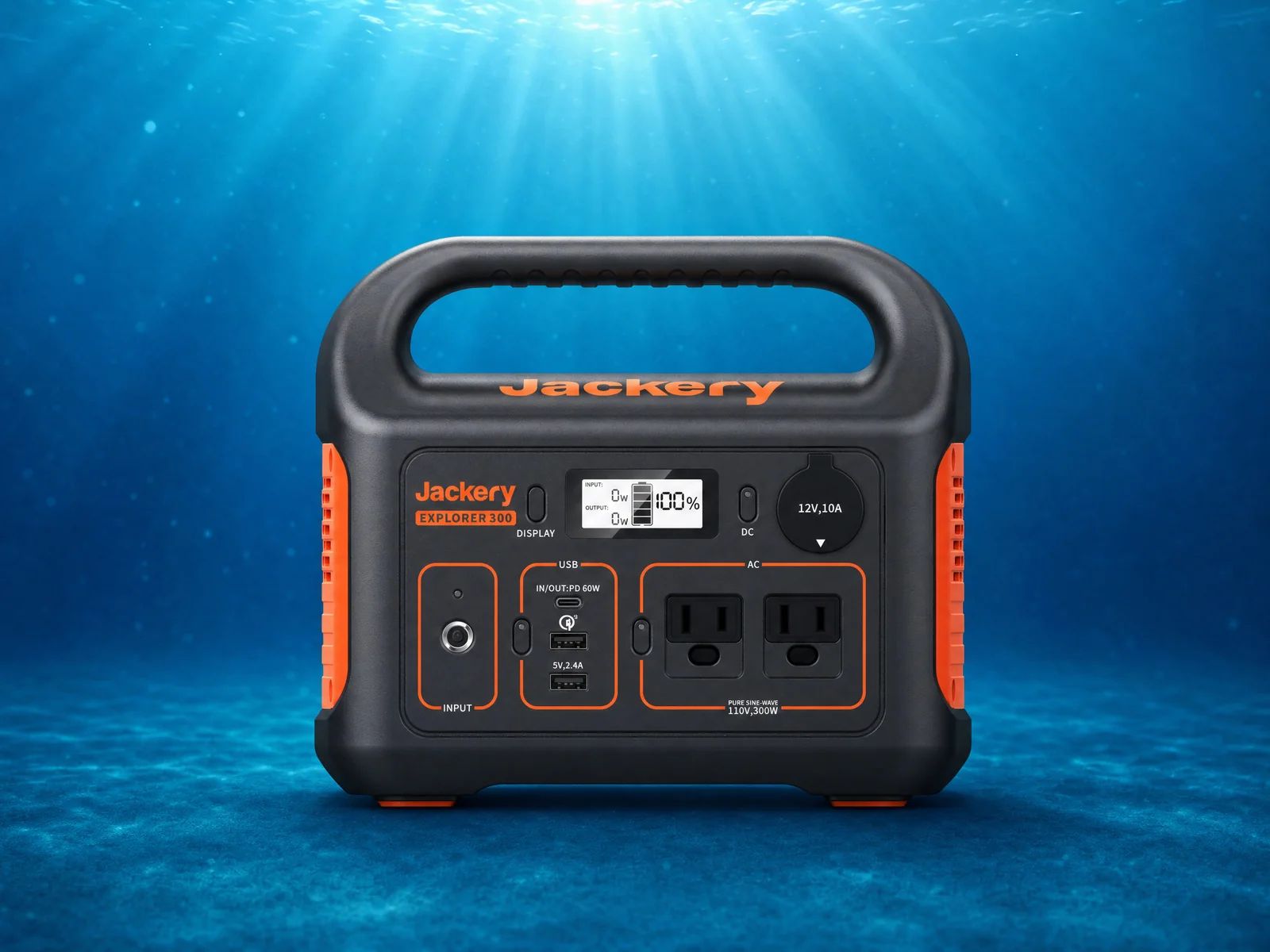
Discover the Jackery Explorer 300- a portable power station with 293.8 Wh, perfect for recharging your diving and photography equipment during your land expeditions.
Share
/blog/jackery-explorer-300-en
Table of Contents
- 01A substantial power reserve for fieldworkThe core of this power station is a NMC type lithium-ion battery with an energy capacity of 293.8 Wh [1]. For a photographer using modern mirrorless cameras, this capacity allows for more than twenty full charge cycles, easily covering the needs of a long weekend or a light expedition with complete autonomy. AquaExposure's performance ratings place this model as a relevant benchmark for users seeking a balance between weight and storage capacity, capable of powering a complete kit including a drone, laptop, and underwater lighting.
- 02Port Versatility and Pure Sine Wave OutputThe Explorer 300 features a pure sine wave inverter capable of delivering 300W continuously, with peak start-up power reaching 500W [1]. This feature ensures that the power is as stable and clean as that from a standard household outlet, preventing damage to the delicate transformers in your flash chargers or dive computers. The connectivity is designed for simultaneous use, and the European version includes a standard AC outlet, a 60W USB-C Power Delivery port, a Quick Charge 3.0 USB-A port, a standard USB-A port, and a 12V output. This variety allows you to charge your computer via USB-C while powering your camera batteries from the AC outlet without compromising charging speed.
- 03Charging Flexibility Between DivesThe operational lifespan of a power station is also measured by how quickly it can be recharged. The Jackery Explorer 300 offers features suitable for a nomadic lifestyle, including the ability to combine the 90W AC input with the 60W USB-C PD port to achieve an 80% charge in approximately two hours [1]. This double-charging function is a major advantage during a quick stop at a cafe or marina. For those who prioritize complete independence, compatibility with SolarSaga solar panels allows for a full recharge in a few hours under optimal sunlight conditions. Recharging via the 12V socket of a vehicle remains a reliable option for longer journeys.
- 04Durability and Portability: A Reliable CompanionWeighing 3.2 kg and measuring 23.1 x 13.2 x 19.8 cm, the Explorer 300 is easily operated with one hand thanks to its integrated ergonomic handle [1]. In the confined space of a support vehicle, its compact size allows it to be stored under a seat or on an improvised workbench without being intrusive. The high-strength plastic construction withstands the rigors of fieldwork and the vibrations of rough roads. The LCD screen provides clear information about input power, output power, and the remaining battery percentage. The quiet operation is also noteworthy, with the internal fans remaining discreet during nights spent in a van.
- 05Who is this battery suitable for?This power station is designed for divers and photographers who prioritize land-based travel and self-sufficiency. It becomes essential for those who plan dives away from established facilities or set up camps on remote beaches. It is particularly suitable for drone users whose batteries require AC power for their multiple chargers, as well as videographers using powerful lighting systems. For a dive instructor who needs to manage the logistics for multiple students while also taking their own photos, the Explorer 300 serves as a central charging station for dive computers and communication radios.
- 06Limitations and Air Travel Safety: A Crucial PointIt is crucial to understand that the Jackery Explorer 300 is not a universal travel accessory, especially when it comes to air travel. With an energy capacity of 293.8 Wh, this power station significantly exceeds the 100 Wh limit, and even the 160 Wh limit that requires special authorization, as set by the IATA and the FAA [2] [3]. Therefore, it is strictly prohibited on commercial airline flights, whether in the cabin or as checked baggage. For any trip involving a commercial flight, you will need to consider lower-capacity solutions or arrange for transport via specialized freight.
- 07Useful ConclusionThe Jackery Explorer 300 successfully combines significant power with a compact size that maintains portability. For underwater photographers, it provides the assurance of never missing a moment of beauty due to depleted batteries during isolated dives. While its use is primarily intended for the boat deck or other locations near a power source, it fulfills its purpose with a reliability that allows you to focus entirely on what's important. Investing in a power station like this means choosing a level of independence, allowing you to stay an extra day at a magnificent dive site, far from everything, without constantly worrying about the battery levels of your equipment. It's the price of peace of mind in a world where images increasingly depend on electricity.
Questions about the Journal
Can I bring a Jackery Explorer 300 on an airplane?
No, with a capacity of 293.8 Wh, this power station exceeds the 160 Wh limit set by the IATA. It is strictly prohibited both in the cabin and in the cargo hold on commercial flights. It is essential to check the regulations of your airline before any departure.
How many times can it recharge a camera battery?
This power station provides approximately 20 to 25 full charges for a standard hybrid camera housing, depending on the battery capacity and conversion losses.
Is it possible to charge the unit using solar panels?
Yes, the Explorer 300 is compatible with Jackery's SolarSaga solar panels, allowing for a full recharge in an isolated environment in approximately 5 to 6 hours under optimal sunlight conditions.

