AquaExposure
HomepageTrainingToolsArticles
AquaExposure

© 2026 AquaExposure. Ethically preserving the depths.

AquaExposure
Homepage
Pricing
Menu
Homepage
PricingShopArticles
AquaExposure — Explore Beneath, Capture Beyond
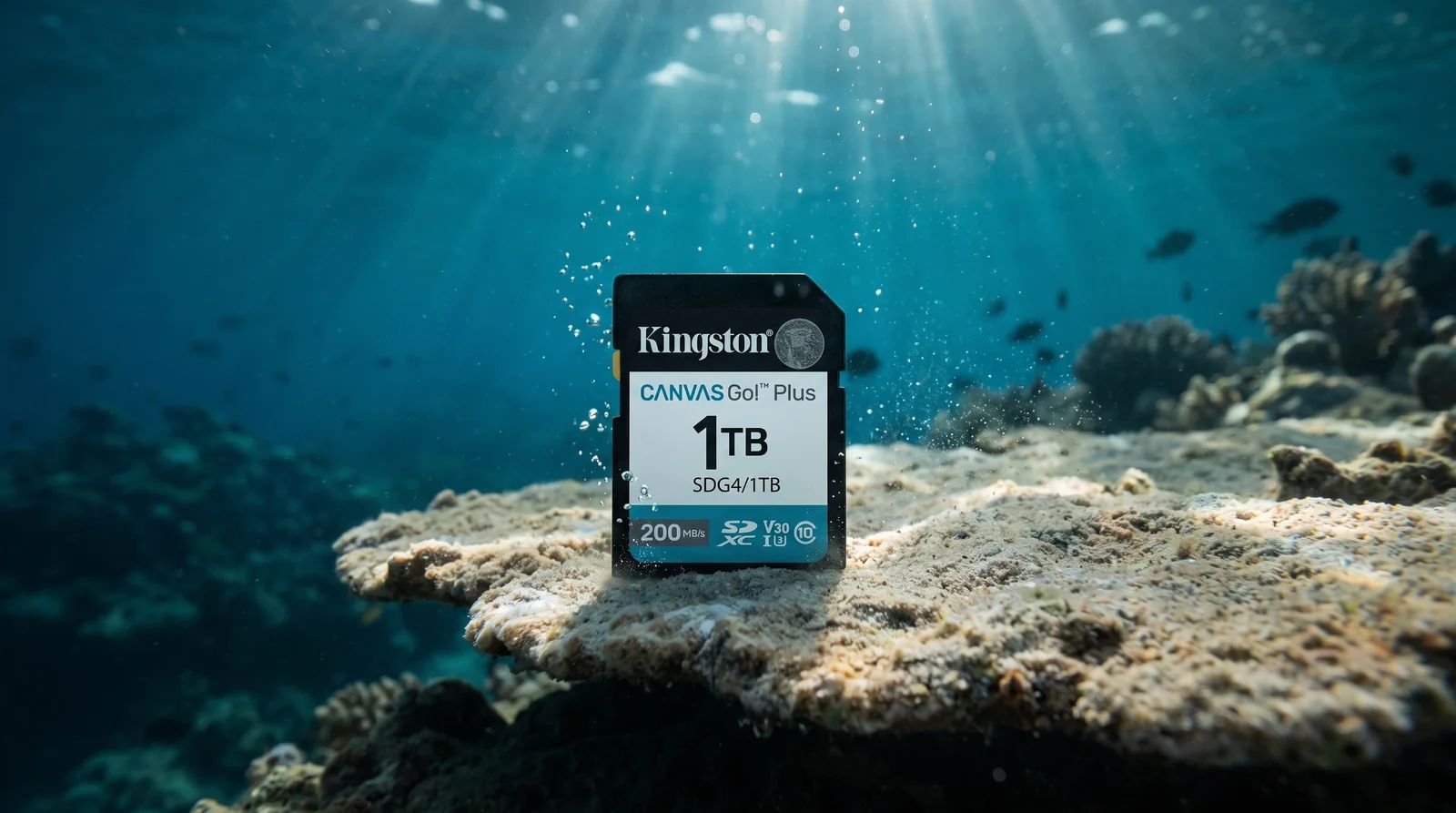
Kingston Canvas Go! Plus: The perfect balance of durability and performance for the traveling photographer.
Table of Contents
  • 01A design tailored for humid environments.The daily life of an underwater photographer involves a constant battle against elements that are harsh on electronics. Ambient humidity, splashes of saltwater, and handling equipment with wet hands pose real risks. The Kingston Canvas Go! Plus meets these challenges with an IPX7 certification. This rating guarantees that the card can withstand accidental immersion in one meter of water for thirty minutes [1]. This protection proves invaluable when a drop of water infiltrates the reader while you are transferring your files.
  • 02The technical reality of transfer speedsThe specifications of the Kingston Canvas Go! Plus card indicate a high level of performance for a card using the UHS-I bus. The manufacturer claims a read speed of up to 200 MB/s. This performance exceeds the typical theoretical limits of the UHS-I standard, which is set at 104 MB/s, thanks to a proprietary technology developed by Kingston [1]. This speed is not universally accessible and depends on the equipment used to read the card.
  • 03Write Performance and 4K Workflow ManagementWhile a faster read speed simplifies post-processing, the write speed determines the camera's responsiveness during shooting. The Kingston Canvas Go! Plus series exhibits performance variations depending on the storage capacity. For models ranging from 256 GB to 1 TB, the write speed reaches 160 MB/s. However, the 64 GB and 128 GB versions are limited to 100 MB/s [2]. This difference affects the time required to clear the buffer during burst shooting.
  • 04Durability Designed for the Demands of Travel
  • 05Limitations and recommended uses for diving
  • 06Useful conclusion for practical useThe Kingston Canvas Go! Plus isn't designed to break speed records, but it succeeds in providing reliability. It offers peace of mind to the photographer who knows their equipment will be exposed to challenging conditions. By prioritizing superior performance for optimal data transfer rates, you get a reliable system. The card fades into the background, which remains its greatest strength when traveling.
  • 07References
MATERIEL 7 minBenjamin Coste

Kingston Canvas Go! Plus: The perfect balance of durability and performance for the traveling photographer.

Technical review of the Kingston Canvas Go! Plus SD card for underwater photography. UHS-I performance, IPX7 durability, and practical usage tips.

To improve your mastery of your equipment and optimize your procedures while diving, discover our specialized training modules on AquaExposure training.

Kingston Canvas Go! Plus: The balance between robustness and performance for the traveling photographer.

Between a backpack still damp from seawater, the unstable deck of a boat, and the few minutes between dives, choosing a memory card often goes beyond simply reading a technical specification sheet. For an underwater photographer, the priority is not just pure speed, but the ability of the storage medium to protect your images from the hazards of humidity. It is in this context of seeking balance that the Kingston Canvas Go! Plus SDXC UHS-I positions itself as a storage solution that is both robust, accessible, and designed to meet the demands of the field.

Identified by the product code SDG4, this model is aimed at experienced users of compact cameras and mid-range mirrorless cameras. Within the AquaExposure ecosystem, it scores 8.7 in performance and 9.3 in robustness. It is a solid editorial reference for those who prioritize data security during transfers in humid environments [1]. Understanding its real limitations before diving can help avoid technical problems far from any assistance.

A design tailored for humid environments.The daily life of an underwater photographer involves a constant battle against elements that are harsh on electronics. Ambient humidity, splashes of saltwater, and handling equipment with wet hands pose real risks. The Kingston Canvas Go! Plus meets these challenges with an IPX7 certification. This rating guarantees that the card can withstand accidental immersion in one meter of water for thirty minutes [1]. This protection proves invaluable when a drop of water infiltrates the reader while you are transferring your files.

This water resistance should not be confused with resistance to hydrostatic pressure. The card should never be exposed directly to water during a dive. The pressure encountered even at the first few meters would immediately exceed the structural limits of the casing. Its role is preventative. It protects your memories during a battery change on a wet deck. This resilience offers a welcome peace of mind when conditions are far from the comfort of a studio.

The technical reality of transfer speedsThe specifications of the Kingston Canvas Go! Plus card indicate a high level of performance for a card using the UHS-I bus. The manufacturer claims a read speed of up to 200 MB/s. This performance exceeds the typical theoretical limits of the UHS-I standard, which is set at 104 MB/s, thanks to a proprietary technology developed by Kingston [1]. This speed is not universally accessible and depends on the equipment used to read the card.

To achieve this level of performance when transferring hundreds of RAW files, it is essential to use a MobileLite Plus reader from the same brand. Without this specific accessory, which is capable of interpreting the proprietary protocol, the transfer speeds are limited to around 100 MB/s. This distinction is crucial for photographers who want to optimize their workflow in the evening. Saving time on file transfers allows them to focus on image selection or rest during intensive trips.

Write Performance and 4K Workflow ManagementWhile a faster read speed simplifies post-processing, the write speed determines the camera's responsiveness during shooting. The Kingston Canvas Go! Plus series exhibits performance variations depending on the storage capacity. For models ranging from 256 GB to 1 TB, the write speed reaches 160 MB/s. However, the 64 GB and 128 GB versions are limited to 100 MB/s [2]. This difference affects the time required to clear the buffer during burst shooting.

The Video Speed Class 30 certification guarantees a constant minimum write speed of 30 MB/s. This threshold is the standard required for recording 4K UHD video without risking dropped frames. For a videographer using standard settings, this card offers reassuring stability. It allows you to film reef environments without worrying about malfunctions. The card effectively handles continuous data streams, avoiding the frustration of missed sequences.

Durability Designed for the Demands of Travel

Transporting equipment to remote locations imposes significant mechanical stresses. Memory cards are subjected to vibrations from engines, impacts during baggage transfers, and exposure to X-rays at airports. The Kingston Canvas Go! Plus is designed to withstand these stresses. Its construction supports mechanical shocks, reducing the risk of physical damage [1].The operating temperature range extends from -25°C to 85°C. This range allows the equipment to be used on expeditions in cold waters or under intense tropical climates. Inside a housing exposed to the sun, the temperature can rise quickly. Maintaining its integrity under these conditions is a guarantee of reliability. Resistance to X-rays prevents any data corruption during safety checks.

Limitations and recommended uses for diving

The Kingston Canvas Go! Plus has limitations related to its UHS-I technology. For videographers using cameras capable of recording in 8K or with very high All-Intra frame rates, this card will become a bottleneck. In these situations, switching to V60 or V90 cards with a UHS-II bus becomes inevitable. It is important to check the requirements of your camera before making this choice.

This card is best suited for landscape photography, macro photography, or standard 4K video. It offers an excellent balance between cost and reliability for those who do not use continuous shooting modes. Its reliability makes it a rational choice for a second camera body. It is still essential to verify compatibility with the SDXC format to avoid any problems.

Useful conclusion for practical useThe Kingston Canvas Go! Plus isn't designed to break speed records, but it succeeds in providing reliability. It offers peace of mind to the photographer who knows their equipment will be exposed to challenging conditions. By prioritizing superior performance for optimal data transfer rates, you get a reliable system. The card fades into the background, which remains its greatest strength when traveling.

When the equipment disappears, what remains is the reason we travel to the ends of the earth. This light beneath the surface, the silence of the depths, and the desire to share the beauty of the wild world are the essence of our practice. This card fulfills its role by protecting our images and our memories.

References

To compare this model with all the products on the market, consult our SD and microSD card comparison tool and our complete selection of diving equipment.

[1]: https://www.kingston.com/en/memory-cards/canvas-go-plus-sd-card-sdg4 "Kingston SDG4 specifications" [2]: https://www.cameramemoryspeed.com/reviews/sd-cards/kingston-canvas-go-plus-64gb-memory-card/ "Kingston Canvas review by Camera Memory Speed" [3]: https://www.camerajabber.com/reviews/kingston-canvas-go-plus-256gb-review/ "Durability review by Camera Jabber"Here's the translation:

The reality of data transfer rates involves technical considerations.

[Image 1: Close-up of a Kingston Canvas Go! Plus SD card placed on a wooden table next to a hybrid housing, showcasing its robust design. Natural side lighting, with focus on the Kingston logo and the V30 marking.]

Before discussing the limitations and recommended uses for diving, consider this:

[Image 2: A Kingston Canvas Go! Plus card inserted into a MobileLite Plus card reader connected to a laptop, with a dive bag in the background. The image evokes a sense of travel, with blue tones, illustrating the workflow of a photographer on the go.]

Share

/blog/kingston-canvas-go-plus-en

Table of Contents

  • 01A design tailored for humid environments.The daily life of an underwater photographer involves a constant battle against elements that are harsh on electronics. Ambient humidity, splashes of saltwater, and handling equipment with wet hands pose real risks. The Kingston Canvas Go! Plus meets these challenges with an IPX7 certification. This rating guarantees that the card can withstand accidental immersion in one meter of water for thirty minutes [1]. This protection proves invaluable when a drop of water infiltrates the reader while you are transferring your files.
  • 02The technical reality of transfer speedsThe specifications of the Kingston Canvas Go! Plus card indicate a high level of performance for a card using the UHS-I bus. The manufacturer claims a read speed of up to 200 MB/s. This performance exceeds the typical theoretical limits of the UHS-I standard, which is set at 104 MB/s, thanks to a proprietary technology developed by Kingston [1]. This speed is not universally accessible and depends on the equipment used to read the card.
  • 03Write Performance and 4K Workflow ManagementWhile a faster read speed simplifies post-processing, the write speed determines the camera's responsiveness during shooting. The Kingston Canvas Go! Plus series exhibits performance variations depending on the storage capacity. For models ranging from 256 GB to 1 TB, the write speed reaches 160 MB/s. However, the 64 GB and 128 GB versions are limited to 100 MB/s [2]. This difference affects the time required to clear the buffer during burst shooting.
  • 04Durability Designed for the Demands of Travel
  • 05Limitations and recommended uses for diving
  • 06Useful conclusion for practical useThe Kingston Canvas Go! Plus isn't designed to break speed records, but it succeeds in providing reliability. It offers peace of mind to the photographer who knows their equipment will be exposed to challenging conditions. By prioritizing superior performance for optimal data transfer rates, you get a reliable system. The card fades into the background, which remains its greatest strength when traveling.
  • 07References

Questions about the Journal

Is the Kingston Canvas Go! Plus suitable for 4K video recording while diving?

Yes, its V30 certification guarantees a minimum write speed of 30 MB/s, which is sufficient for the 4K UHD video streams of current compact and hybrid cameras.

Can this card be used in an underwater housing without any risk?

The card is IPX7 certified, which means it can withstand accidental submersion at the surface. However, it should never be subjected to hydrostatic pressure and must remain protected within its housing during dives.

Why is my transfer speed lower than the advertised 200 MB/s?

The 200 MB/s read speed is achieved through a proprietary technology. To take advantage of this speed, you must use a Kingston MobileLite Plus reader. With a standard reader, the speed is limited by the UHS-I bus to approximately 100 MB/s.

Articles in the same category

Metalsub Inox Tech 1.5 mm Stainless Steel Reel with Stainless Snap - Review, Features, and Scuba Diving Opinions (2026)

Metalsub Inox Tech 1.5 mm Stainless Steel Reel with Stainless Snap - Review, Features, and Scuba Diving Opinions (2026)

Metalsub 1.5mm Dive Reel with Brass Snap Spool: Review, Features, and Scuba Diving Opinions (2026)

Metalsub 1.5mm Dive Reel with Brass Snap Spool: Review, Features, and Scuba Diving Opinions (2026)

Mares XR Regular SMB Deco Buoy: Review, Visibility, and DSMB Parachute Opinions (2026)

Mares XR Regular SMB Deco Buoy: Review, Visibility, and DSMB Parachute Opinions (2026)

AquaExposure

Underwater photography excellence, accessible to everyone.

Stay in touch

[email protected]

Stay informed about our new courses and expeditions.

Support the project
Legal Notices·CGV·Confidentiality·

© 2026 AquaExposure. Ethically preserving the depths.