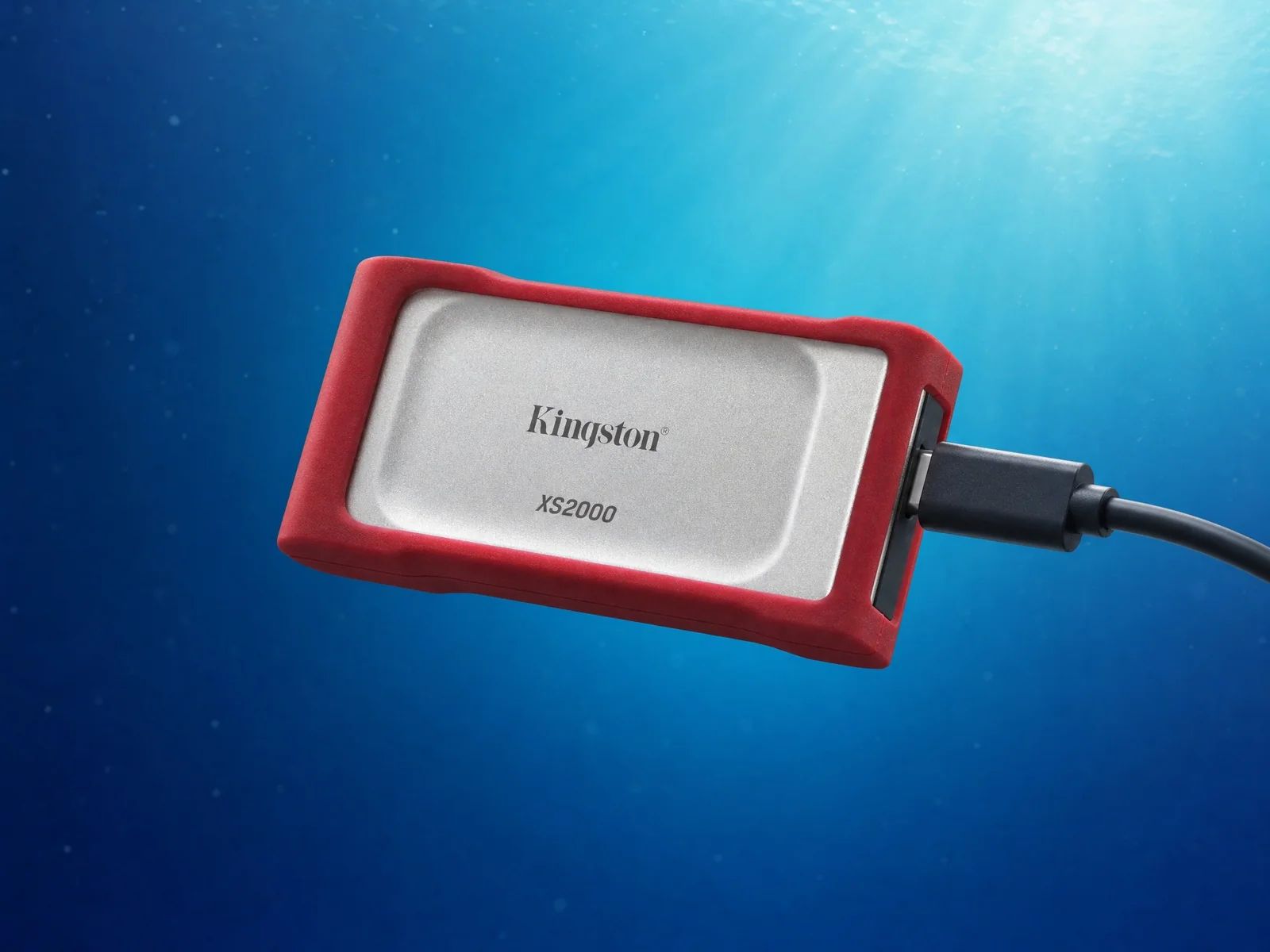
Kingston XS2000: Extreme performance and compactness for the traveling photographer.
SSD Kingston XS2000 review- ideal for underwater photographers. Ultra-compact drive with 2000 MB/s speed. Lightweight but requires careful protection in the marine environment.
To improve your mastery of your equipment and optimize your procedures while diving, discover our specialized training modules on AquaExposure training.
Kingston XS2000: The power of a 2000 MB/s SSD in a compact format
Between the sliding deck of a boat and a camera bag overflowing with cables, the choice of a storage device often comes down to physical details. After a dive that generates many RAW files or 4K videos, the priority is to secure this data before the equipment returns to the water. It is in this context of absolute mobility that the Kingston XS2000 stands out with its radical approach to compactness. This small enclosure promises top-level performance without adding bulk to your carry-on luggage.
No, despite its IP55 certification, this SSD is not submersible. It is resistant to splashes of water and dust, but accidental submersion would damage the data. It must absolutely remain in a waterproof enclosure or a dry area on the boat.
How do I achieve the maximum read/write speed of 2000 MB/s?
To achieve read and write speeds of 2000 MB/s, your computer must be equipped with a USB 3.2 Gen 2x2 port. With a standard USB-C port, the speed will be limited to approximately 1000 MB/s.
Is a rubber housing essential?
Yes, the IP55 certification and the 1.8-meter drop resistance are dependent on using the included protective housing. Without it, the drive is much more vulnerable to impacts and moisture.
The Kingston XS2000 is surprising for its lightness. Weighing only 28.9 grams, this drive is the lightest model on the market [1]. For a photographer who carefully monitors every gram of their backpack to stay within airline limits, this weight saving is invaluable. The drive is so small that it can be easily stored in a shorts pocket, offering complete discretion during travel. Its reduced dimensions make it only slightly larger than a USB flash drive, yet it can hold up to 4 TB of internal storage [2].The chassis design combines metal and plastic to ensure sufficient rigidity without adding excessive weight. This choice also allows for adequate passive heat dissipation. When transferring several terabytes of data, the enclosure can become warm to the touch. This temperature increase indicates that heat is being dissipated away from the flash memory chips, although the lack of a large heatsink requires caution in tropical environments.
This compact design does not compromise robustness. Kingston provides a removable rubber cover that is essential when you leave the office. It ensures a secure grip, even with wet fingers, and allows the drive to withstand drops of 1.8 meters according to the manufacturer's tests [2]. This is a welcome safety feature when handling the drive on a boat deck or in the hustle and bustle of transportation.
Theoretical Performance and Real-World Limitations
The XS2000 boasts speeds that can reach up to 2000 MB/s for both sequential read and write operations [2]. This performance is based on the USB 3.2 Gen 2x2 interface. For a photographer, such speed allows you to offload a 128 GB card in less than two minutes. This time savings is crucial between dives to review your shots before the light changes or the boat moves to a new location.A technical limitation is worth noting. The USB 3.2 Gen 2x2 standard is still relatively uncommon on laptops. If you connect this SSD to a standard USB-C port, the transfer speeds will drop to around 1000 MB/s [1]. The drive remains fast, but it only delivers its full potential with specific hardware configurations. It is important to check the compatibility of your equipment before relying on these maximum transfer speeds.
Even when limited to 1000 MB/s, the experience remains excellent. The responsiveness is significantly better than that of mechanical drives, which typically max out at 150 MB/s. The difference is most noticeable with large file transfers rather than in immediate responsiveness. For a video editor, working directly from the XS2000 is feasible without noticeable latency, provided that the cache is not overloaded during extended sessions.
Protection, Limitations, and Compatibility in Marine Environments
The marine environment is harsh on electronics. The Kingston XS2000 has an IP55 rating, protecting it against dust and water jets [2]. This feature allows it to withstand splashes or handling with wet hands. However, this protection is modest compared to models that are truly submersible, such as the SanDisk Professional PRO-G40.The IP55 rating does not allow for any submersion. A drop into a rinsing tank or a wave on the workbench could be fatal to your files. Using a waterproof housing remains essential for trips at sea. Regarding the climate, the manufacturer limits the operating temperature to 40°C [2]. Under a tropical sun, this threshold is quickly exceeded. It is recommended to keep the drive in the shade and in a well-ventilated area to avoid any thermal throttling. Excessive heat could slow down your transfers and affect the long-term reliability of the components.
Who is this SSD really for?
The Kingston XS2000 is aimed at creators who prioritize portability. If you travel light, this model is a natural choice. It is suitable as a temporary work drive for sorting photos or editing short sequences without slowdowns. Its tiny size allows it to be integrated into any travel kit without compromise.
The lack of hardware encryption is a point of concern for sensitive data [1]. Security here relies on third-party software. We envision the XS2000 as a second backup drive or a fast transfer unit. Its lightness allows you to easily carry two copies, a prudent strategy for doubling your backups without weighing down your equipment.This approach allows you to apply the 3-2-1 rule. This means keeping three copies of your data, on two different storage media, with one copy stored in a separate location. With two XS2000 units, you have a redundant and ultra-fast backup solution that fits in the palm of your hand. This is a significant advantage during frequent expeditions.
AquaExposure's Opinion: A Score of 5/10, to be Interpreted Carefully
In our technical evaluation, the Kingston XS2000 receives a Diver Score of 5/10. This result reflects a specific technological compromise. This score is affected by the limited water protection and the lack of hardware encryption, two essential criteria for safety during expeditions.
For supervised use, this drive remains a relevant option. Its performance-to-price ratio is excellent, and its compactness remains unmatched. This is not the device you would leave on the deck of a boat, but rather a discreet storage solution that will stay dry in a protected bag. This score of 5/10 encourages caution: the XS2000 is performant but requires strict protection measures.
When the sun sets and memory cards are empty, peace of mind comes from the security of your images. The Kingston XS2000 offers this speed in a miniature format, provided you give it the dry protection it deserves. It is a consistent choice for photographers who refuse to compromise between speed and lightness.Visuel 1: The Kingston XS2000 placed next to a USB drive and an SD card to emphasize its extreme compactness. Alt text: Size comparison between the Kingston XS2000 SSD, a USB drive, and an SD card, showing its tiny format.
Visuel 2: The SSD with its blue rubber casing, placed on a wooden table in the shade, with a laptop in the background. Alt text: Portable Kingston XS2000 SSD with its blue protective casing next to a laptop.