Komodo National Park: drift photography technique, Manta Alley, strong current diving and liveaboard logistics. An honest guide for experienced underwater photographers.
No. Komodo is a destination for experienced divers (minimum 50 dives, solid current handling). Currents can be violent and unpredictable. A beginner holding a camera in strong current is a risk to themselves and others. Build experience in calmer destinations (Maldives, Red Sea) before Komodo.
Manta Alley is active year-round, but April to November (dry season, clearer water) offers the best photography conditions. December to March brings occasional reduced visibility. Giant manta rays (Manta birostris) are present year-round at Manta Alley and Karang Makassar.
Not mandatory, but strongly recommended for photographers. A liveaboard gives access to isolated sites (Cannibal Rock, Batu Bolong, South Komodo) that day trips cannot reach, allows diving at the right tidal stages, and provides expert briefings on the day's specific currents.
Drift photography: let the current carry you instead of fighting it, anchor behind a coral formation to create a stable shooting platform, pre-configure the camera before leaving your shelter, and shoot in burst mode. Body stabilization (slightly bent knees, elbows tucked in) replaces a tripod.
On Komodo and Rinca islands, dragons sometimes descend to beaches. Observing them from a zodiac or from shallow water is possible. Photography from the surface (snorkeling) provides a unique angle: a dragon on the beach seen at water level. Always maintain safety distance (minimum 5 meters).
Variable. In the dry season (April-November), 15 to 30 meters on northern sites (Batu Bolong, Crystal Rock). During the rainy season, sometimes under 5 meters on some sites. Cold upwelling water (18-22°C on southern sites) can bring plankton that reduces visibility but attracts manta rays.
Log at least 20 dives in moderate current before departure (rocky Mediterranean coastline or tidal channels). Master BCD control in current (rapid venting without stopping). For photography: learn to pre-set your camera quickly and switch to survival auto-mode if the situation requires it.
To learn how to get the most out of your gear underwater, discover the AquaExposure training.
Komodo is not a destination you choose for a relaxed dive. You choose it when you want to push your underwater photography to its limits: violent currents, guaranteed megafauna, and seascapes with no equivalent elsewhere in Southeast Asia. This guide is honest about what the destination demands.
Komodo National Park, a UNESCO World Heritage site, sits between the islands of Flores and Sumbawa in central Indonesia. What makes it unique for photographers is the meeting of several water masses: the Indian Ocean, the Flores Sea and the Banda Sea create currents that can exceed 8 knots in the channels.
These currents have two contradictory effects for the photographer. On one hand, they make diving technically demanding. On the other, they are the reason marine life is so dense: nutrients brought up from the depths feed a food chain whose upper links are giant oceanic manta rays, reef sharks, massive fusilier schools and an impressive number of sea turtles.
In a Mediterranean training session, a student once asked me how to improve at current photography. My answer: start with tidal currents at rocky sites in France or Spain, then move to Maldives channels, and only after that consider Komodo. Progression matters.
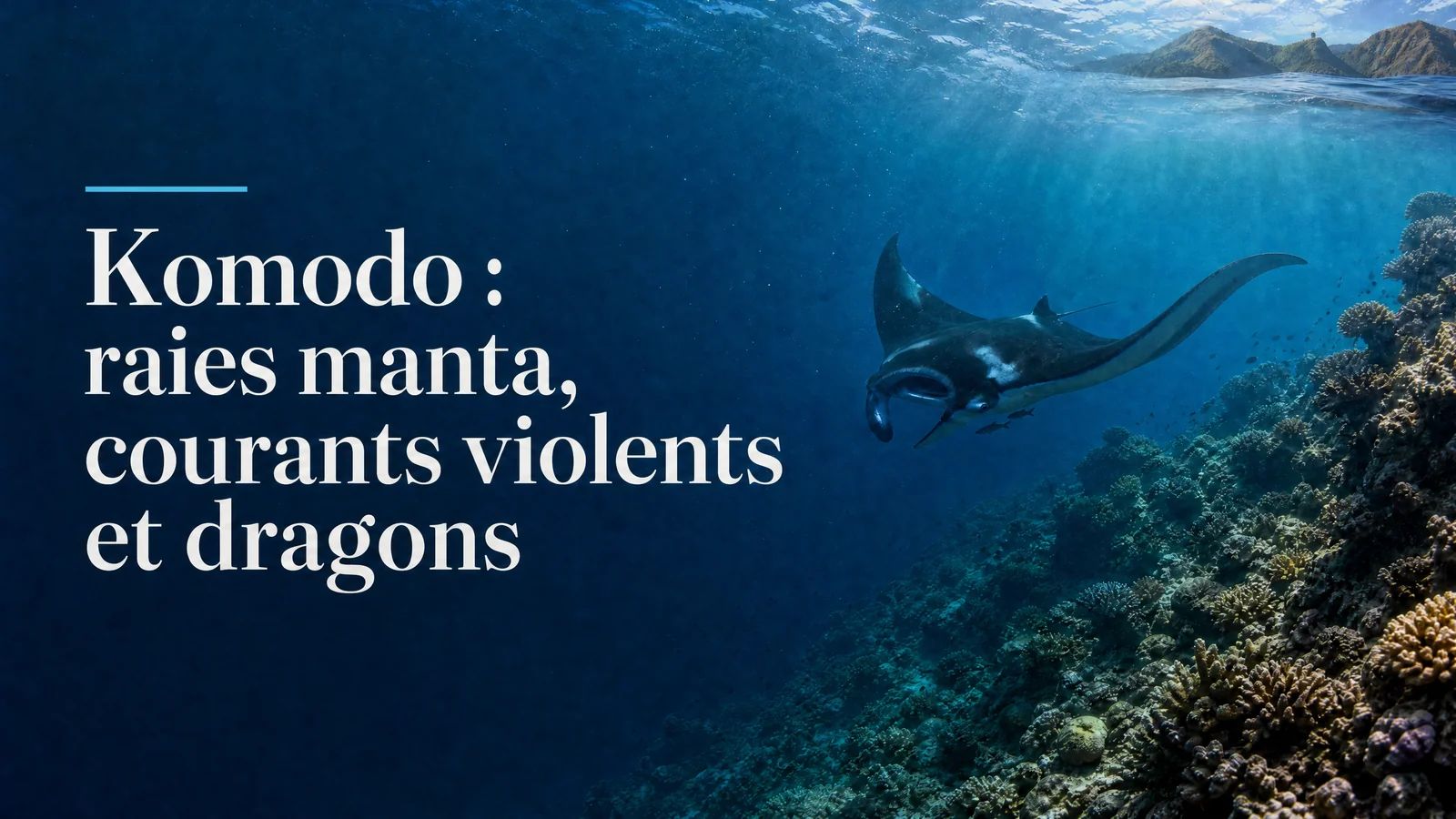
Manta Alley, on the southern tip of Komodo island, is one of the few places in the world where giant oceanic manta rays (Manta birostris, up to 7 meters wingspan) are reliably present year-round. They come to get cleaned by wrasse fish on coral heads at shallow depths (5 to 15 meters).
The photography technique here differs from the Maldives: the current pushes mantas toward you rather than allowing you to approach them. Position yourself downstream from the current, behind a coral formation, and let the mantas pass overhead. Shooting angle: toward the surface, slightly upward, to capture the manta's silhouette against the background light.
Recommended settings: wide angle (14-24mm full-frame equivalent), f/8, ISO 400, 1/250 to freeze the manta's wings. Pre-configure before leaving your shelter.
Karang Makassar (often called "Manta Point") is a cleaning station where mantas circle above coral heads. Visibility can be reduced here (cold water upwellings), but the mantas are within arm's reach.
The recommended shot: position yourself 3-4 meters below the mantas, aim toward the surface to silhouette them against the diffuse background light. With proper backlight and silhouette composition, the image holds even in limited visibility.
Batu Bolong is an isolated rock in the channel between Komodo and Rinca. The current is strong (up to 5-6 knots at full tide) and creates a remarkable aggregation of marine life: thousands of fusiliers, patrolling reef sharks, giant Napoleon wrasse.
This site is dived only at slack tide (the current slows for 30-45 minutes around the turn). Your guide calculates the exact time during the briefing. For photography: anchor behind the rock, use the slack period to frame fish schools with the current visible in the background (fish hold position facing the current, creating geometric formations).
Cannibal Rock offers the calm contrast to Komodo. In a sheltered lagoon, little current, and extraordinary macro life density: orange dendrophyllia corals in mass, pygmy seahorses on soft coral, abundant nudibranchs. It is the relaxation site after major current dives.
Drift photography is the art of photographing while letting the current carry you rather than fighting it. It is the fundamental technique of Komodo.
Real stabilization comes from the body, not from an accessory. In current:
Komodo's currents can reverse or accelerate without warning. Safety rules that apply well beyond photography:
Photography never justifies taking safety risks. Read our planning guide for dive photography travel before departure.
The most photographically productive sites (Manta Alley, Cannibal Rock, southern Komodo sites) are at minimum 90 minutes by boat from Labuan Bajo. A day trip gives you 2-3 dives on accessible sites. A 4-day liveaboard gives you 12-16 dives across the entire park, with expert briefings adapted to the day's specific currents.
A 4-day/3-night liveaboard at Komodo runs approximately €500 to €1,500 [Estimate], varying by boat comfort level. For operator recommendations, consult PADI or SSI certified local dive centers.
Fly into Labuan Bajo via Bali (connection) or from Lombok. Labuan Bajo is the departure point for all liveaboards and day trips to the national park. The town has developed significantly in recent years with a good range of accommodation and dive centers.
Komodo National Park also shelters Komodo dragons (Varanus komodoensis), the world's largest lizards. On the islands of Komodo and Rinca, they sometimes descend to beaches.
The interesting shot: from a zodiac or snorkeling at the surface, photograph a dragon on the beach with the water and reef as foreground. Very few photographers do this because everyone exits the water to shoot from the beach. Staying in the water at eye level gives a unique angle that few portfolios contain.
Safety distances are non-negotiable: minimum 5 meters from dragons, and never swim alone in areas where dragons are visible on the beach.
Komodo appears in our best underwater photography destinations 2026 list, but with an honest caveat: this is not a beginner's destination. Current photography requires solid technical diving and body stabilization skills.
If you are traveling to Southeast Asia and want to combine Komodo with a more accessible destination, Bali and Nusa Penida work well as a tandem: start at Nusa Penida to revisit megafauna fundamentals, then move to Komodo for strong currents and giant mantas.
Check our seasonal guide by destination for the best photography window for your travel period.
For photographers looking to build their technique before departure, the AquaExposure underwater photography course includes a dedicated module on difficult-conditions photography directly applicable to Komodo's currents.
AquaExposure receives no affiliate commission from liveaboards, dive centers or accommodation mentioned in this article.


