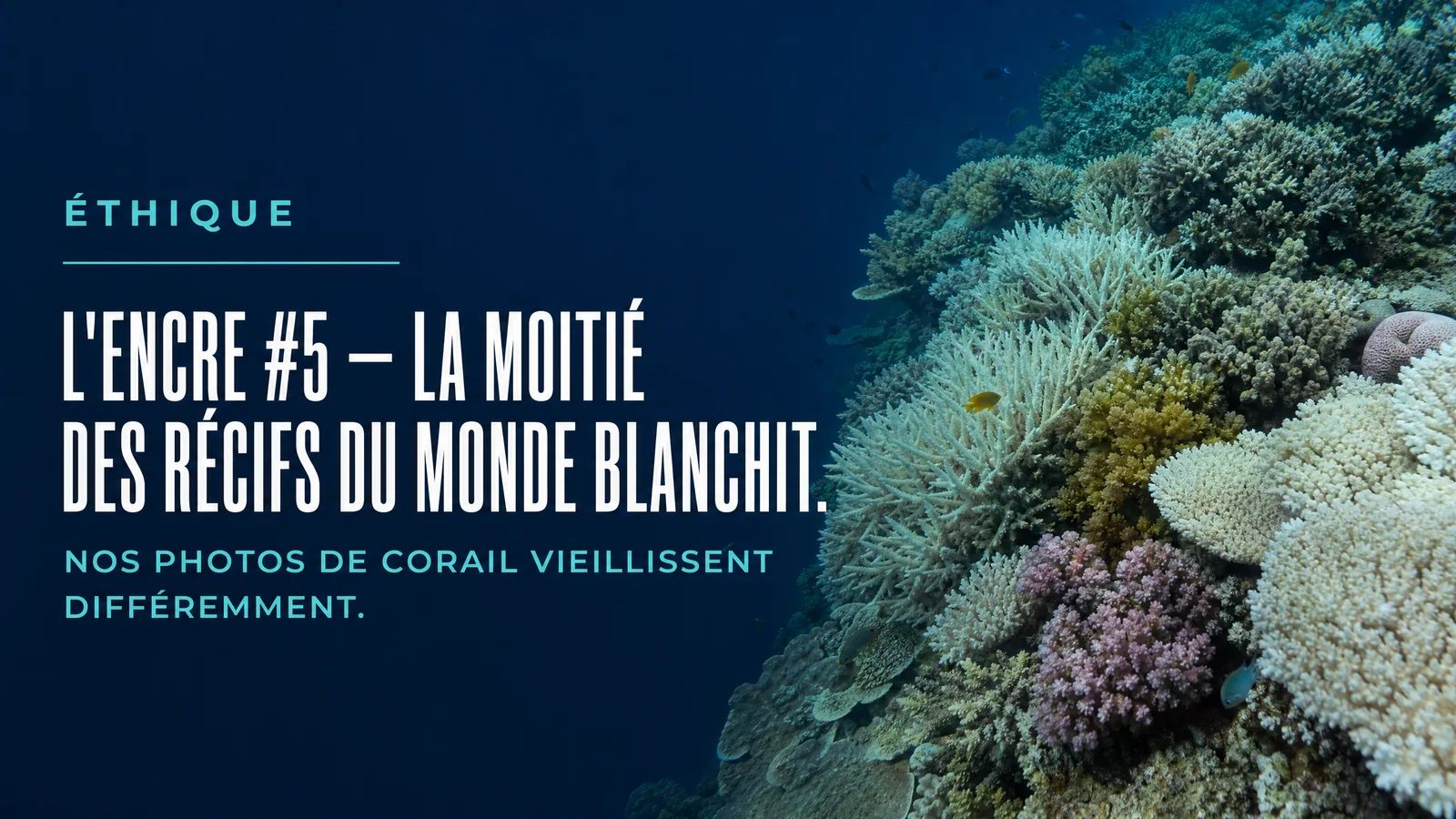
51% of coral reefs bleached in the 4th global bleaching event, microplastics undermining ocean CO2 absorption, a third of Pacific fish carry plastic. What it means for underwater photographers.
A bleached reef is not immediately dead. It is under extreme stress. The living tissues have expelled their symbiotic algae, exposing the white skeleton. The animal is still there, but deprived of its main energy source. For photographers, images of a bleaching reef have particular documentary value. They capture a transitional state, sometimes irreversible, that very few people see and even fewer document well.
No. Microplastics are by definition smaller than 5 mm. Most measure just a few microns. They are invisible to the lens in the water and in the tissues of the animals we photograph. That is precisely what makes their presence so difficult to communicate and document visually.
Microplastics disrupt phytoplankton, responsible for roughly 25% of global CO2 absorption. When plastic particles come into contact with these micro-algae, they reduce their ability to photosynthesize and reproduce. A study published in January 2026 confirmed that this interference measurably reduces the ocean's capacity to act as a carbon sink.
Document precisely (species, GPS, date, estimated bleaching percentage), share data with citizen science programs like CoralWatch or ReefCheck, avoid any physical contact with bleached corals which are in a state of maximum vulnerability. Properly documented diver photos enrich monitoring databases and have genuine scientific value.
"No water, no life. No blue, no green." Sylvia Earle
There is a precise moment, during the descent, when the reef appears. Not all at once. In fragments. A brain coral block, a few staghorn branches, and that palette of colours forming as the eyes adjust to filtered light. For photographers, this is often the best second of the dive. Before pressing the shutter. Before even putting your eye to the viewfinder. Just the first look.
In February 2026, a study published in Mongabay analysing data from more than 15,000 reefs across the planet put a number to something many divers had felt but could not quantify. 51% of the world's coral reefs suffered moderate or worse bleaching during the Fourth Global Bleaching Event. Not a forecast. A reckoning.
Three pieces of news from the water. Three topics with no easy resolution. And a question that underwater photographers will have to carry more and more often.
The first major episode dates back to 1997-1998. The second, to 2010. The third, from 2014 to 2017, was the longest ever recorded. The one unfolding since 2023 is the fourth. NOAA added new alert levels to classify it, because the old ones were no longer sufficient to describe what is happening.
The mechanism is the same each time. Surface water temperature exceeds coral tolerance thresholds for too long. Corals expel the zooxanthellae algae living in their tissues and providing their pigmentation. Without these algae, the white calcium carbonate skeleton becomes visible again. The coral is not dead. It is under extreme stress, stripped of its primary energy source.
If the temperature drops fast enough, the algae return. If it stays high too long, the coral dies. And during this fourth episode, the water is not cooling fast enough in many areas.
15% of the reefs observed in the February 2026 study suffered "significant mortality". That is no longer stress. That is permanent loss.
The Great Barrier Reef experienced its sixth mass bleaching since 2016. The Caribbean, the tropical Pacific, the Indian Ocean: events are repeating, more frequently and more intensely than in previous episodes. The recovery interval between two episodes is shrinking. A reef that bleaches every five or ten years can recover. A reef that bleaches every two years cannot.
In January 2026, a study published in ScienceDaily confirmed something scientists had suspected for several years. Microplastics do not just pollute. They interfere with the basic functioning of the ocean.
Phytoplankton accounts for roughly 25% of global CO2 absorption. These micro-algae capture dissolved carbon dioxide, integrate it into their biomass through photosynthesis, and help maintain the chemical balance of the atmosphere. The ocean absorbs about a quarter of all human CO2 emissions. It is an invisible, free, and massive function.
Microplastics disrupt phytoplankton photosynthesis. When particles come into contact with these micro-algae, they reduce their capacity to reproduce and capture carbon. At scale, this interference diminishes the ocean's ability to act as a carbon sink. Which contributes to warming. Which heats surface waters further. Which intensifies bleaching events.
A loop. Not a metaphor. A documented mechanism.
In 2026, a team from the University of the South Pacific, based in Fiji, published the results of a study conducted on 878 coastal fish representing 138 species across four countries: Fiji, Tonga, Tuvalu and Vanuatu. Of these fish, nearly a third contained microplastics in their tissues.
The numbers vary by site. In Fiji, 75% of sampled fish contained them. In Vanuatu, around 5%. The difference reflects coastal population density, waste management practices, and local ocean currents.
What this study confirms is that plastic contamination now affects coastal fish in archipelagos that many still imagine as pristine waters. The species involved include common reef fish, exactly the kind of subjects found in thousands of diver photographs.
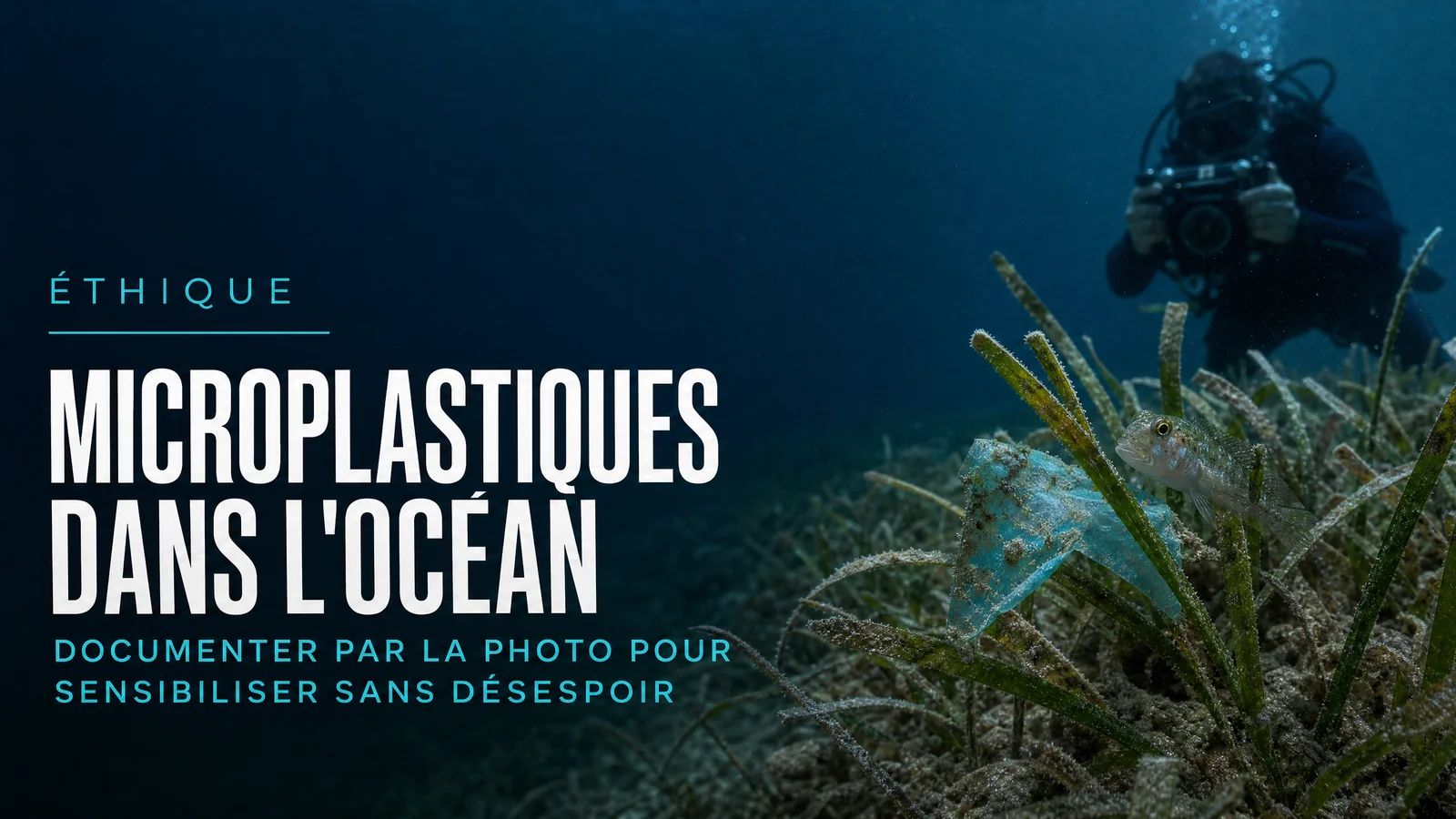
There is nothing visible in these fish. Their behaviour has not changed. Their colour has not changed. The microplastics sit in their gastrointestinal tracts, sometimes in their muscles. These fish are swallowing synthetic fibres, fragments of degraded bottles, polyethylene beads. The image is the same. The content is different.
For those who dive with a camera, these three pieces of information raise a question that nobody had to ask in 2010.
Coral reef photographs are becoming archives. Not in a hundred years. Now. A reef photographed in 2019 on certain Great Barrier Reef sites already looks like a period document. The structures are partly the same, some species are the same, but the colour density, the health of the colonies, the distribution of life no longer bear any resemblance to what is there today.
This does not mean photographing reefs the way one documents a disaster. The approach I have always defended is to look for the living, the movement, the light. But it means that the date on a coral reef photo now matters as much as the composition.
Microplastics add another layer to this reflection. We photograph fish that carry, invisible in their tissues, the traces of how we make and discard objects. We photograph reefs bleaching partly because the ocean absorbs less CO2 than before, itself partly because plastic disrupts phytoplankton. The photo shows none of these connections. It shows a fish in the light.
That is not a reason to stop photographing. It is a reason to understand what you are photographing.
If you want to go further on the links between ethics, science and underwater photography practice, the AquaExposure training includes specific modules on these subjects. Because a photographer who understands their environment does not frame the same image as one who dives without that context.
A bleached reef is not immediately dead. It is under extreme stress. The living tissues have expelled their symbiotic algae, exposing the white skeleton. The animal is still there, but deprived of its main energy source. For photographers, images of a bleaching reef have particular documentary value. They capture a transitional state, sometimes irreversible, that very few people see and even fewer document well.
No. Microplastics are by definition smaller than 5 mm. Most measure just a few microns. They are invisible to the lens in the water and in the tissues of the animals we photograph. That is precisely what makes their presence so difficult to communicate: a photo of a contaminated fish and a photo of a healthy fish look identical.
Microplastics disrupt phytoplankton, the micro-algae responsible for roughly 25% of global CO2 absorption. When plastic particles come into contact with these organisms, they reduce their ability to photosynthesize and reproduce. A study published in January 2026 confirmed that this interference measurably reduces the ocean's capacity to act as a carbon sink, contributing to accelerating surface water warming.
Document precisely (species, GPS, date, estimated bleaching percentage), share data with citizen science programs like CoralWatch or ReefCheck, avoid any physical contact with bleached corals in their state of maximum vulnerability. Properly documented diver photos enrich monitoring databases and have genuine scientific value.
Further reading:
The first time you photograph a bleached reef, you often think the light is wrong. That the water is murky. That the subject is not at its best. And then you understand: no. The light is perfect. The water is clear. The reef has changed. And the date in the metadata of that photo now matters more than the exposure.