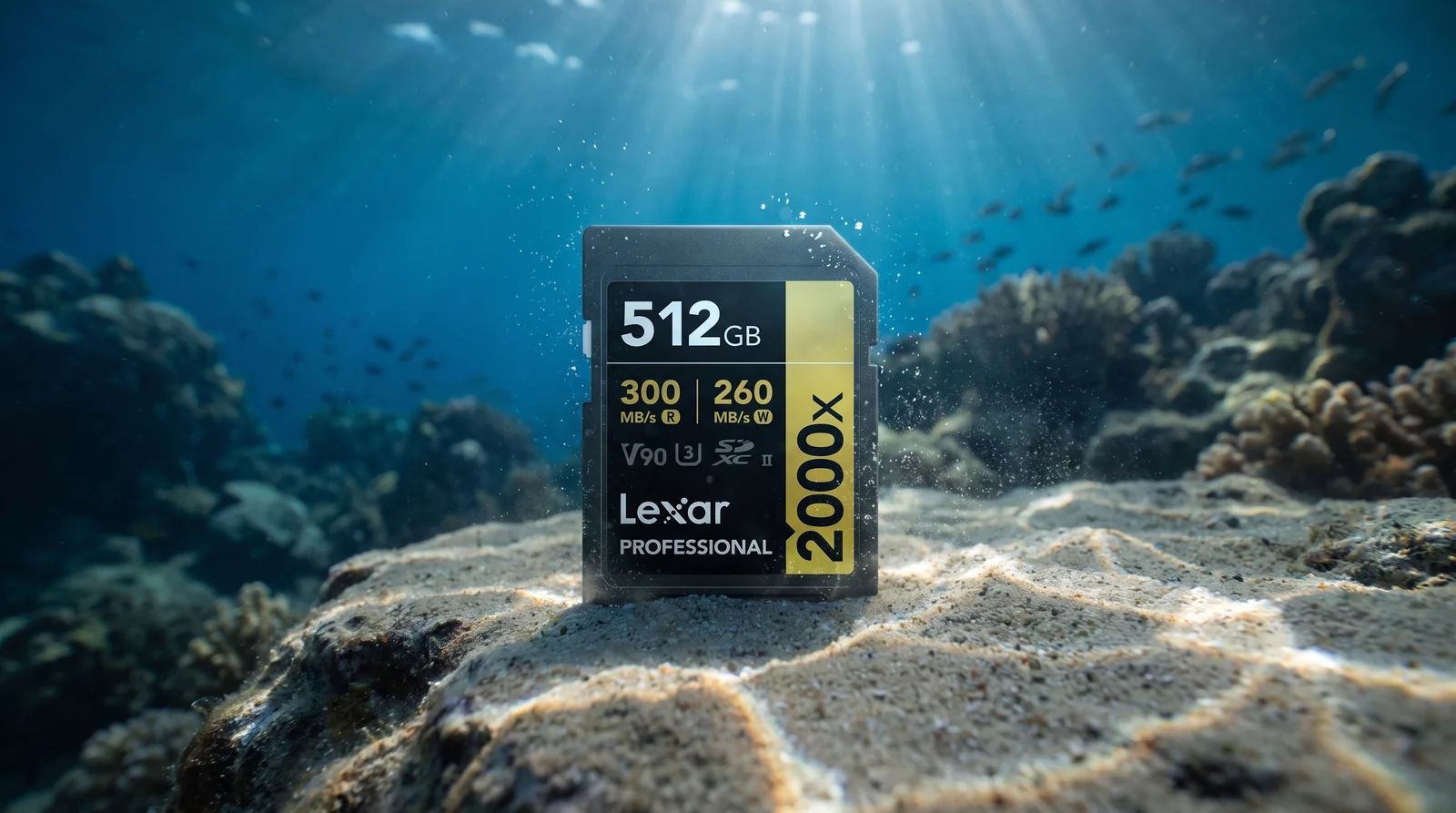
Is the Lexar 2000x GOLD memory card truly waterproof for diving?
The current GOLD series does not have an explicit IPX7 or IP68 certification in its official technical documentation. While it is resistant to shocks and temperature variations, direct immersion remains risky. The use of a waterproof housing is essential, and all contacts must be protected from any trace of salt water.
Can this card be used to record video in 8K without interruption?
The Video Speed Class 90 certification guarantees a constant minimum write speed of 90 MB/s. This threshold is sufficient for 8K video recording and All-Intra formats on modern hybrid cameras, preventing recording interruptions caused by storage medium saturation.
What is the difference between the 260 MB/s speed that is advertised and the V90 standard?
The 260 MB/s refers to the peak sequential write speed during short bursts. The V90 rating guarantees sustained performance that never falls below 90 MB/s, which is the necessary condition for the stability of a high-resolution video recording.
To improve your mastery of your equipment and optimize your diving procedures, discover our specialized training modules on AquaExposure training.
Lexar Professional 2000x GOLD: V90 performance for underwater 8K video
Between a still-damp camera bag and the deck of a boat, some equipment choices are made less by reading a technical specification sheet and more by the moment when you really need to rely on them. Data management is a technical challenge that is as crucial as mastering lighting. The increasing number of cameras capable of filming in 8K or shooting high-resolution bursts places unprecedented demands on storage media. For professionals working in an aquatic environment, the memory card becomes a critical link between the captured scene and the final file. The Lexar Professional 2000x GOLD is positioned in this high-end segment where speed and data flow stability are the absolute priorities. Analyzing its specifications allows you to precisely understand the potential and limitations of this storage medium, ensuring the complete integrity of the files produced.
A UHS-II architecture designed for extreme speeds.The performance of the Lexar Professional 2000x GOLD relies on the UHS-II interface. This technology features a second row of connectors on the back of the card, doubling the communication pathways with the camera. Thanks to this architecture, the card boasts a theoretical read speed of up to 300 MB/s [1]. This translates to a significant time saving when transferring files after an intensive dive session, making it easier to switch equipment between dives.
For a photographer producing hundreds of RAW files, transfer speed is a major factor in productivity. The ability to empty a 256 GB card in just a few minutes optimizes the workflow. In terms of write speed, the card achieves peaks of 260 MB/s [1]. This responsiveness is particularly beneficial for wildlife photography, where burst shooting captures the precise moment of an interaction. A high write speed allows the camera's buffer to clear more quickly, preventing the shutter from locking up.
The V90 Certification: A Guarantee for 8K Video
The key characteristic for video recording is the Video Speed Class 90, or V90, certification. This standard guarantees that the card maintains a constant minimum write speed of 90 MB/s, regardless of its fill level [1]. For videographers using demanding formats such as 8K or high-bitrate 4K All-Intra, this guarantee is essential to avoid any loss of footage.A high-resolution video recording will not tolerate any slowdowns. If the storage fails, the camera will stop recording, resulting in the loss of a unique sequence. The Lexar Professional 2000x GOLD ensures this continuous flow, allowing you to utilize the most demanding recording modes of hybrid cameras. This stability results from optimized internal controller management for extended sequential writes, meeting the highest professional standards.
Reliability and Limitations in a Marine Environment
Robustness is a fundamental selection criterion. The Lexar Professional 2000x GOLD operates within a temperature range of 0°C to 70°C, and can be stored between -25°C and 85°C [3]. This thermal tolerance is valuable when equipment heats up quickly inside a waterproof housing exposed to sunlight. The card also benefits from resistance to shocks, vibrations, and X-rays [3].
However, waterproofing remains a point of concern. The technical specifications do not explicitly state an IPX7 or IP68 certification for the GOLD series [2]. The card retains a classic design with plastic ribs that represent potential points of weakness. In a marine environment, salt is a formidable corrosive agent. Handling the card with wet hands can compromise the connectors. Therefore, it is essential to rigorously protect the card from any trace of salt water before inserting it.## Workflow Management and Data Transfer
The efficiency of a memory card impacts the entire production chain, from shooting to editing. Storage capacities ranging from 64 GB to 512 GB allow you to tailor the storage to the needs of each dive [1]. For a full day of diving without the possibility of data transfer, high-capacity models offer a welcome peace of mind. Using a fast storage medium transforms the post-production phase, and the time saved allows you to focus on creative editing.
Lexar offers a limited lifetime warranty, demonstrating its confidence in the durability of its components [1]. To optimize longevity, it is recommended to perform a full format within the camera before each session. This practice ensures a clean file structure and allows the controller to manage cell wear effectively. In a professional setting, regularly replacing the storage media prevents failures related to the natural wear of the NAND chips.
Compatibility and Technical Usage PrecautionsBefore using this type of memory card, it is essential to verify hardware compatibility. While the card is backward compatible with the UHS-I standard, its performance will be limited to around 100 MB/s. Purchasing a V90 card becomes technically unnecessary if the housing cannot utilize the UHS-II bus. It is also important to consider the physical structure of the card, as the thin plastic tabs separating the connectors are particularly delicate and susceptible to twisting.
Regularly inspecting the card's physical condition is recommended to avoid any risk of it becoming stuck in the reader. Finally, thermal management should be monitored during extended video recordings. High-performance UHS-II cards can generate significant heat when writing 8K video streams, which may trigger thermal safety alerts on some housings. Ensuring good heat dissipation and avoiding direct exposure to sunlight are simple steps that help maintain the card's health.
Conclusion regarding professional useThe Lexar Professional 2000x GOLD is a high-performance storage solution for demanding creators working in challenging environments. Its V90 certification and high data transfer rates make it suitable for modern video recording and high-resolution photography. It allows you to push the technical limits of your equipment by providing a stable data flow, which is essential for ensuring the quality of your images. This performance must be accompanied by consistent and careful use, especially given the risks of exposure to saltwater.
The lack of a waterproof certification serves as a reminder that this storage device remains a sensitive electronic component. For underwater photographers, it represents an excellent compromise between speed and capacity, provided that strict protection protocols are followed. When used judiciously, it is a valuable asset for transforming encounters in the underwater world into lasting digital files. When the equipment no longer demands your attention, you are finally left with what brought you there: a changing light, a settling silence, and that simple desire to return to the water.
References
To compare this model with all the available options on the market, consult our SD and microSD card comparison tool and our complete selection of diving equipment.Here are some essential considerations for underwater photographers:
* Memory Cards: Choose high-performance memory cards specifically designed for professional use. The Lexar Professional 2000x SDHC/SDXC UHS-II card [1, 2] is a good option, offering fast read and write speeds. Refer to the technical specifications [3] for detailed information.
[VISUEL 1] Location: After the first paragraph of the section "A UHS-II architecture designed for extreme speeds." Type: Macro photograph of the back of a Lexar 2000x GOLD card, highlighting the double row of gold UHS-II connectors. Alt text: Detailed view of the UHS-II connectors on a Lexar Professional 2000x GOLD card, showing the second row of pins for high-speed transfers.
[VISUEL 2] Location: Before the section "Conclusion on professional use." Type: Illustration showing the card inserted into a professional card reader connected to a laptop, with a waterproof housing in the background. Alt text: Downloading data from a Lexar Professional 2000x GOLD card to a workstation after an underwater photography session.
Lexar Professional 2000x GOLD: V90 performance for 8K underwater video. | AquaExposure