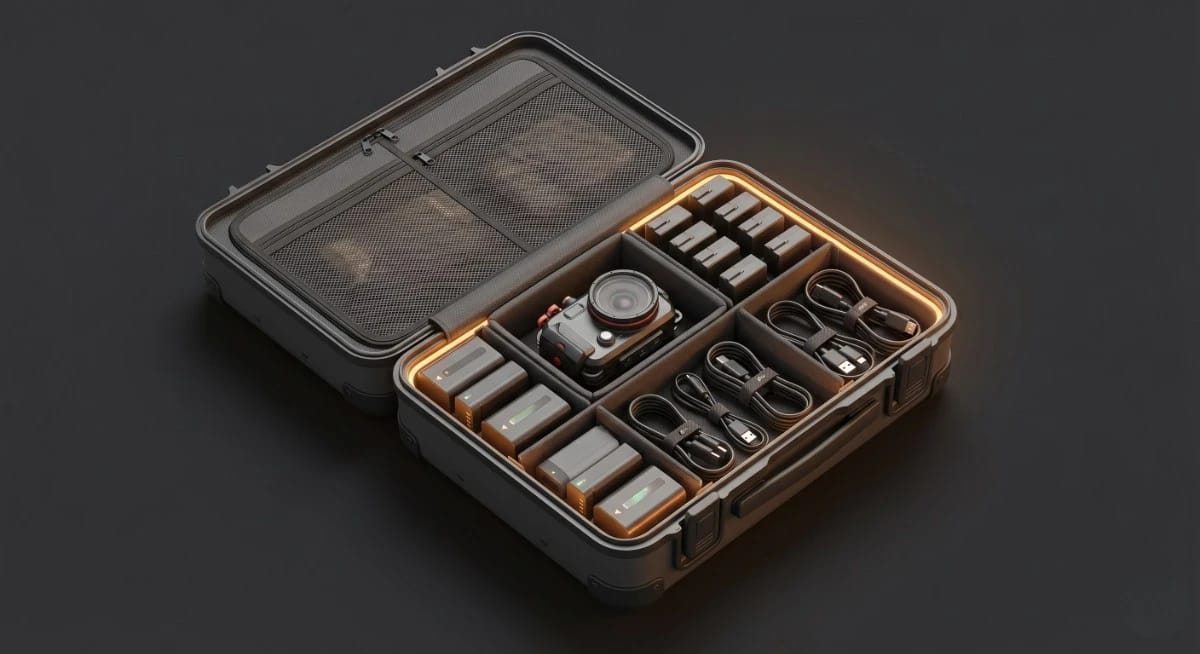
Dive batteries and lights on airplanes: the complete IATA guide for stress-free travel
Transporting lithium batteries and dive lights on planes: IATA 2026 rules, cabin vs hold, fireproof pouch. Practical guide by a former instructor.
The scene repeats on every dive trip. You are at the airport, your bag on the belt, and the security agent points at your batteries asking what they are. You stammer something about underwater lights. He frowns. Behind you, the line grumbles.
How many lithium batteries can you bring on a plane?
For batteries under 100 Wh (the vast majority of dive gear), IATA does not set a strict limit. Most airlines allow between 4 and 10 spare batteries in the cabin. Above 100 Wh, a maximum of 2 spare batteries with prior approval.
Do GoPro batteries cause problems on planes?
No. A GoPro battery is about 6.6 Wh, which is 15 times less than the 100 Wh threshold. You can travel with several spare GoPro batteries in the cabin without any issues.
Do you need a fireproof pouch for dive batteries?
It is not mandatory under IATA rules, but it is strongly recommended. The pouch costs 10-15 euros, weighs nothing, and contains a potential overheat. A minimal investment for maximum peace of mind.
Can my dive light go in checked luggage?
Yes, if the battery is installed and the light cannot activate accidentally (switch locked or battery disconnected). But DAN Europe recommends carrying lights and batteries in cabin baggage when possible.
Are Ikelite strobe batteries affected by these rules?
Most Ikelite strobes use NiMH (nickel-metal hydride) batteries, not lithium. IATA lithium restrictions do not apply to NiMH. Check the battery type on your specific model.
I have lived this scene in Colombo, in Male, in Sharm el-Sheikh. Every time, the same cold sweat. And every time, the same conclusion: the problem was not the regulations. The problem was that I did not know them well enough to explain them in 30 seconds to someone who has never seen a dive light.
This guide is the one I wish I had on my phone before my first flight with dive gear. No legal jargon. Clear answers, field-tested, updated with IATA 2026 regulations.
What the IATA regulations say in 2026
IATA (International Air Transport Association) publishes its Dangerous Goods Regulations every year. The 67th edition, in effect since January 2026, governs the transport of lithium-ion and lithium-metal batteries for passengers.
Three thresholds to remember, one number per threshold.
Under 100 Wh: the vast majority of your dive batteries. Allowed in the cabin and in the hold (if installed in the device). Spare batteries must go in the cabin. There is no strict limit on the number of spare batteries, but most airlines apply a practical limit between 4 and 10 units. This category covers your dive lights, GoPros, compact cameras, and most strobes.
Between 100 and 160 Wh: prior approval from the airline is required. Maximum 2 spare batteries per passenger, cabin only. Some high-end dive lights (video, 10,000+ lumens) and large strobe batteries can reach this range. Check before you travel.
Above 160 Wh: prohibited on passenger flights. Period. If your battery exceeds this threshold (some rebreathers, professional video packs), it must be shipped separately as "dangerous goods" freight by an approved carrier. This rarely happens in underwater photography, but it does exist.
How many Wh do your dive batteries have?
The problem is that most manufacturers do not indicate Wh on the battery. They list mAh and volts. Here is the formula:
Wh = (mAh x V) / 1000
A few concrete examples.
A standard dive light (OrcaTorch, Big Blue type) uses an 18650 battery rated at 3400 mAh at 3.7V. That gives 12.6 Wh. Far below the 100 Wh threshold, no problem.
A powerful video light (Keldan, Light & Motion type) can use a 4x18650 pack rated at 14,000 mAh at 14.8V. That gives 207 Wh. Above the threshold. Prohibited on passenger flights.
A GoPro Hero 13: battery rated at 1720 mAh at 3.85V = 6.6 Wh. You could bring 20 without raising an eyebrow.
A compact camera (TG-7, TG-6): LI-92B battery rated at 1350 mAh at 3.6V = 4.9 Wh. No issues.
A hybrid camera (Sony A7 IV, Nikon Z6 III): battery of approximately 2280 mAh at 7.2V = 16.4 Wh. Comfortable.
A photo strobe (Ikelite DS165): rechargeable NiMH battery, not lithium. Lithium rules do not apply. But check with your airline anyway.
The practical rule: if your battery fits in one hand and powers personal dive equipment, it is almost certainly under 100 Wh.
Cabin or hold: the golden rule
Here is the table I laminated and stuck in my camera bag. It has not changed in 5 years, and the 2026 regulations confirm it.
Batteries installed in the device: cabin or hold. But the cabin is preferred. DAN Europe explicitly recommends this: if a light accidentally activates in the hold, no one can intervene.
Spare batteries (not in a device): cabin only. This is the law, not a recommendation. A loose battery in a hold overheating without supervision is a scenario that civil aviation categorically refuses.
Batteries in a charger: if the charger is connected to the battery, the battery is considered "in a device." If it is just sitting next to it, it is a spare battery. An important subtlety.
The 6 steps that prevent problems at the airport
These steps are not in the IATA regulations. They come from 15 years of dive travel and conversations with security agents around the world.
1. Protect the terminals. Each spare battery must have its terminals protected against short circuits. Electrical tape on the poles, or individual pouches. A short circuit in a cabin bag produces smoke in 10 seconds.
2. IATA-rated fireproof pouch. This is the AquaExposure tip I repeat to every student. A certified fireproof pouch (available for 10-15 euros) contains a fire in case of battery failure. It costs nothing, weighs nothing, and reassures the security agent.
3. Disconnect your lights. Remove the battery from each dive light before packing it. A light that activates in a bag is an intense heat source in a confined space. DAN Europe recommends separating batteries from lamp bodies for this reason.
4. Label your batteries. A small sticker reading "Li-ion 12.6Wh" on each battery. The security agent sees that you know what you are talking about. That defuses 90% of discussions.
5. Keep documentation accessible. The technical data sheet for your batteries (printed or as a PDF on your phone) with the Wh indicated. If there is any doubt, you can show you are under the threshold.
6. Check your airline. Each airline may have stricter rules than IATA. Air France, Emirates, Qatar Airways, EasyJet: they all publish their conditions on their website. 5 minutes of reading before the flight prevents 30 minutes of stress at the airport.
Special cases for the photographer-diver
Underwater drones (FIFISH, Chasing type): underwater drone batteries often exceed 100 Wh. Check before buying if you plan to travel with one. Some manufacturers offer "travel" batteries under 100 Wh, but with reduced range.
Rebreathers: batteries for some rebreathers (JJ-CCR, AP Diving type) can exceed 160 Wh. Freight shipping is mandatory, or dedicated travel batteries.
Safety lights: a main light plus a backup light is the minimum AquaExposure standard for every dive. Both use standard 18650 cells (12-13 Wh). No transport issues.
Chargers: chargers themselves are not batteries. They travel freely in the cabin or hold. But a charger with a battery plugged into it = the battery is "in a device."
Packing your battery bag: the checklist
Before every flight, I do the same thing. It takes 10 minutes and avoids any surprises.
1List every lithium battery in my luggage
2Calculate the Wh for each one (formula mAh x V / 1000)
3Verify that all are under 100 Wh (or request airline approval if 100-160 Wh)
4Remove batteries from lights
5Protect the terminals of every spare battery
6Put all spare batteries in the fireproof pouch in my cabin bag
7Keep technical documentation accessible
To go further, we created a free tool: the Airline Battery Checker by AquaExposure. You select your equipment (light, strobe, camera, GoPro, DPV), it calculates the Wh automatically, and it cross-references the specific rules of your airline (Air France, Lufthansa, Emirates, Ryanair.). Instant verdict: green, orange, or red. No need to calculate anything by hand.
You can also prepare your complete luggage with the Pack My Dive Bag app in Kai App, which integrates battery filters, AquaExposure doctrine, and a personalized checklist by trip type and climate.
What DAN Europe recommends
DAN Europe has published a specific guide on transporting dive lights by air. Their recommendations align with this guide, with three additional points.
First, prioritize cabin transport for bulbs and optics in addition to batteries. The hold mistreats fragile equipment.
Second, check the regulations of your return country. Some countries have local rules stricter than IATA. Senegal, for example, regularly confiscates poorly labeled batteries.
Third, contact the airline at least 48 hours before the flight if you are transporting batteries between 100 and 160 Wh. Verbal agreement over the phone is not always enough. Ask for written confirmation.
FAQ
How many lithium batteries can you bring on a plane? For batteries under 100 Wh (the vast majority of dive gear), IATA does not set a strict limit. Most airlines allow between 4 and 10 spare batteries in the cabin. Above 100 Wh, a maximum of 2 spare batteries with prior approval.
Do GoPro batteries cause problems on planes? No. A GoPro battery is about 6.6 Wh, which is 15 times less than the 100 Wh threshold. You can travel with several spare GoPro batteries in the cabin without any issues.
Do you need a fireproof pouch for dive batteries? It is not mandatory under IATA rules, but it is strongly recommended. The pouch costs 10-15 euros, weighs nothing, and contains a potential overheat. A minimal investment for maximum peace of mind.
Can my dive light go in checked luggage? Yes, if the battery is installed and the light cannot activate accidentally (switch locked or battery disconnected). But DAN Europe recommends carrying lights and batteries in cabin baggage when possible.
Are Ikelite strobe batteries affected by these rules? Most Ikelite strobes use NiMH (nickel-metal hydride) batteries, not lithium. IATA lithium restrictions do not apply to NiMH. Check the battery type on your specific model.
This article was written based on IATA DGR 67th edition (2026) regulations, DAN Europe recommendations on transporting dive lights, and 15 years of experience traveling with dive-photo equipment.
Preparing for a dive trip? The Pack My Dive Bag app in Kai App generates your personalized checklist with all battery filters and regulations built in. And if you want to learn how to photograph without flash (and therefore with fewer batteries to carry), discover our underwater photography course.
Dive batteries and lights on airplanes: the complete IATA guide for stress-free travel | AquaExposure