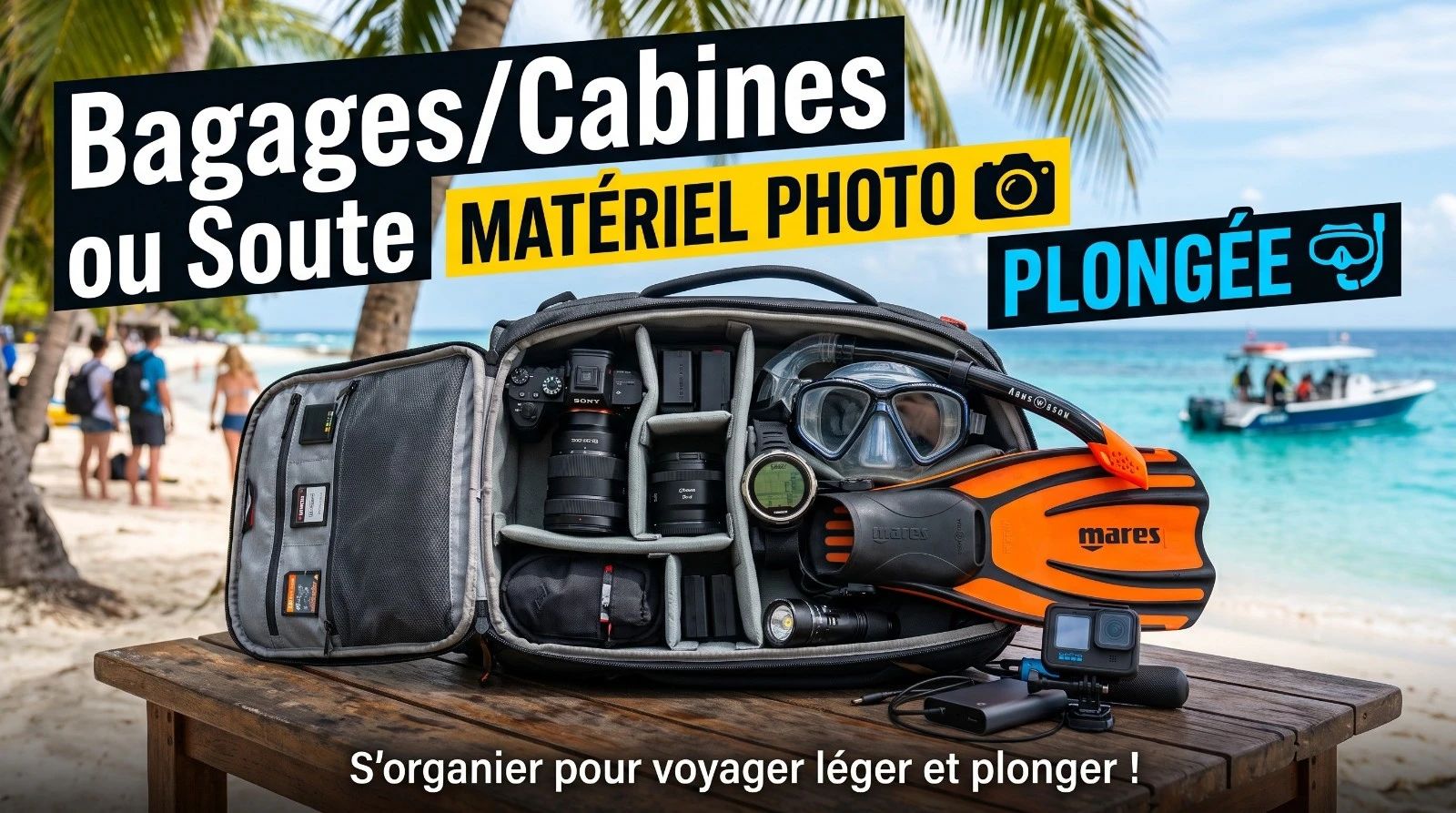
Cabin or hold: how to distribute your photo and diving gear
Cabin or hold for your underwater photo gear? Full strategy: what to protect in cabin, what can go in hold, and how to handle lithium batteries on planes.
Can I put an underwater photo housing in the hold?
Yes, if the housing is empty (no camera inside) and well protected in a hard case or wrapped in clothing. The camera body, lenses and batteries must travel with you in the cabin.
How do you transport lithium batteries on a plane for diving?
Lithium batteries travel in cabin only, never in the hold. Up to 100 Wh with no formality required. From 100 to 160 Wh with airline approval. Check the Wh marking on each battery before you leave.
Should a dive computer go in cabin or hold baggage?
Cabin. A dive computer contains a battery and costs several hundred euros. If it is lost or damaged in the hold, your diving trip is compromised the moment you land.
Can fins go in cabin luggage?
Almost never. Fins exceed standard cabin dimensions. They go in the hold, inside a sport bag or hard suitcase. Bring a sturdy fin bag.
How do you avoid overweight baggage fees on a dive trip?
Pack your hold suitcase around 20 kg of wetsuit, fins, regulator and empty housing. Carry heavy, fragile items in cabin (camera, computer, batteries). Weigh everything at home, not at the airport.
What if the airline refuses my camera bag as carry-on?
Always keep batteries in your backpack, never in the camera bag you might have to gate-check. If you are forced to check the camera bag, separate the batteries first and keep them with you.
Pour apprendre à tirer le meilleur parti de votre équipement sous l'eau, découvrez la formation AquaExposure.
Dividing your gear between cabin and hold is the first real puzzle of any photo diving trip. The short answer: everything expensive, fragile or containing lithium batteries travels with you in cabin. The rest can go in the hold, properly protected. This strategy protects your investment, respects IATA regulations and prevents the nightmare scenario of arriving at the dive site without a working camera.
The mistake I almost made in Malta
In 2022, before a week in Gozo, I had packed everything into one hold suitcase. Housing, camera, lenses, dive computer, wetsuit, fins. The whole setup in a 25 kg suitcase. At check-in, an agent asked if the housing contained batteries or a camera. I said no (it was empty), but the camera was right next to it in the same bag. He explained that the camera and especially the housing batteries had to travel in cabin. I reorganized on the spot, standing at the counter, while the queue behind me grew. Since then, I always leave home with two bags prepared the night before.
What must travel in cabin
Some items cannot go in the hold, either for regulatory reasons or plain common sense.
Camera body and lenses. A mirrorless camera in a housing represents between 800 and 3,000 euros. Baggage handlers do not know what is inside your suitcase. Bags fall, get crushed, get stuck. A lens in the hold is an unnecessary gamble. Pack the camera in a padded sleeve inside your backpack.
Dive computer. It costs between 200 and 800 euros depending on the model. It contains a battery. It is the brain of your dive. If the hold damages or loses it, you have no backup. Cabin, in its protective case.
All lithium batteries. This is the IATA rule most frequently misunderstood. Lithium batteries travel in cabin, never in the hold. This includes: housing batteries, dive light batteries, rechargeable cells for strobes, power banks. Batteries between 100 and 160 Wh require explicit airline approval (ask in advance). Beyond 160 Wh, prohibited on board in both cases.
Memory cards and backup hard drive. Small, light, irreplaceable. Always in cabin.
Photo filters and domes. These accessories are fragile and expensive. A cracked dome in the hold compromises the photo trip.
What can go in the hold without risk
Everything that resists impacts and contains no battery can travel in the hold.
Wetsuit. This is what takes up the most space. A dry 5mm suit can easily weigh 3 to 4 kg with significant volume. It goes in the hold, rolled tight or in a compressible sport bag.
Fins, mask and snorkel. The mask deserves a rigid box even in the hold. Fins handle impacts well.
Regulator and BCD. These are sturdy pieces of equipment. They travel well in the hold inside a hard suitcase.
Empty housing. A housing with no camera or batteries can go in the hold, provided it is well protected. Wrap it in clothing or place it in a rigid transport case. Some manufacturers (Ikelite, Nauticam) sell dedicated transport bags.
Accessories and spare parts. O-rings, silicone grease, chargers (without batteries), arms and trays. All ancillary equipment goes in the hold without issue.
The lithium battery question: the detail that changes everything
IATA regulations on lithium batteries are strict and evolve regularly. In 2026, the basic rules remain:
Batteries up to 100 Wh: accepted in cabin without prior approval, up to two per passenger for standalone batteries.
Batteries between 100 and 160 Wh: accepted in cabin with airline approval. Ask in advance. Some budget carriers refuse systematically.
Batteries over 160 Wh: prohibited on board in either case.
Practical tip: write the Wh capacity of each battery on a sticky note attached to its label. Security personnel will ask and having the answer ready avoids lengthy discussions.
How to stay within weight limits
A photo diving trip easily generates 25 to 30 kg of gear. Here is how to distribute it intelligently.
Cabin bag (7 to 12 kg depending on airline): - Camera body and lenses (2 to 4 kg) - Dive computer (300 to 700 g) - All batteries and chargers - Memory cards, hard drive - Filters, domes, fragile accessories - Laptop if you bring one
Hold suitcase (20 to 23 kg depending on your ticket): - Wetsuit (3 to 6 kg) - Fins, mask, snorkel (2 to 3 kg) - Regulator (2 to 3 kg) - BCD (2 to 3 kg) - Empty housing (1 to 4 kg depending on model) - Clothes and personal items
What makes the scale tip: the tank. It stays on location, rented from the dive center. Never bring one.