Malta and Gozo for underwater photography: cave technique, the Um El Faroud and P29 wrecks, natural light and travel logistics from Belgium. Instructor guide.
For most sites the Open Water certification is plenty. Gozo's caves mainly ask for ease and good buoyancy, and only deep wrecks like the Um El Faroud, around 36 metres, call for an Advanced level. Snorkelling, the Blue Hole stays within reach.
Clear water and proximity. You find caves, wrecks and drop-offs within a few kilometres, three hours by plane from Brussels. To progress, that combination beats one long-haul trip a year: you can redo the same site the next day to fix what you missed.
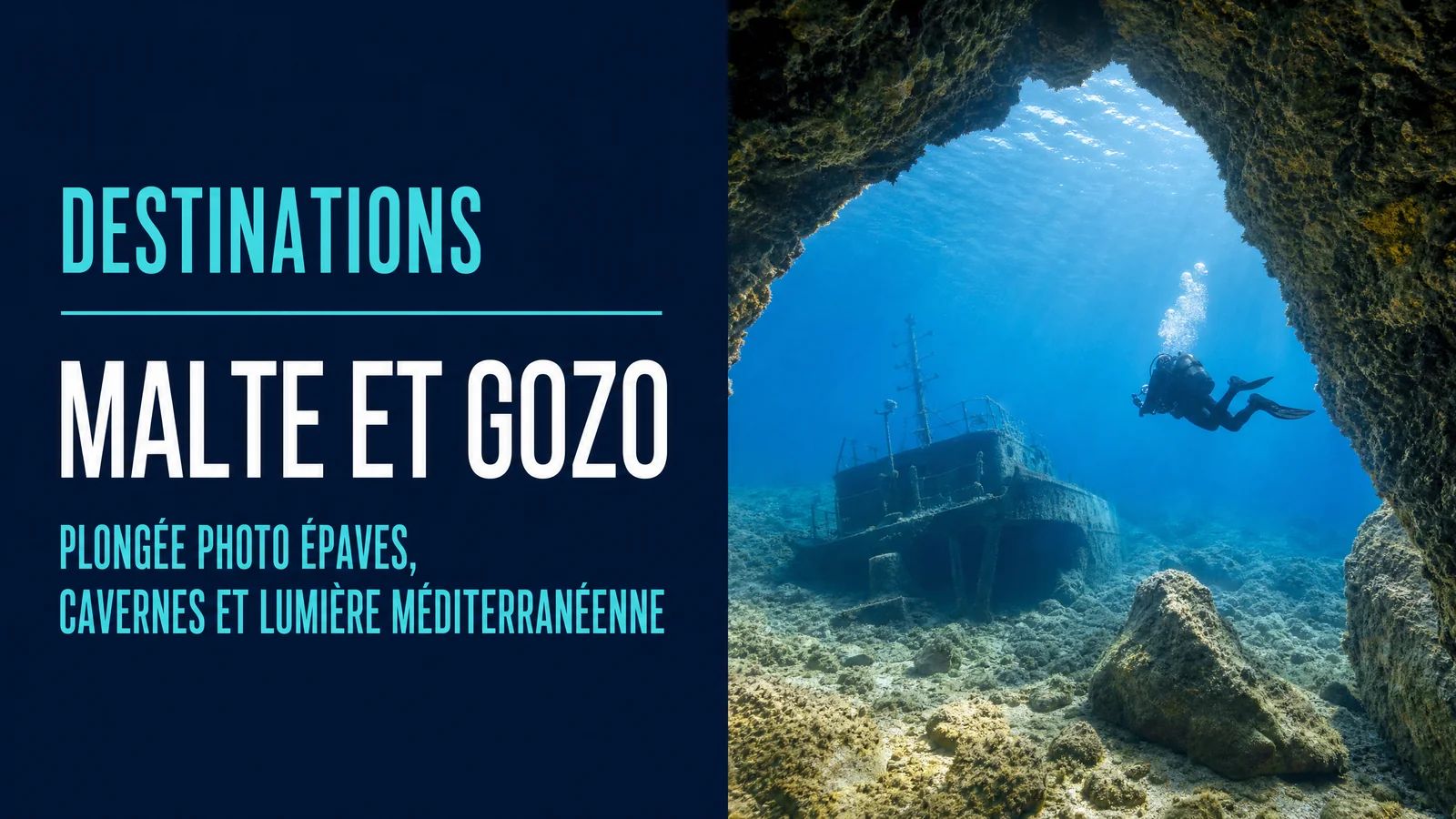
You expose for the bright exit, leave the foreground in the dark, and place a diver in silhouette in the opening. It is the contrast that makes the image, not added light. A flash would reveal the particles and kill exactly what makes these caves beautiful.
Yes, and rather well in water this clear. With a housing and a wide-angle lens you capture the P29 or a section of the Um El Faroud very decently. The limit is not the phone, it is depth and available light, so you choose a detail rather than trying to frame the whole ship.
June to October for warm water and maximum visibility. But my preference goes to September and October: the water is still good, the light softens, and the crowds thin out. Winter remains divable in a drysuit, with beautiful low-angle light for those who handle the cold.
Both if you can, but I would start with a few nights in Gozo, wilder, to hit the caves at first light with nobody around. Malta then concentrates the big shore-accessible wrecks. The ferry between the two is quick, so there is no real need to choose.
To learn how to get the most out of your gear underwater, discover the AquaExposure training.
There are kinds of light you recognise before you even understand where you are. When I was teaching in Cyprus, I found that almost unreal blue water every morning, the limestone carved with caves, the clarity that forgives the beginner everything. Malta and Gozo offer exactly that water, three hours by plane from Brussels.
What I know intimately is Mediterranean light, the kind that sculpts contrast in clear water. And that is precisely what makes Malta and Gozo the most interesting European destination for anyone wanting to learn natural-light underwater photography.
Because you find gathered there, within a few kilometres, the three families of subjects you usually chase across the world. The cave for backlight, the wreck for wide angle, the drop-off for Mediterranean wildlife. All of it in water that often exceeds thirty metres of visibility in summer.
The first reason is clarity. Limpid water means fewer particles in suspension, so less of that grey veil that ruins beginners' images, and light that travels deep without diffusing. It is the luxury that lets you learn fast, because you finally see what you are doing.
The second reason is the rock. The archipelago is limestone, carved with arches, chimneys and caves that play with the sun. The strong contrasts, the light rays, the brilliant exits, you do not have to manufacture them. You just have to see and frame them, which is already a whole craft.
The third reason is down to earth. Malta is English-speaking, the dive centres are serious, and many sites are done from shore. So you can stack dives, redo the same cave twice in a day, fix in the afternoon a framing mistake from the morning. That repetition is the real engine of progress, far more than expensive gear.
To prepare a first international trip without ruining it, take a look first at the .
Gozo's caves are the archipelago's signature. The Inland Sea, the Blue Hole, the Cathedral Cave of Comino, mineral cathedrals where light enters through an opening and carves the space.
The beginner's mistake is trying to light the inside. You must do exactly the opposite. You expose for the bright exit, let the foreground sink into darkness, and place a diver in silhouette in the opening. The contrast makes the whole image. I detail this backlight logic in the guide on silhouettes and backlight.
For settings, you lock exposure on the blue of the exit. On a smartphone, tap the bright zone of the screen and lower the brightness slightly to keep the brilliance of the blue. On a GoPro or compact, work one or two stops under. The silhouette draws itself, and that is the whole magic.
One thing I repeat in courses: the photo is prepared at the surface. A silhouette in motion, fins spread, tells more than a frozen one. Agree on two or three positions with your buddy before entering the water, rehearse them dry on the terrace. You will save precious air and concentration once underwater.
Malta concentrates some of the finest accessible wrecks in the Mediterranean. The Um El Faroud, a tanker over a hundred metres long deliberately scuttled, rests between twenty-five and thirty-six metres. The P29, a former patrol boat, sits around thirty metres in remarkably clear water. The tugboat Rozi, shallower, is perfect for a first wreck.
Photographing a wreck means accepting a basic rule: you never fit a hundred-metre ship sharply into a single frame. And backing away is pointless, because the further you go, the more the water greys the image. The answer is to choose a detail that speaks. A propeller, a mast, a hull opening with a diver passing behind, a school of fish that colonised the structure.
Wide angle is not there to show everything, it is there to give scale to a fragment. It is the same approach I describe for natural-light wide angle, and Malta's wrecks are an ideal practice ground thanks to the visibility.
A warning I never drop: these beautiful wrecks are deep, and depth eats into both light and time. At thirty metres, red is gone and your air drops fast, especially when you focus on framing. You set a floor depth, a bottom time, an ascent pressure, and you stick to it even if the light is perfect. No photo is worth a compromised ascent.
All of this rests on a simple conviction: in this water, natural light is enough, and it does better than any flash. The water is so clear that pulling out a flash most often amounts to lighting particles and flattening a scene the sun was already sculpting well.
The flash keeps legitimate exceptions, which I described in when to use flash. But on caves and silhouettes, it is not only useless, it is counterproductive. Backlight is the soul of these images, and an artificial burst destroys it.
That is also why I believe in the smartphone. A phone in a good housing, with a wide-angle lens, gives results in water this clear that I would not have believed possible a few years ago. Heavy gear is no longer the price of entry, and that is good news for everyone.
Three hours of direct flight from Brussels, no jet lag, English everywhere, centres used to photographers. Malta fits the one-week getaway category, without the logistics of a long-haul trip. To set the right window for your dates, the seasonal guide by destination will help, and the archipelago also features in our overview of the best underwater photography destinations 2026.
If I had to send someone to Gozo, I would point them to a centre that dives in very small groups, because that is what makes the difference in photography. Nautic Team Gozo has run for over thirty years on a simple motto, quality over quantity, with groups of two to five divers. It is exactly the setting you need to take your time in a cave without being rushed. For a family or a beginner buddy pair, that guide-to-diver ratio changes everything, and it is more reassuring than the big operations.
A destination like this rewards those who arrive prepared. Mastering backlight, knowing how to lock exposure, managing depth, all of that is built before departure, not during the six dives of the trip. That is the whole purpose of the AquaExposure underwater photography course.
The day you surface from a Gozo cave with your first real backlit silhouette, you will understand why some return every summer. Stars in their eyes, and the urge to go back the very next morning.


