Marine algae and blue carbon: why it's worth photographing
Marine seagrass beds capture 35 times more carbon than forests. Posidonia, J-Blue Credit, and photographic techniques for documenting these underwater meadows.
Marine plants and blue carbon: why photographing them matters
Posidonia seagrass beds capture up to 35 times more carbon per hectare than tropical forests. This blue carbon remains stored in the sediments for millennia as long as the seagrass bed stays intact.
How do you photograph a Posidonia seagrass bed underwater?
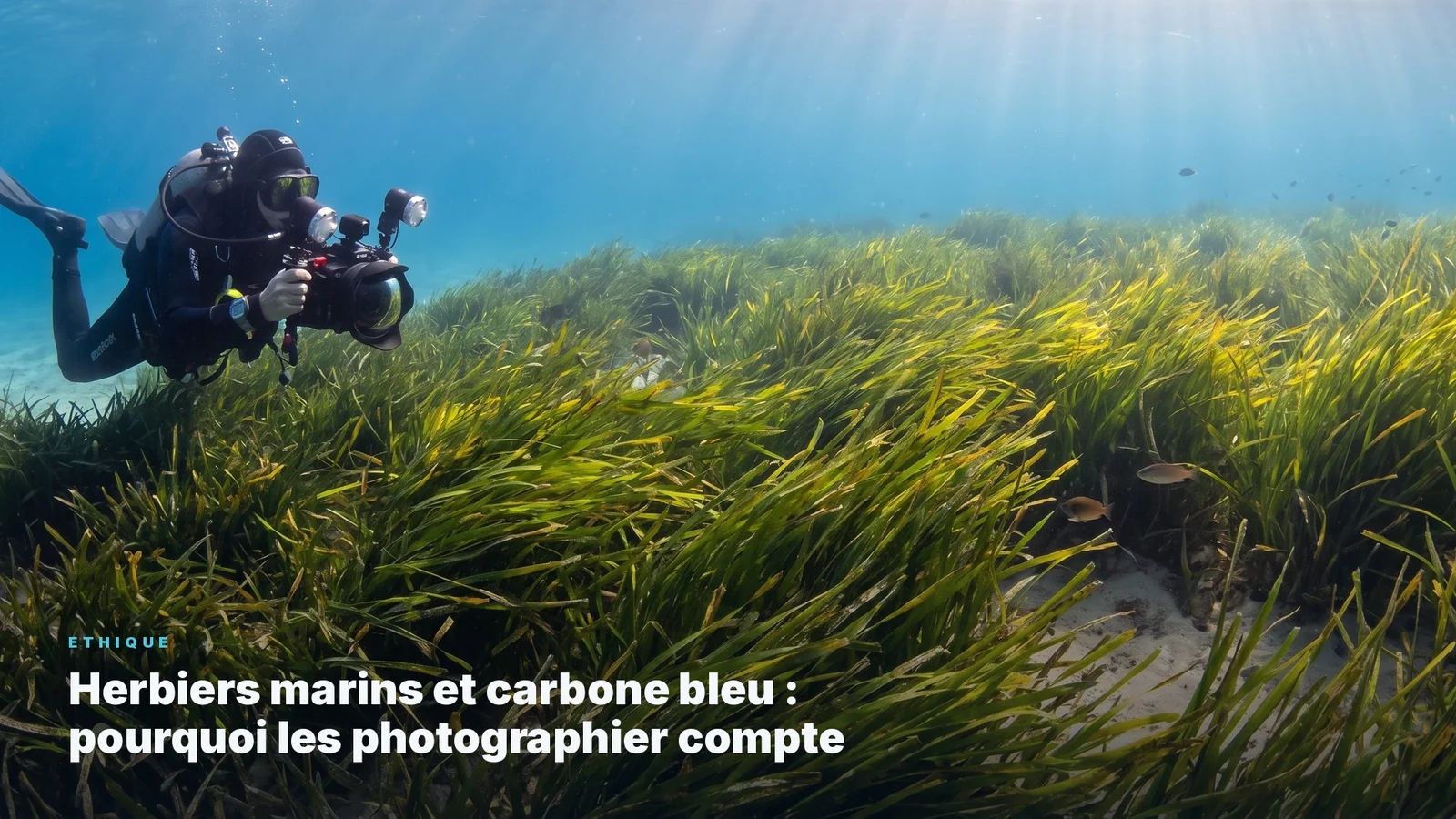
Work in low-angle natural light (early morning or late afternoon). Wide-angle captures the undulations of the meadow. Macro reveals the hidden life between the leaves (seahorses, nudibranchs, juveniles).
Are seagrass beds protected in the Mediterranean?
Yes. Posidonia (Posidonia oceanica) is a protected species throughout the Mediterranean. Uprooting and anchoring on seagrass beds is prohibited. Divers should avoid finning above the meadows at shallow depths.
There was a time, in almost every dive in the Mediterranean, when one would pass through a zone of swaying seagrass without slowing down. The fins move, the eye is already searching for the drop-off, the grouper, the reef. The seagrass is just a corridor. An unavoidable passage between entering the water and reaching the main subject.
I've had this reflex for years. And it turns out that it misses one of the most effective carbon absorption ecosystems on the planet.
Not a corridor, but a complete ecosystem
Seagrass beds are not algae. They are flowering plants that colonized coastal bottoms about 100 million years ago, long before humans decided to walk on them in neoprene wetsuits.
Beneath their leaves lies a density of life that rivals coral reefs. Seahorses, juvenile seahorses, nudibranchs, starfish, and cleaner shrimp. Hundreds of species find refuge, a nursery, or a pantry in these underwater meadows.
The roots stabilize the sediments. The leaves reduce wave action. The root network traps organic matter for centuries. A healthy seagrass bed protects the coastline just as effectively as a seawall, with the advantage of not requiring municipal funding.
Blue Carbon: The Numbers That Give You Goosebumps
The concept of "blue carbon" refers to the carbon captured and stored by coastal and marine ecosystems. Mangroves, salt marshes, and especially seagrass beds.
The numbers are difficult to believe at first glance. Seagrass meadows capture carbon up to 35 times faster than rainforests. They cover only 0.1% of the ocean floor, but store between 10 and 18% of the total carbon absorbed by the ocean.
Alternatively put: one hectare of seagrass sequesters as much carbon as a car traveling 6,400 kilometers in a year. This is not a metaphor. It's a calculation.
In January 2026, a milestone was achieved in Japan. The enhalus acoroides seagrass beds in the Iriomote and Ishigaki islands, in the Okinawa prefecture, have received certification J-Blue Credit. This is the first time that a marine seagrass bed enters an official carbon credit mechanism in Japan. Large-scale mechanical restoration projects are following, with a goal of 18 hectares replanted.
The logic is simple. If we certify the storage capacity of a seagrass meadow in the same way we certify that of a forest, we can finance its protection using the same mechanisms. And during COP28, the "2030 Seagrass Breakthrough" initiative has established an international framework to accelerate this recognition.
Posidonia vs tropical seaweed: What divers need to know
Not all seagrass meadows are created equal when it comes to carbon storage. And that's where the Mediterranean comes in with a strong argument.
The seagrass (Posidonia oceanica) stores 5 to 8 times more carbon per hectare than a tropical forest. Its roots accumulate over millennia, forming "mats" that can reach several meters in thickness. Some seagrass meadows in the Mediterranean are over 6,000 years old. These are among the oldest organisms on the planet.
For divers who frequent the Catalan coast, Corsica, Sardinia, or the Provençal coast, this means one concrete thing. The Posidonia seagrass meadow that you fly over on every dive is a thousand-year-old carbon sink. A single tap on the rhizomes can destroy decades of growth.
Tropical seagrasses (such as Enhalus acoroides, certified in Japan) grow faster but store for a shorter period. Posidonia grows slowly but accumulates over geological timescales. Both are important. However, Posidonia is irreplaceable in the literal sense.
Photographing Seagrass Beds: The Subject No One Sees
Let's move on to what directly concerns us. A marine plant is a fully-fledged photographic subject. Not a decoration, not a backdrop, not an obstacle between you and the moray eel.
Natural light, the best ally. Seagrass meadows are found in shallow areas, often between 2 and 25 meters deep. This is the area where natural light works best. The sunlight filtering through the leaves creates patterns of light and shadow that are impossible to reproduce with flash. Dive between 10am and 2pm, when the sun is high. Position yourself facing the sun to capture these beams that pass through the underwater canopy.
Macro in the prairie. Get close to the substrate without touching it (flawless buoyancy, always). The seahorses attach themselves to the leaves. The nudibranchs move on the rhizomes. The seahorse eggs hang down like small black clusters. A macro lens or a macro mode on a compact camera is enough to capture a world that most divers never see.
Wide-angle and atmosphere. The other approach is that of the underwater landscape. A diver in silhouette above a meadow of Posidonia, with the sun's rays in the background. Or a school of sardines grazing on the leaves like a herd in an underwater pasture. These images tell a story that a coral reef does not.
The "Invisible" Subject That Makes the Difference in Competitions. Seaweed is underrepresented in the portfolios of underwater photographers. It is precisely this that makes it interesting. A well-composed shot of a living seaweed, with its fauna and light, immediately stands out from yet another clownfish shot.
What this means for us, underwater
When we know that a Posidonia seagrass bed captures more carbon per hectare than the Amazon rainforest, we no longer approach it in the same way. We slow down. We adjust our buoyancy. We look between the leaves instead of looking beyond.
This is not activism. It is well-placed curiosity. The underwater photographer has a role that no one else can play: to make visible what people do not see. And seagrass meadows are the most spectacular blind spot in current underwater photography.
Documenting marine life is not only about charismatic species. Seagrass beds need images just as much as coral reefs. Perhaps even more, because no one photographs them.
The next time your fins graze a seagrass meadow in the Mediterranean, at Banyuls, in Corsica, or in the Balearic Islands, give it five minutes. Descend slowly. Observe what moves between the leaves. Take the shot.
You will be photographing a thousand-year-old carbon sink. And incidentally, a subject that almost no one shows.
Frequently Asked Questions
What is the difference between a marine herbarium and algae?
Seagrass beds are flowering plants (angiosperms) with true roots, stems, and leaves. Algae do not have a root system and attach themselves using a holdfast. This distinction is important: it is the roots of the seagrass beds that trap carbon in the sediments for long periods.
Why seagrass meadows are protected in the Mediterranean?
The Posidonia grows extremely slowly (a few centimeters per year) and its meadows take centuries to recover. It is protected by the European Habitats Directive and by national legislation in most Mediterranean countries. Wild anchoring is one of the main causes of destruction.
Can the J-Blue Credit certification be extended to other countries?
The Japanese initiative is a pilot model. Similar initiatives exist in Australia and the United Kingdom. The "2030 Seagrass Breakthrough" announced at COP28 aims precisely to generalize the recognition of blue carbon from seagrass meadows on an international scale. By 2030, we should see comparable certifications in the Mediterranean.
How to photograph a seaweed without damaging it?
The rule is the same as for coral reefs: do nothing. Master your buoyancy before descending into the seagrass bed. Keep your fins up. Avoid sitting on the seabed. And prefer natural light to avoid stressing the fauna with a flash.
The key is to use the right settings. Experiment with different ISO and aperture combinations to find what works best for your camera and the conditions. Remember that a higher ISO will make your images brighter, but it will also introduce more noise. A wider aperture will let in more light, but it will also make your images shallower. Finally, be sure to use a fast shutter speed to avoid motion blur.