Why are new marine species still being discovered in 2026?
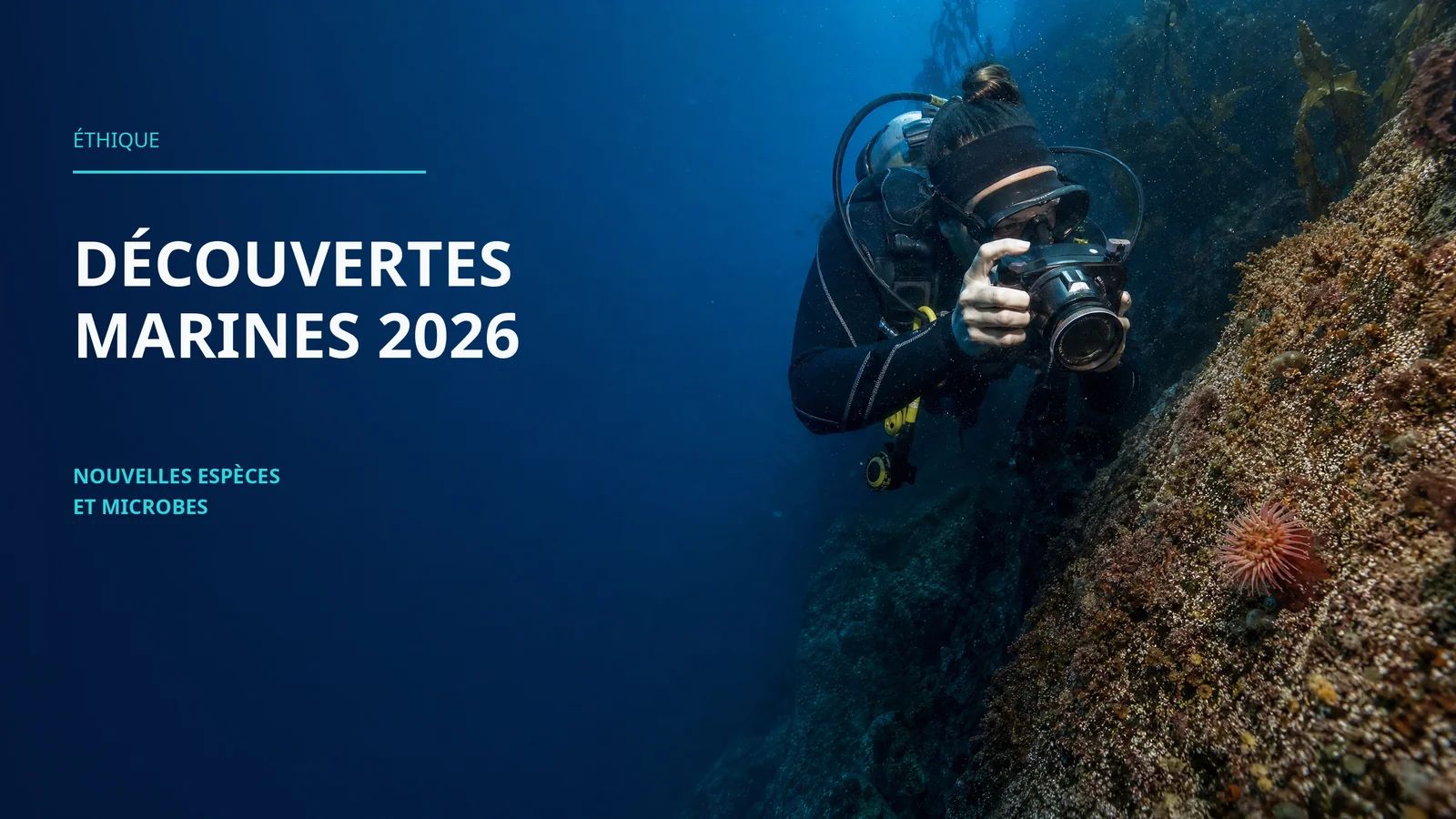
Scientists estimate that we know less than 10% of ocean species. The deep sea, which makes up the majority of the ocean floor, remains largely unexplored. Each expedition with ROVs into unstudied areas reveals dozens of unknown species. Exploration technology is advancing faster than our inventory of marine life.
How can the discovery of coral microbes help medicine?
Micro-organisms living inside corals produce unique chemical compounds forged by millions of years of evolution. Some of these compounds show potential antibiotic, antiviral, or anticancer properties. Every destroyed reef takes with it molecules we may not have identified yet.
What is the Clarion-Clipperton Zone and why is it important?
It is a vast expanse of deep-sea floor between Mexico and Hawaii, at nearly 4,000 meters depth. This zone harbors exceptional biodiversity, largely unknown. It is also coveted for its mineral resources, creating a direct conflict between exploitation and conservation.
Can an underwater photographer contribute to the discovery of new species?
Absolutely. Divers have documented unknown species at macro sites like Lembeh or Anilao. Quality underwater photography allows taxonomists to identify distinctive morphological characteristics. Participating in iNaturalist by sharing geolocated photos directly contributes to the inventory of marine life.
There is something profoundly reassuring about the idea that the ocean continues to surprise us. Not minor surprises, not variations in color on a known species, but discoveries that challenge our very understanding of the tree of life. And 2026 didn't wait for summer to deliver its harvest.
A new branch on the tree of life
In the Clarion-Clipperton Zone, this vast seabed located between Mexico and Hawaii, researchers have identified 24 new species of amphipods. These small crustaceans, which vaguely resemble flattened shrimp, lived at depths of almost 4000 meters, in a world where sunlight has never penetrated.
Among these 24 species, one is so different from everything that was known that it required the creation of a new family (Mirabestiidae) and a new superfamily (Mirabestioidea). In biology, creating a new superfamily is like discovering an entire branch of the tree of life that you had never noticed before. It doesn't happen every day. It doesn't even happen every year.
And this is just a fraction of what has been found. In the same area, five years of international research have revealed hundreds of previously unknown species, all living in complete darkness, under a pressure that would crush a standard submarine.
Off the Coast of Argentina and California
Other expeditions further enriched the marine species catalogue in 2026. Off the coast of Argentina, marine biologists identified 28 potentially new species, including sea snails, sea urchins, anemones, and worms. All were discovered while exploring previously unstudied marine habitats.
Off the coast of California, researchers using remotely operated vehicles (ROVs) have discovered a new species of sparkling sea slug, named "Iskra sea slug" (Photinopolynoe iskrae), a polychaete covered in scales that reflect light in the depths of the Pacific. An animal that glows in the dark at several hundred meters below the surface, and that no one had ever seen before.
Ocean Census mid-2026: 1,121 species in a single year
The Ocean Census tally published in summer 2026 exceeded all projections: 1,121 new species described between mid-2025 and mid-2026, a 54% increase over the previous year. Thirteen coordinated expeditions crossed areas never before explored, from abyssal trenches to underwater mountains.
Among the highlights: 31 new species described in a single expedition off Brazil, aboard the Schmidt Ocean Institute's vessel Falkor too. The ROV robot SuBastian, capable of filming in 4K at thousands of meters of depth, documented organisms no one had ever observed before.
The most striking result is the confirmation that one of the Clarion-Clipperton Zone species represents an entirely new branch of the tree of life, and that less than 0.001% of the ocean floor has been directly observed by scientists. In other words, almost everything remains to be discovered.
Coral microbes: an invisible world with amazing properties
While deep-sea explorers added species to the list, other researchers turned their attention to an invisible world, but one of vital importance: the microbial communities that live within corals.
A study published in May 2026 in ScienceDaily reveals that each coral species harbors its own specialized microbial partners, with most having never been studied before. These microorganisms are not merely hitchhikers: they produce a variety of chemical compounds with potentially useful properties in medicine and biotechnology.
This is a reminder that the coral reef is not only beautiful to photograph. It is a reservoir of microscopic biodiversity, of which we are only just beginning to measure the richness, and the loss (due to bleaching or habitat destruction) would lead to the loss of molecules that we have not even yet identified.
What this means for underwater photographers
Each dive is an expedition into a world largely unexplored. Scientists estimate that we know less than 10% of the species that inhabit the oceans. What we photograph, document, and share is only a glimpse of an ecosystem of dizzying complexity.
For underwater photographers, these discoveries are a reminder that the most fascinating subject may be the one that we haven't yet noticed. This small crustacean on the black sand of Lembeh, this luminous worm in the shadow of a reef, this coral colony that harbors unknown microbes.
The ocean still has surprises in store for us. And perhaps this is the best reason to continue diving with a camera.
Frequently Asked Questions
Why are we still discovering so many new marine species in 2026?
Scientists estimate that we know less than 10% of marine species. The deep sea, which represents the majority of the ocean floor, remains largely unexplored. Each expedition with ROVs (remotely operated vehicles) in unexplored areas reveals dozens of unknown species. The technology for exploration is advancing faster than our inventory of marine life.
How the discovery of coral microbes can help medicine?
The microorganisms living inside corals produce unique chemical compounds, forged over millions of years in an extreme environment. Some of these compounds show potential antibiotic, antiviral, or anticancer properties. Each destroyed reef takes with it molecules that we may not have yet identified.
What is the Clarion-Clipperton Zone and why is it important?
It is a vast underwater plain between Mexico and Hawaii, at a depth of nearly 4000 meters. This area is home to exceptional biodiversity, which is largely unknown. It is also coveted for its mineral resources (polymetallic nodules), which creates a direct conflict between exploitation and conservation. Twenty-four new species of amphipods have been discovered there recently.
Can an underwater photographer contribute to the discovery of new species?
Absolutely. Divers have documented unknown species in macro locations such as Lembeh or Anilao. High-quality underwater photography allows taxonomists to identify distinctive morphological characteristics. Participating in citizen science platforms such as iNaturalist by sharing geolocated photos directly contributes to the inventory of marine life.
Learning to observe underwater is the first step towards discovery. Our underwater photography course develops your eye for marine life, from macro to animal behavior.