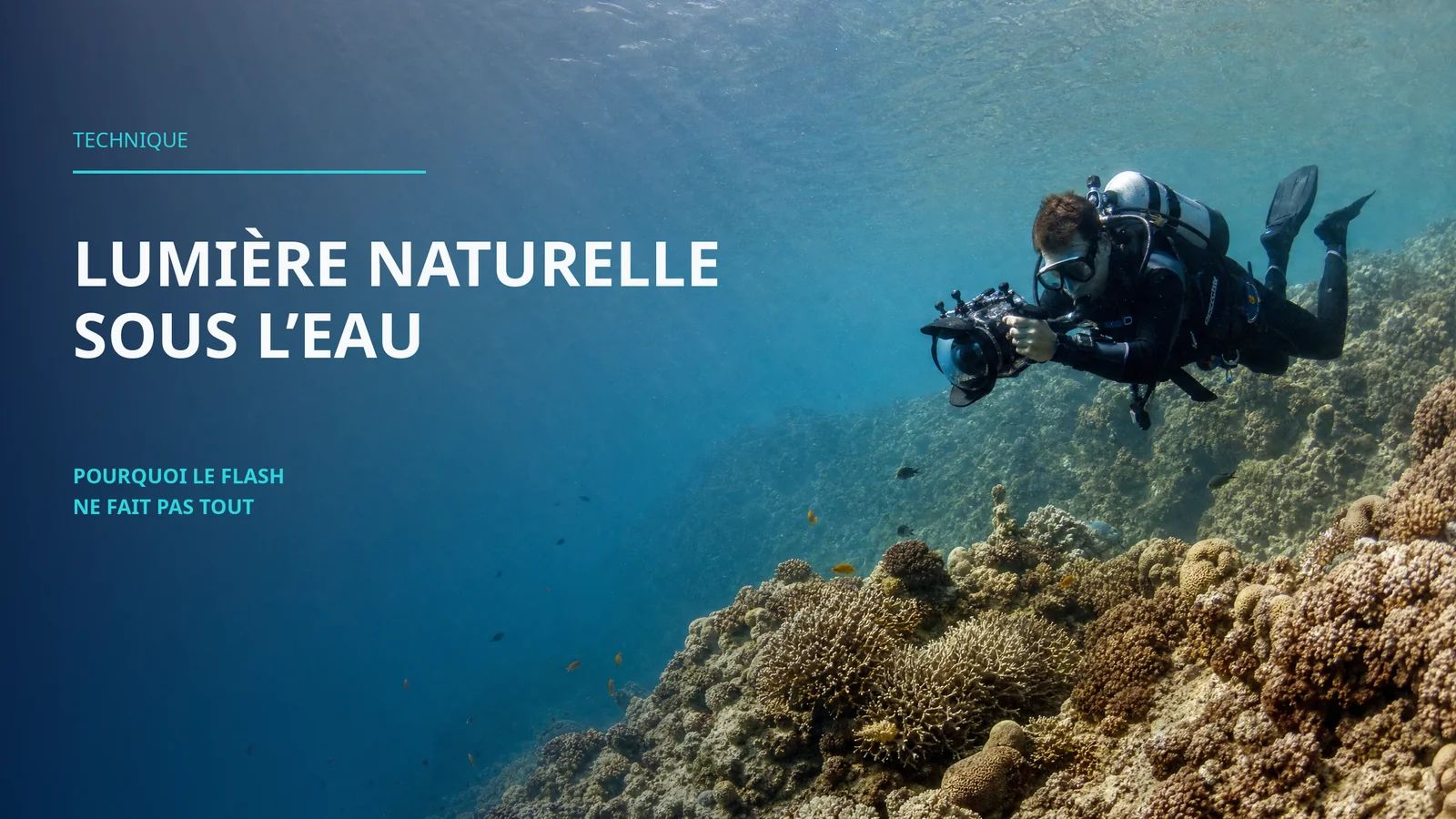
What about macro (small subjects)? Should I really ditch the flash?
For macro, natural light is even more important. A small crustacean shot with flash will be white and overexposed. With natural light, you see its true texture and colours. Solution: raise the ISO (1600-3200), dive between 5-15 metres where sunlight penetrates well, position yourself so the sun comes from the side, and shoot in 4K to extract the best frames.
Is it true that fish behave better without flash?
Absolutely. Without the stress of flash, fish continue their natural activities. You have a much better chance of capturing authentic behaviour (a moray hunting, a trumpetfish camouflaging). With flash, they flee or ignore you.
At what depth should I stop relying on natural light?
Technically, beyond 40 metres, natural light becomes very limited. But in practice, at 25 metres you are already in a zone where you need support. Between 10 and 25 metres is your zone of excellence.
Natural underwater light is your best ally for authentic, striking images: it preserves natural colours, it doesn't stress marine life, and it creates an atmosphere that no flash could ever reproduce. I'm going to show you how to use it wisely.
Yes, I know. You've spent a fortune on underwater photo gear. You've read guides that said "you absolutely need a flash to compensate for colour loss underwater." And you believed it. So did I, once upon a time.
The Real Threat Underwater: It's Not What You Think
When I was a diving instructor in the Maldives, Benjamin had just been sent there for an intensive underwater photography course. Like every keen beginner, I invested in the most powerful flash gear in my range. External battery, dual flash, diffuser, the whole setup. For six months, I was diving with this thing that looked like a small arsenal.
And you know what? I managed to photograph frightened fish. That's all I got.
Fish hate flash. They hate it viscerally. When you fire a flash at three metres from a moray eel or a scorpionfish, you're not taking a photo: you're triggering a flight reflex. The animal disappears. Or worse, it charges you. Scientists at the University of Queensland found that repeated flash can stress marine fauna and affect their reproductive cycles. A 2019 study on corals showed that flash acts as a stressor that diminishes the immune responses of coastal ecosystems.
But that's only half the problem.
Why Flash Really Kills Your Images
Here's something nobody tells you frankly: underwater flash creates a wall of white light that completely flattens the composition.
Think about it. Underwater, the water itself is your medium. It has texture, depth, atmosphere. That's what makes underwater photos spectacular. When you blast a flash, you create a hard edge of light: everything illuminated becomes hyper-bright and white, everything else goes black. No more depth. No more atmosphere.
Laurent Ballesta, the man behind the Gombessa expeditions (you know, the one who discovered new species at 2,000 metres depth) works almost exclusively with natural light. And his images? They're the most visceral photos I've ever seen. No flash. No artifice. Just the ocean as it is.
In an interview for National Geographic, Ballesta explained: "Natural light tells the story of the place. It tells how the creatures actually live." That's what you lose with flash.
The Physics of the Problem (Yes, It Matters)
To truly understand why natural light works better, you need to grasp a fundamental concept: light travels differently in water.
Nils Jerlov, a Swedish oceanographer, established a model in 1976 explaining how light behaves beneath the surface. His findings show that:
Red disappears completely at 5 metres. Barely more than the height of a house. That means the clownfish you're photographing? It isn't really orange. It's brownish-grey to itself. Our eyes recompose the colours, but underwater, it's an illusion.
Orange disappears at 15 metres. Yellow around 30-40 metres.
What remains is blue and green. That's why underwater photos without flash look like symphonies of blue, because that's the physical reality of the ocean.
David Doubilet, senior National Geographic photographer with 50 years of experience underwater, explained in an essay for the magazine that the true magic of underwater photography lies not in artificial colour restoration, but in the acceptance and creative use of the natural colour palette.
That's when my photography changed: the moment I understood this.
The Moment Everything Shifted
It was during my years in the Maldives. I was diving with a group of tourists, and we had a date with a manta ray, one of the most magical moments of any dive. It arrived slowly, majestic, filtering. The sun was at its zenith. The ray was bathed in that soft, diffused natural morning light.
I didn't use flash.
For the first time.
You know why? Because my battery was dead. (No, I'm not exactly discreet about my mistakes.)
The images I got, even without flash, even with imperfect light, were alive. You could see the movement of the animal, its texture, the clear blue water around it. You could see a moment, not just a properly exposed subject.
From that day on, I put the flash away. And my images took off. Clients who looked at my photos would say spontaneously: "I feel like I was there. I can feel the water."
That's what natural light does.
The Golden Window: How to Work With Natural Light
Now that you're convinced (or at least intrigued), let's get practical.
There's an optimal window for natural light underwater: between 10am and 2pm. The sun is high, the light is direct yet diffused, and it penetrates the water well. This is the moment when your chances of success increase dramatically.
Settings for Different Depths
At 5-15 metres (the optimal light zone): - ISO: 400-800 - Aperture: f/5.6 to f/8 (to keep depth of field) - Shutter speed: 1/60th to 1/125th of a second
At 15-25 metres (the twilight zone): - ISO: 1600-3200 - Aperture: f/4 to f/5.6 - Shutter speed: 1/30th to 1/60th of a second
Beyond 25 metres, natural light becomes very limited. At that point, you accept the physical limits of depth. You push ISO as high as your sensor tolerates, you work in post-production to correct colours, and you embrace the blue palette of the deep. True mastery is knowing your limits and creating with what nature offers.
Three Natural Light Techniques for Underwater Photography
1. The Silhouette (Backlit)
This is my favourite technique. You position your subject between you and the light source (the sun, a few metres above). The subject becomes a shadow, but the background is bright and blue. It creates dramatic depth.
Settings: low ISO (200-400), expose for the sky, medium aperture (f/5.6-f/8). You expose for the background and let the subject fall into silhouette.
2. Sun Rays
This is difficult, but when it works. it's magical. You need the sun high, a fish suspended in the water, and you meter the light so the rays also appear in the composition.
Settings: ISO 800-1200, medium aperture (f/5.6), you shoot slightly against the sun to create the diffraction effect. You accept that some areas will be overexposed.
3. Soft Direct Light (Natural)
You position your subject facing soft sidelight. No flash. Just the patience to wait for the fish to position itself well. This gives natural images with shadows that create structure.
Settings: ISO 800-1600, aperture f/5.6-f/8, shutter speed 1/60th-1/125th.
Snell's Window and Depth
There's a crucial physical phenomenon you need to understand: Snell's window.
It's the critical angle (97 degrees) beyond which light can no longer penetrate the water from the air. In practice, this means that all the sky (sunlight) passes through an imaginary "cone" above you. The deeper you are, the more this cone shrinks. At 20 metres, the cone has contracted considerably.
Understanding this concept helps you figure out where the light comes from. That's why the best underwater photographers dive between 5 and 20 metres in the middle of the day. It's the zone where the cone of light is wide enough to create atmosphere.
Colour Correction in Post-Production
Alright, you have your images. They're a bit too blue. Here's the secret: you're not trying to restore colours, you're trying to balance them.
In Lightroom or Capture One:
1Slightly increase the overall warmth (temperature around 4500-5500K instead of the standard 3500K underwater).
1Use the Curves tool to gently lift the shadows (not the highlights). This creates more definition.
1Apply a slight reduction in blue-cyan saturation (10-15%), then a very slight increase in overall saturation (5-8%).
1Never push the correction too far. The goal isn't to make it look like you were on land. It's to create an image that breathes the ocean while being pleasant to look at.
Sylvia Earle, the living legend of oceanography, has a saying: "Underwater photography should honour the place, not disguise it." That's what intelligent post-production is about.
Why AquaExposure Chose Natural Light
At AquaExposure, we don't fire flash any more. Full stop. It's a philosophical choice as much as a practical one. We train divers to:
1Observe the light. Before even lifting a camera, we learn to read light underwater.
1Position the subject rather than correct with flash.
1Accept the limits and turn them into creative strengths.
1Respect the wildlife. Animals that see us flashing every two seconds have their natural behaviours affected. We want to photograph marine life, not traumatise it.
Mistakes to Avoid
Mistake 1: Increasing flash for "extra safety"
No. All you need is your camera and composition. Animal stress is never a solution.
Mistake 2: Diving too deep hoping ISO will compensate
At some point, ISO isn't enough. It's physics. Dive between 10-20 metres for natural light instead.
Mistake 3: Putting the sun in every frame
Backlighting works when it's motivated. If every image is a silhouette, it's mannered. Vary your approach!
Mistake 4: Hesitating to raise ISO
An ISO of 3200 with good natural light is a thousand times better than a low ISO with flat flash. Your camera can handle it.
FAQ: The Questions I Get Asked All the Time
Q1: What about macro (small subjects)? Do I really have to give up flash?
A: For macro, natural light is even more important. A small crustacean shot with flash will be white and overexposed. With natural light, you see its true texture, its colours. The challenge is shutter speed (it drops when you zoom in). Solution: raise the ISO (1600-3200), dive between 10-15 metres where light penetrates well, position yourself to use the sunlight from the side, and shoot in 4K to extract the best frames.
Q2: Is it true that fish "settle down" better without flash?
A: Absolutely. Without flash stress, fish continue their natural activities. You have a much better chance of capturing authentic behaviour (the moray eel hunting, the trumpetfish camouflaging). With flash, they flee or ignore you.
Q3: At what depth should I stop relying on natural light?
A: Technically, beyond 40 metres, natural light becomes extremely limited. But practically, at 25 metres you're already in a zone where you need support. Between 10-25 metres is your zone of excellence. Stay there while you're learning.
Q4: How do I know I'm exposing correctly without flash?
A: Check your histogram. You're not looking for a "normally" well-exposed image. You're looking for an image where the mid-tones are rich and the highlights aren't blown out. The image will have a bluish, shadowy "look." That's normal. That's correct.
Q5: What do I do when natural light isn't enough?
A: You have several options. Push your ISO as high as your sensor tolerates (3200-6400 is no problem on a modern sensor). Work in post-production to correct colours and boost saturation. Shoot in 4K rather than stills, because video handles high ISO more forgivingly. Also accept the natural palette of depth. Blue and green are honest, not a limitation but a physical reality. Smart post-production transforms these images into works of art.
Q6: My natural-light images are less "spectacular" than flash ones. Is that normal?
A: Yes and no. They're different. Less flashy (pun intended), but they have authenticity. If you find them "less spectacular," it's because you still have a flash photographer's eye. After a few months, you'll change your mind. Natural images age better. They tell a story. Flash images quickly look dated.
The Final Truth
Here's what I've learned after all these years of diving and underwater photography: natural light is not a limitation. It's a freedom.
When you stop fighting the water, when you stop trying to correct it with equipment, when you learn to see what it truly offers, that's when photography becomes genuinely interesting.
Laurent Ballesta doesn't use natural light because he can't access professional flash. He chooses it because it's truer. David Doubilet tells the stories of the ocean with its natural tones, not with colours restored by flash.
You can do the same.
Start this week. Descend to 12 metres between 11am and 1pm. Leave the flash on the surface. Observe how light behaves. Shoot in 4K for 20 minutes. Let the light do its work, let the animals live around you. Then extract your best frames. Look at them. Then show them to someone.
You'll be surprised.
Benjamin Coste Founder, AquaExposure Underwater content creator, natural light specialist
Understanding light is the first half of the job. The second is knowing how to recover it in post-production when the water has swallowed it. Module 4 of the AquaExposure training covers both together, with before/after examples on footage shot in real conditions. Available at [aquaexposure.com](/en/blog/Download the free guide