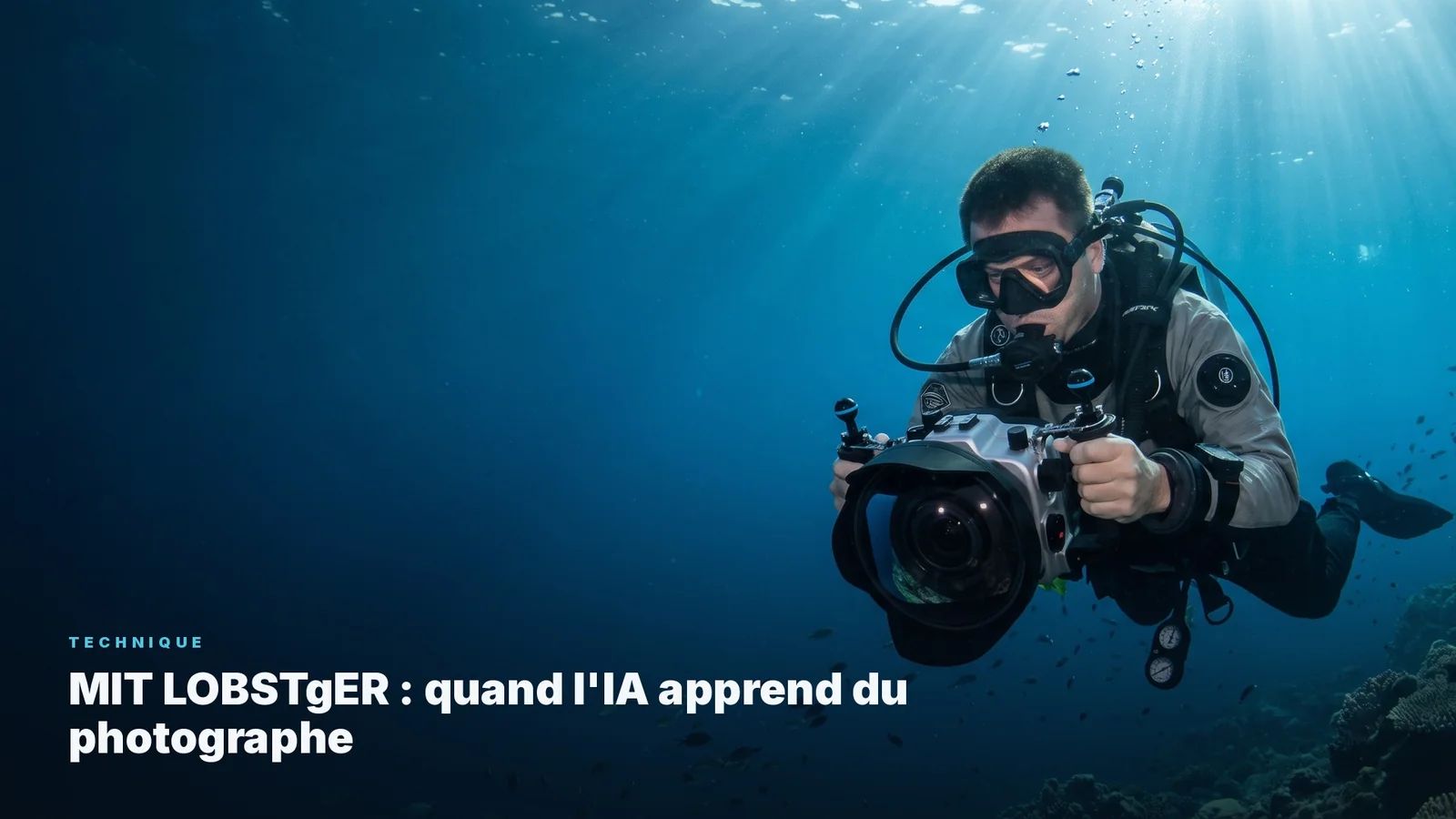
LOBSTgER stands for Learning Oceanic Bioecological Systems Through Generative Representations. It is a project by the MIT Sea Grant that combines artificial intelligence and underwater photography to document marine life in the Gulf of Maine and raise public awareness through AI-generated or AI-enhanced images.
How does LOBSTgER use photographers' images?
The model is trained exclusively on the photo library of underwater photographer Keith Ellenbogen. Each image was selected for its artistic intent, technical precision, and geographic context. This ensures that the generated images remain faithful to ecological reality.
Can LOBSTgER replace an underwater photographer?
No. The model depends entirely on the quality of the photos that feed it. Without the photographer's eye, field knowledge, species identification, and artistic choices, the AI has nothing to learn from. The human remains the source of the entire chain.
Why does LOBSTgER focus on the Gulf of Maine?
The Gulf of Maine is warming faster than 99 percent of the world's oceans. Documenting its ecosystems before they change irreversibly is a race against time. LOBSTgER uses AI to accelerate this documentation and make it accessible to the public.
MIT LOBSTgER: When AI learns from the underwater photographer
There is a question that often arises when we talk about artificial intelligence and visual creation. Photographers ask it with a hint of concern, scientists with curiosity, and the general public with fascination: will AI eventually replace the human eye behind the lens?
A project from MIT provides an unexpected answer. Not only does AI not replace the photographer, but it needs him to exist. And this dependence is not a weakness of the system, but its founding principle.
LOBSTgER, an acronym that lives up to its name
LOBSTgER stands for Learning Oceanic Bioecological Systems Through Generative Representations. Behind this playful name (yes, it's a nod to the Maine lobster), lies a research project co-directed by Keith Ellenbogen, a marine photographer and artist-in-residence at MIT Sea Grant, and Andreas Mentzelopoulos, a doctoral student in mechanical engineering at MIT.
The principle is both elegant and radical: to train an artificial intelligence model exclusively on Ellenbogen's personal photographic library. No generic image bank. No photos found on the internet. Only images created with artistic intent, technical precision, correct species identification, and documented geographical context.
Each image in the training set has been selected and validated by the photographer himself. This is a fundamental difference from most generative AI projects, which draw on millions of images without discrimination.
A real-world model, not a generic one
The technical model of LOBSTgER is based on latent diffusion. Approximately 11 million parameters, resulting in approximately 2,500 images, are used to generate visuals at 512 by 768 pixels. These are modest figures compared to the giants of generative AI, and this is deliberate.
Andreas Mentzelopoulos has developed a custom code to protect the process from any external data or model contamination. The dataset is small, but it is clean. Each pixel carries the signature of Ellenbogen's fieldwork, his framing choices, his understanding of light, and his knowledge of the species.
This is a principle that every underwater photographer intuitively understands: the quality of what goes in determines the quality of what comes out. A model trained on mediocre images will produce mediocre images. A model trained on the work of a photographer who knows their subject will produce something different.
Two modes for two uses
LOBSTgER operates in two distinct modes. The first generates completely new underwater scenes from scratch, creating images that have never existed but remain consistent with the ecological reality of the Gulf of Maine. The second enhances real photos by recovering details obscured by underwater conditions (turbidity, color absorption, light diffusion).
The Gulf of Maine was not chosen at random. It is one of the most biodiverse marine ecosystems on the planet, with its whales, sharks, jellyfish, herring, and hundreds of other species. It is also one of the fastest-warming ocean regions, faster than 99% of the world's oceans.
It is urgent to visually document this transformation. And it is precisely here that the combination of photographic art, scientific rigor, and the power of AI calculation takes on its full meaning.
What this means for underwater photographers
The LOBSTgER project is not software that you can download tomorrow morning. It is a research project, and it will take time before its applications become available to the general public. But what it demonstrates has an immediate impact on our practice.
First, it confirms that the training data is everything. AI models are not magic. They learn what they are shown. If you show them demanding work, they produce demanding results. This is exactly the approach that AquaExposure advocates: master the fundamentals first, because technology can never compensate for a lack of understanding of light, composition, or animal behavior.
Next, it opens up an exciting avenue for public engagement. Showing someone who has never dived what happens beneath the surface, with images that combine the scientific precision and the emotional power of photography, is a powerful tool for marine conservation.
Humans remain the source
This is perhaps the most important lesson from LOBSTgER. The model does not replace the photographer. It depends on the photographer. Without Ellenbogen's years of experience in the field, without his ability to correctly identify species, without his sense of composition and light, the model would have nothing to learn.
AI is an amplifier, not a creator. It extends the human gaze, allowing us to share that gaze with a wider audience, and helps to reveal details that the eye alone could not capture. But the vision, the sensitivity, the decision to dive at this place, at this time, in this light - all of that remains deeply human.
Keith Ellenbogen says: the project is not an attempt to replace underwater photography, it is an attempt to multiply its impact. And for that, there must first be a photographer in the water.
Learning the fundamentals that even AI cannot ignore
The tools are evolving, the models are becoming more refined, and the algorithms are becoming more powerful. But the constant remains the same: understanding the light underwater, knowing how to frame in buoyancy, and reading the behavior of an animal before taking the shot. These are the skills that AI is trying to imitate, and these are the ones that our underwater photography training teaches you.
Because the best investment in underwater photography is not the latest trendy software. It is the photographer himself.
Frequently Asked Questions
What is the LOBSTgER project at MIT exactly?
LOBSTgER (Learning Oceanic Bioecological Systems Through Generative Representations) is a research project from MIT that uses generative AI to create and improve underwater images. It is co-directed by photographer Keith Ellenbogen and doctoral student Andreas Mentzelopoulos. Its particularity is that it is exclusively trained on Ellenbogen's personal photos, guaranteeing the quality and ecological relevance of the results.
Can LOBSTgER generate realistic underwater photos from scratch?
Yes, the model can generate unique underwater scenes that have never been photographed. These images remain consistent with the ecological reality of the Gulf of Maine, because the model has learned from a scientifically rigorous dataset. It can also improve existing photos by recovering details lost due to underwater conditions.
Will AI replace underwater photographers?
LOBSTgER actually demonstrates the opposite. The model depends entirely on the quality of the photographer's work to function. Without the images taken by Ellenbogen, which were taken on-site with technical expertise and knowledge of the species, the AI would have nothing to learn from. The human remains the source, the AI is simply an amplifier of their perspective.
Why was the Gulf of Maine chosen for this project?
The Gulf of Maine is one of the richest and most diverse marine ecosystems on the planet. It is also warming up faster than 99% of the world's oceans, making it a crucial area for documenting ongoing changes. LOBSTgER allows you to visualize and share this reality with a wider audience.