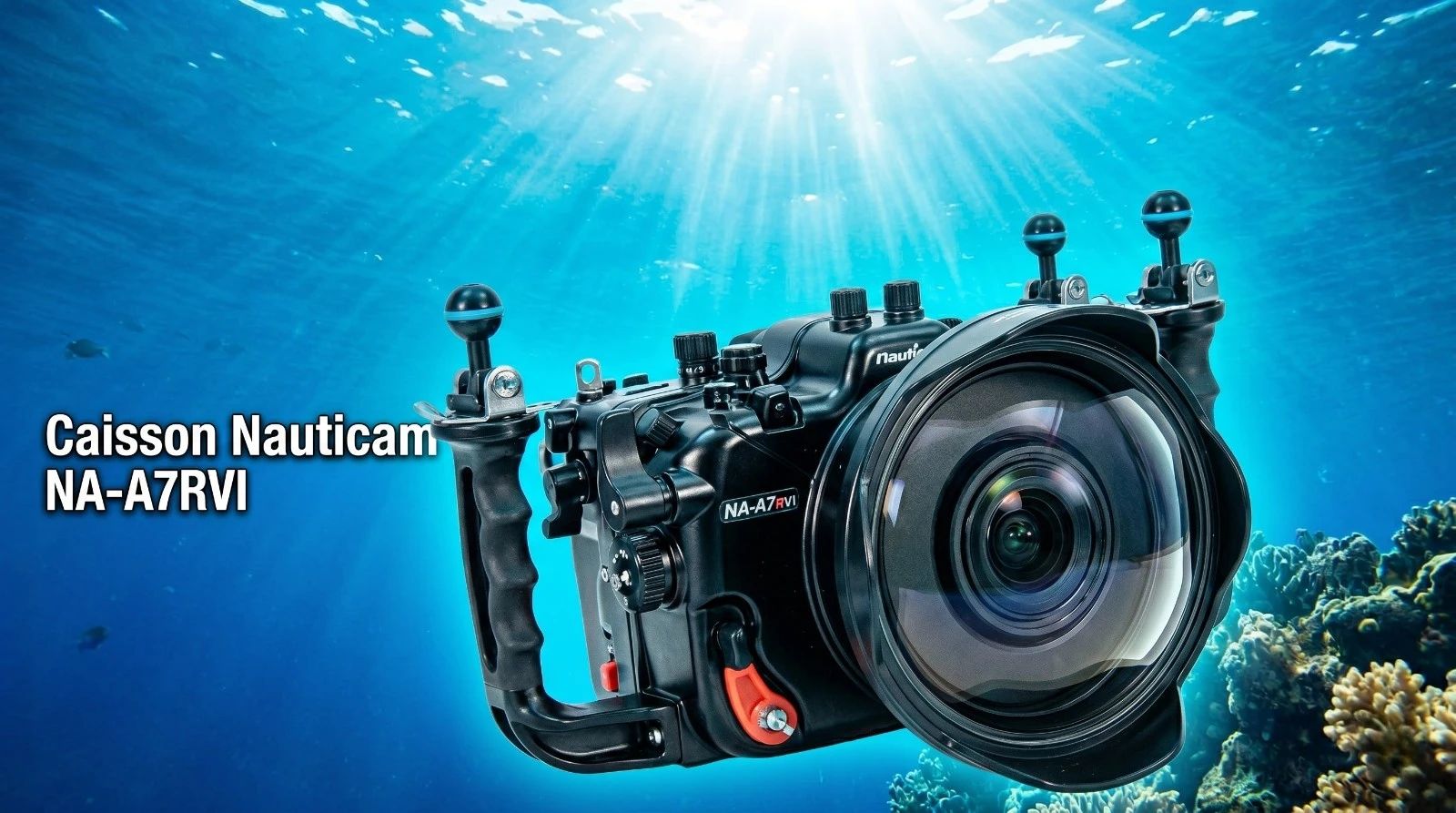
The Nauticam NA-A7RVI starts at €4,200 (housing only, without dome port or lens port). A typical wide-angle setup including dome and zoom port runs between €6,100 and €7,800 depending on configuration. Pre-orders have been open since June 2026.
Is the NA-A7RVI compatible with NA-A7RV ports and domes?
Yes. The NA-A7RVI uses the N100 port system, identical to the NA-A7RV and most recent Nauticam housings. If you already own N100 domes, ports and extension rings, they transfer directly. This is one of the key advantages of the Nauticam ecosystem for photographers moving up in system.
What are the differences between the Sony a7R VI and the a7R V for underwater photography?
The a7R VI moves to a stacked 66.8 MP sensor (versus a non-stacked 61 MP on the a7R V), paired with the Bionz XR2 processor. Burst rate rises to 30 frames per second (versus 10 fps on the a7R V). Video jumps to native 8K/30p and 4K/60p. Underwater, the most tangible gains are autofocus speed (better acquisition in murky water or low light), burst rate for fast-moving pelagics, and the cropping margin offered by 66.8 MP.
Nauticam or Ikelite for a Sony a7R VI housing?
The two brands serve different profiles. Nauticam (aluminium, 100 m, N100 system, from €4,200) targets serious or professional underwater photographers who want a scalable system and optimised ergonomics. Ikelite (polycarbonate, 60 m, around €2,300) suits leisure divers or photographers who dive occasionally and want a reliable housing without a pro budget. The question is not which is better, but which fits your practice.
How do you choose your first underwater housing?
The choice depends on three factors: your camera, your usual diving depth, and your total budget (housing plus dome plus port plus flash/video light). A comprehensive guide is available on AquaExposure to help you navigate these choices without making costly mistakes.
When Nauticam announces a new housing, the question is never whether it will be good. The question is whether the camera it protects is worth investing four to nine thousand euros to take underwater.
The NA-A7RVI has been available for pre-order since June 2026, purpose-built for the Sony a7R VI and its 66.8 megapixels. Here is what it concretely changes for the underwater photographer.
Sony a7R VI: what the stacked sensor brings underwater
The a7R VI is not a simple iteration. The move to a stacked CMOS sensor at 66.8 MP, paired with the Bionz XR2 processor, changes things on three points that matter when diving.
Burst rate rises to 30 frames per second with continuous autofocus tracking. For anyone who has tried to photograph a moving manta ray or a spinning school of barracuda, the difference between 10 fps and 30 fps is not a luxury. It is the difference between hoping for the right frame and building it.
Autofocus becomes more responsive thanks to the stacked sensor, which reads data faster. In murky water or low light (the two most common conditions in underwater photography, precisely), acquisition is more reliable. Eye tracking (human and animal) works with less contrast.
Video rises to native 8K/30p and 4K/60p. For underwater photographers who also shoot video, this is a camera that eliminates the need for a second dedicated video housing in many situations.
And then there are the 66.8 MP. In natural light, which is what we favour at AquaExposure, every extra megapixel is a cropping margin. When you cannot get closer (sensitive species, current, visibility), cropping without losing print quality is a genuine field tool.
NA-A7RVI: what Nauticam puts inside the housing
The NA-A7RVI takes the architecture Nauticam has mastered for years, with a few adjustments for the a7R VI.
Machined aluminium construction, depth-rated to 100 metres. This is the Nauticam standard, and it is what separates their housings from the entry level. Aluminium offers better pressure resistance, greater durability than polycarbonate, and a weight in hand that inspires confidence when descending beyond 40 metres.
The N100 port system is maintained, which means full compatibility with the existing Nauticam ecosystem. If you already own dome ports, zoom ports or extension rings for a NA-A7RV or another N100 housing, everything transfers. This is a quiet but decisive argument for those already in the ecosystem.
Vacuum leak detection is integrated. A system that checks the seal before water entry, by controlled depression. In practice, it is the kind of feature that serves no purpose until the day it saves a 3,000-euro camera from flooding.
Control ergonomics are adapted to the a7R VI, with direct access to adjustment dials and customisable buttons. Nauticam is known for the precision of its levers, and the NA-A7RVI is no exception.
What it actually costs
The price of the NA-A7RVI alone is €4,200. But a housing alone photographs nothing.
A typical wide-angle setup (housing plus dome port plus port) runs between €6,100 and €7,800. A macro setup (housing plus flat port plus macro dome) is slightly cheaper, around €5,200 to €6,500. Add the Sony a7R VI body itself (around €3,500), a lens, a strobe or video light, and the total investment easily exceeds €13,000.
That is a professional budget. And it matters to say this clearly, because the most common trap in underwater photography is not buying bad gear. It is buying excellent gear that you cannot yet use. AquaExposure training comes before the equipment investment, not after.
Nauticam vs Ikelite vs Seafrogs: which profile fits which housing
The Sony a7R VI housing market breaks into three levels, each aimed at a different profile.
Nauticam (NA-A7RVI) targets the pro and semi-pro segment. Aluminium, 100 m, N100 system, benchmark ergonomics, from €4,200. This is the choice for underwater photographers who make a living from their images or who dive frequently enough to amortise the investment. The ecosystem of ports and accessories is the widest on the market.
Ikelite offers a polycarbonate alternative, depth-rated to 60 metres, around €2,300. Polycarbonate is transparent, which allows you to visually check for water inside (a genuinely useful psychological reassurance for less experienced divers). Ikelite's TTL flash system is excellent and more accessible than Nauticam solutions. For the leisure diver taking their camera on holiday or on a liveaboard, this is a hard value proposition to beat.
Seafrogs occupies the entry level (€440 to €2,600 depending on the model). Finish is lower, seals less durable, and the port system more limited. It is a gateway to test underwater photography with a mirrorless or DSLR, but not a long-term investment for anyone wanting to progress seriously.
The NA-A7RVI is not a housing for everyone, and that is precisely its strength. It makes sense for three profiles.
The professional or semi-professional underwater photographer who needs maximum resolution (66.8 MP), burst rate (30 fps) and 8K video for editorial productions, client commissions or scientific documentation.
The advanced amateur photographer already in the Nauticam N100 ecosystem, who can reuse existing ports and domes and wants to step up in resolution without changing their entire setup.
The underwater videographer who wants a hybrid photo-video camera in a single housing, with 8K/30p and 4K/60p as production options.
For everyone else, and particularly for those just starting out in underwater photography, the Nauticam NA-A7RVI is a beautiful tool best admired from a distance while mastering the fundamentals. Natural light, buoyancy, framing, species behaviour: all of this can be learned with any camera, including a smartphone in a housing.
The ocean does not care about the price of your gear. It rewards patience, technique and respect.
Nauticam NA-A7RVI: the housing for the Sony a7R VI aimed at pros | AquaExposure