AquaExposure
Homepage
Pricing
Menu
Homepage
PricingShopArticles
AquaExposure

Underwater photography excellence, accessible to everyone.

Explore

  • Discover AquaExposure
  • Kai_App
  • Underwater Photo
  • AI Training with SAGE
  • Free Guide
  • All modules
  • Shop
  • Subscriptions
  • Articles
  • Manifest
  • About
  • PDC Simulator
  • Smartphone Housing Comparator
  • Partners
  • Frequently Asked Questions

Diving in Belgium

  • Training from Brussels
  • Training in Belgium
  • Photo in Zealand
  • Careers in Belgium

Stay in touch

Stay informed about our new courses and expeditions.

  • [email protected]
  • Contact
  • New items
  • Support the project
Legal Notices·CGV·Confidentiality·

© 2026 AquaExposure. Ethically preserving the depths.

Table of Contents
  • 01The R6 V: A case built for the screen, not for the eye.
  • 02What the NA-R6V provides to compensate for the lack of a sight.
  • 03Who would find this enclosure useful?
  • 04To learn more
MATERIEL 4 minBenjamin Coste

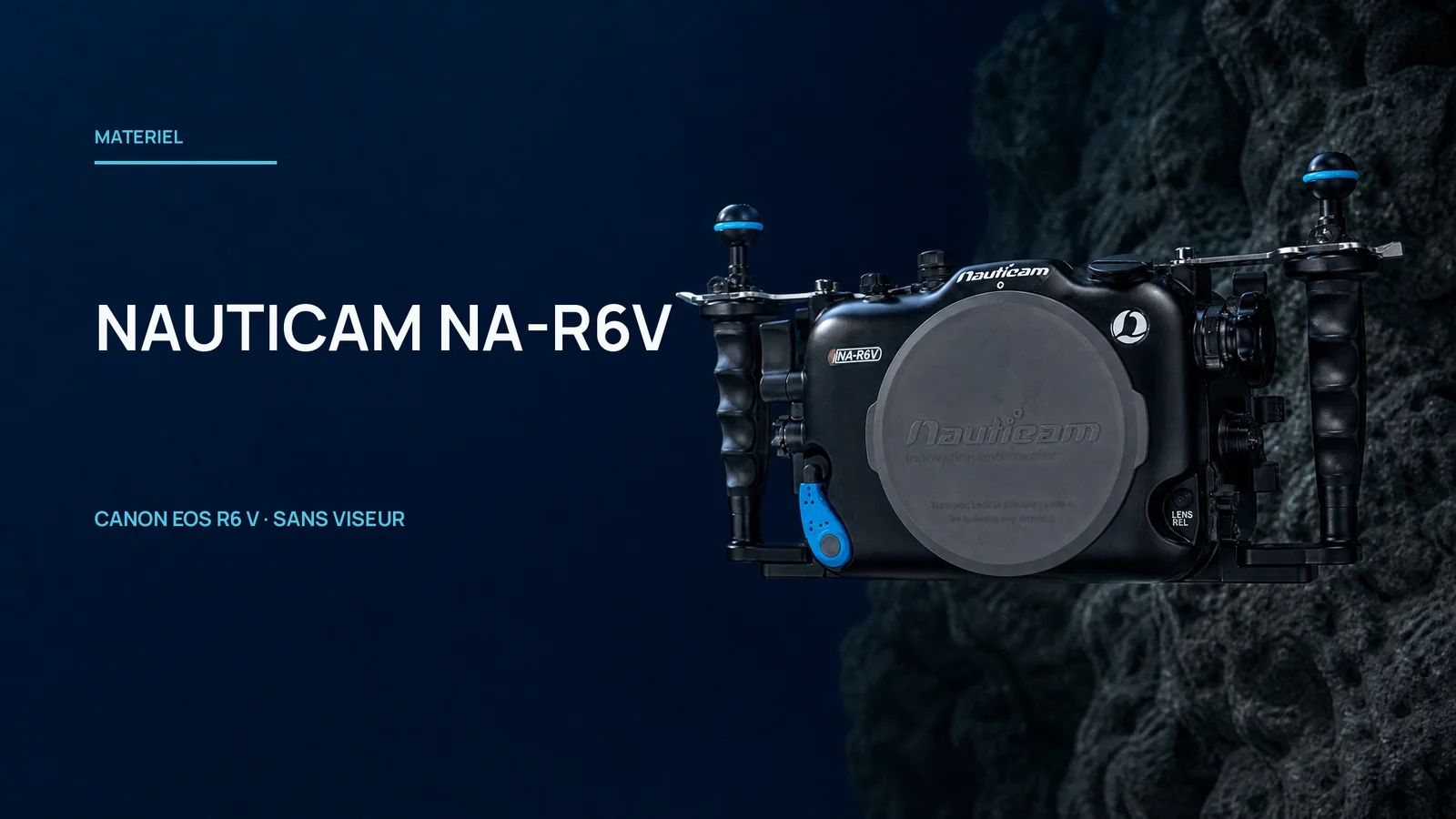
Nauticam NA-R6V: The underwater housing for the Canon EOS R6 V, designed without a viewfinder.

>-

Nauticam NA-R6V: The underwater housing for the Canon EOS R6 V, designed without a viewfinder.

There's a question I often ask underwater videographers who are hesitant between two housings: do you frame the shot by looking through the viewfinder, or do you frame it on the screen? The answer determines more hardware choices than one might think, and the Canon EOS R6 V is here to remind us why.

Nauticam has announced the NA-R6V, its housing for this new Canon camera. And the fact that the R6 V does not have a viewfinder actually changes how this housing needs to be designed and used underwater.


The R6 V: A case built for the screen, not for the eye.

The Canon EOS R6 V is the first body in the V series, announced in May 2026. It features the same 32.5MP full-frame CMOS sensor as the R6 Mark III and shares many of its video capabilities, but with a fundamental difference: it lacks an integrated electronic viewfinder. The body is designed to be framed and controlled via the rear screen or an external monitor.

In terms of recording capabilities, the R6 V films in 7K/60p RAW Light 12-bit internally, in 7K/30p Open Gate (using the entire sensor without cropping for reframing in post-production), in 4K/60p with oversampling for improved resolution, and in 4K/120p without cropping for slow motion. The presence of a cooling fan allows for long recordings, potentially unlimited in duration, which the R6 Mark III (same sensor, but without a fan) cannot guarantee during demanding shoots.

In short, this is a case designed for long-term operation under good conditions, provided there is adequate visual feedback. Underwater, this latter condition is never guaranteed.


What the NA-R6V provides to compensate for the lack of a sight.

Nauticam designed the NA-R6V with this central point in mind. The housing supports HDMI 2.0 and 1.4 monitors, as well as monitor-recorders, and offers direct compatibility with new Nauticam housings for the Atomos Ninja TX, TX GO, and Ninja RAW. In concrete terms, a videographer who wants true external visual feedback rather than relying on the small screen of the camera body can assemble a complete system directly within the Nauticam ecosystem.

The N120 port system remains the same as that of other full-size housings from the brand, with compatibility for RF and EF mounts. Contact optics FCP-1, WWL-C, SMC-3, and CMC-2 are supported. The vacuum leak detection system is pre-installed, as with the entire Nauticam pro range.

Price displayed: approximately €4,700 for the housing alone (converted from $5,400, official manufacturer's price), available from retailers such as Backscatter.


Who would find this enclosure useful?

The R6 V and its housing are designed for a specific user profile: the underwater videographer who prioritizes video quality, shoots long sequences (documentaries, training videos, cruise content), and is willing to build a system with an external monitor to compensate for the lack of a viewfinder.

For the photographer who alternates equally between stills and video, or who needs to frame shots by eye in water with a lot of particles where a screen becomes difficult to read in bright sunlight, this is not the most comfortable configuration. It's a real workflow choice, not just a camera body choice.
What remains true regardless of the device: a well-calibrated external monitor, with brightness adjusted to the depth, never replaces learning about framing and reading natural light underwater. This is the fundamental skill that you work on before choosing which screen to use.


The AquaExposure training course specifically addresses this topic: composing an underwater image, with or without a viewfinder. Discover the AquaExposure training course.

Price converted from the official rate in US dollars (current exchange rate). The actual all-inclusive price charged by European retailers may vary.

To learn more

  • Nauticam NA-A7RVI: The underwater housing for the Sony a7R VI, designed for professionals
  • DaVinci Resolve for underwater video editing
  • Access the AquaExposure underwater photography and videography training courses

Share

/blog/nauticam-na-r6v-the-underwater-housing-for-the-canon-eos-r6-v

Table of Contents

  • 01The R6 V: A case built for the screen, not for the eye.
  • 02What the NA-R6V provides to compensate for the lack of a sight.
  • 03Who would find this enclosure useful?
  • 04To learn more

Questions about the Journal

Can I use the photographs from this journal?

All images are protected by copyright. For any commercial or editorial use, please contact us via our form.

How can I be notified of new articles?

Follow us on social media or join the Sentinels Circle to receive our immersion stories before anyone else.

Do you offer hands-on workshops?

Yes, we organize masterclasses and field expeditions for members of our school. Check the Training page for details.

Articles in the same category

Underwater Macro Lenses: Wet Lenses vs Native, Choosing for Your Level and System

Underwater Macro Lenses: Wet Lenses vs Native, Choosing for Your Level and System

GoPro Hero 1, DJI Osmo Action 6, or Insta360 Ace Pro 2: The 2026 underwater camera comparison.

GoPro Hero 1, DJI Osmo Action 6, or Insta360 Ace Pro 2: The 2026 underwater camera comparison.

Insta360 X6 for diving: 1-inch sensor, Invisible Dive Case Pro, and what it changes.

Insta360 X6 for diving: 1-inch sensor, Invisible Dive Case Pro, and what it changes.