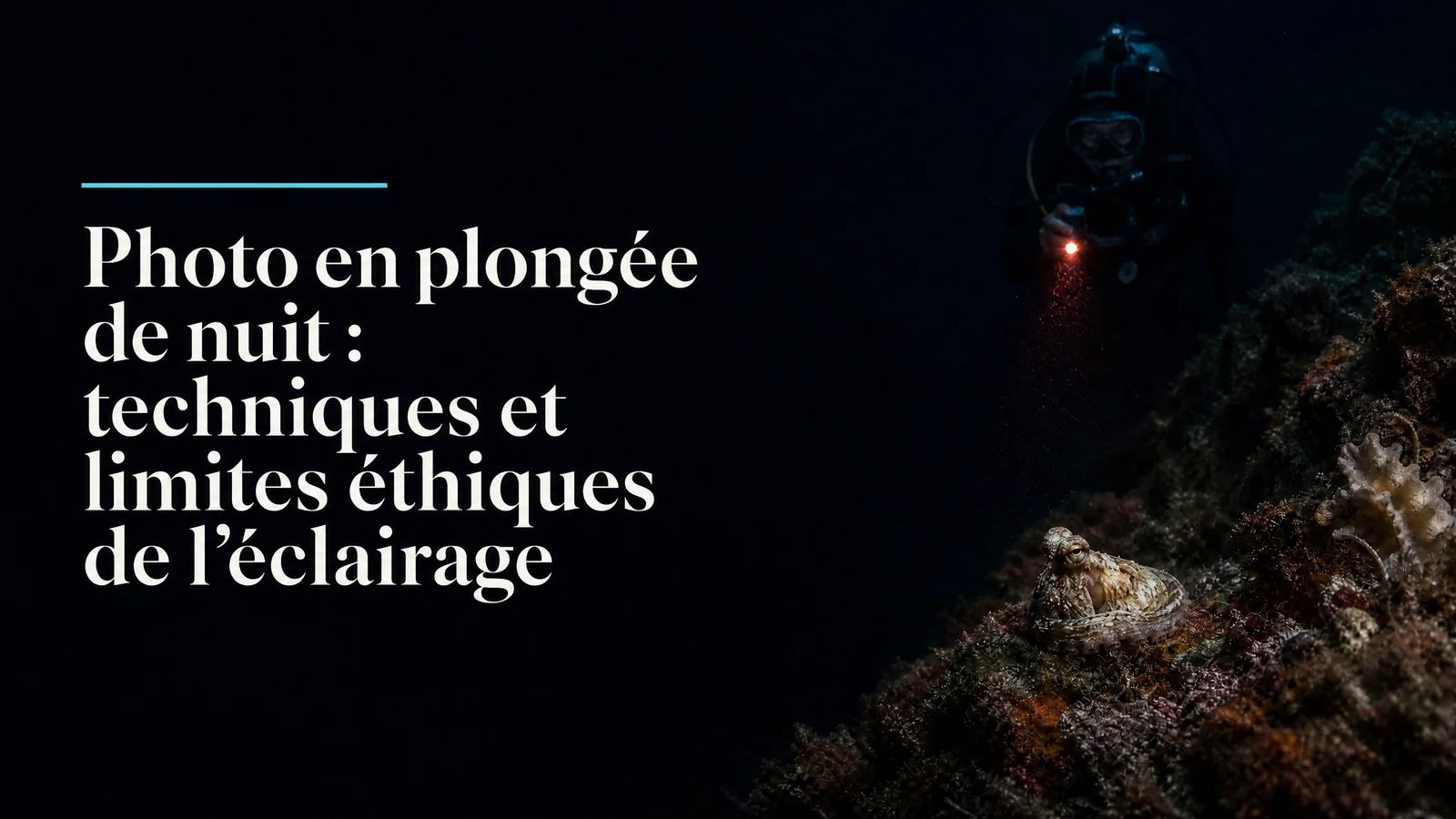
Night Dive Photography: Techniques and Ethical Lighting
Night is the legitimate exception to no-flash shooting. But ethical limits still apply. Red light, ISO, flash rules, and what you must never do underwater at night.
To learn how to get the most out of your gear underwater, discover the AquaExposure training.
Night Dive Photography: Techniques and Ethical Lighting
Can you photograph at night underwater without flash?
Partially. A red focus torch is the first tool. It illuminates without disturbing wildlife. For close macro subjects, a low-power video light is sufficient. Flash remains the legitimate exception for distant subjects.
Why use red light on a night dive?
Red light (620-750 nm) is barely perceived by most marine species. Fish primarily use their vision in the blue and green wavelengths. You see the subject, but the animal does not perceive the disturbance.
What subjects are best to photograph on a night dive?
Nocturnal predators (octopuses, moray eels), nudibranchs on the move, cleaner shrimp, fan worms fully extended, and corals with open polyps. These are subjects that retract during the day.
There are rules, and there are their exceptions. In the AquaExposure approach, the rule is straightforward: natural light first, flash only when there is no alternative. Night diving is one of those legitimate alternatives. But "legitimate" does not mean "without limits".
The underwater night reveals behaviours and subjects invisible during the day. Octopuses hunt, cuttlefish shift colour in seconds, mantis shrimp emerge from their burrows, corals extend their polyps. Photographing all of this without artificial light is impossible. The question is therefore not "flash or no flash", but "how to light without disturbing".
What the Night Reveals and Why It Is Worth the Extra Dive
Daytime fish sleep (some secrete a mucus cocoon to protect themselves from nocturnal predators). Nocturnal predators (moray eels, cuttlefish, octopuses) are active and relatively unwary in the first hours after sunset.
Nocturnal macro is particularly rich: nudibranchs move, cleaner shrimps leave their stations, feather duster worms extend fully. These are subjects that, during the day, retract the moment a shadow passes over them.
Passive bioluminescence (organisms that emit light without external stimulation) is a separate subject, covered in the article photographing underwater bioluminescence. Here, we are talking about night photography in the broad sense: lighting real subjects in darkness.
Red Light as the First Ethical Line
Before even mentioning flash, your focus torch is your primary night tool. And that focus torch must be red.
Red light (wavelength 620-750 nm) is barely perceived by the majority of marine species. Fish use their vision primarily in the blue and green wavelengths. Lighting in red is the equivalent of using a lamp that is nearly invisible to the animal: you see, it barely registers the disturbance.
In practice: a low-power red focus torch (50-100 lumens is enough) mounted on your housing lets you achieve focus and frame the shot without disturbing the subject.
The fundamental rule: minimum power. A red torch at 500 lumens aimed at an octopus is still aggressive. 50-100 lumens, grazing angle (never frontal) - that is the respectful approach.
Flash at Night: When, How, and What You Never Do
Here are the situations where flash is justified at night, in keeping with the AquaExposure Doctrine.
Static macro on non-photosensitive subjects. Nudibranchs, feather duster worms, bryozoans, and sponges do not react to flash. One or two shots on these subjects has no documented behavioural impact.
Scientific documentation. If you are participating in a citizen-science programme and a sharp image is required to identify a species, a single targeted flash is justified.
Portrait of a unique behaviour. An octopus hunting, a crab moulting: if the behaviour is exceptional and natural light is nonexistent, a single shot is acceptable.
What you never do: repeated flash on sleeping fish (triggering nervous-system stress and waking the animal), direct frontal flash into an animal's eyes, continuous flash on a subject that is already fleeing, flash used on cephalopods during a colour-change phase (interrupting communication).
Indirect angle is mandatory: the flash never points directly at the animal. It lights from the side or from behind, illuminating the subject without aiming straight into its face. The article when flash becomes necessary underwater details the indirect-angle technique with examples.
Bioluminescence Without Artificial Light: Settings to Capture the Ocean's Own Glow
Capturing bioluminescence without artificial light is a discipline of its own, very different from standard night photography.
Bioluminescent organisms emit extremely faint light (a few photons per second per cell). To record them on a sensor, three conditions must be met simultaneously: very high ISO (3200-6400 minimum, 12800 if the sensor allows it without excessive noise), long exposure (5-15 seconds, which demands perfect stabilisation), and total absence of artificial light during the exposure (a single white torch destroys the image).
Stabilisation during a long underwater exposure is the real challenge. Some divers brace against the seafloor (taking all necessary precautions not to contact marine life), others use an underwater tripod. Breathing is held for the duration of the exposure.
The result, when everything aligns, is an image where bioluminescence trails appear as blue-green luminous filaments against pure black. It is a technique that takes several nights of practice before producing a satisfying result.
Safety: Night Photography Multiplies the Photographer's Risks
Night diving is already more demanding than daytime diving (loss of spatial reference, less intuitive decompression monitoring, harder buddy communication). Adding a camera doubles the cognitive task loading.
Two non-negotiable rules for night photography.
First, settings are configured before the dive. Everything that can be prepared (ISO, white balance, macro/night mode, flash on or off) is set on the surface, in the light. Underwater at night, adjusting settings takes twice as long and carries twice the risk.
Second, your buddy knows the plan. Before entering the water, you have agreed together: who lights, who shoots, where you regroup if separated, maximum depth, maximum duration, the "we ascend" signal. Night is not the time to improvise communication.
To develop these techniques in a safe, guided setting, the AquaExposure training programme includes supervised night sessions: Discover the training.
FAQ
Can you photograph at night without flash at all? Yes, for bioluminescence (see above) and for certain subjects lit by the focus torch alone, if ISO is pushed high enough (1600-3200) and the shutter slows down (1/60-1/100s). The result is less sharp and noisier, but ethically beyond reproach.
What is the difference between night photography and bioluminescence photography? Standard night photography uses artificial light (torch, flash) to illuminate subjects visible in the dark. Bioluminescence photography captures light emitted by the organisms themselves, with no external lighting, using long exposures and very high ISO. The two techniques are very different.
Do sleeping fish suffer from flash? Scientific data on this subject is limited. What is known: a single flash triggers a startle response in most fish (flight or waking). A series of repeated flashes keeps the nervous system on alert, which has an energetic cost. The AquaExposure position: one shot maximum per sleeping subject, no repeated flash.
Which focus torch should you choose for ethical night photography? A torch with a native red mode (not a red filter over white) between 50 and 100 lumens. Brands that offer this mode: Light and Motion, Sola, Kraken. What matters is the red mode, not the maximum power. AquaExposure earns no affiliate commission on the references mentioned.
Is night diving accessible to beginner photographers? Not recommended without prior night diving experience without a camera. The first rule is to master night diving on its own (navigation, communication, managing bubbles in the torch beam) before adding a camera.
Night Dive Photography: Techniques and Ethical Lighting | AquaExposure