To further master your equipment and optimize your procedures while diving, discover our specialized training modules on AquaExposure training.
Nitecore NB10000 Gen 2: Ultra-light power for minimalist dives
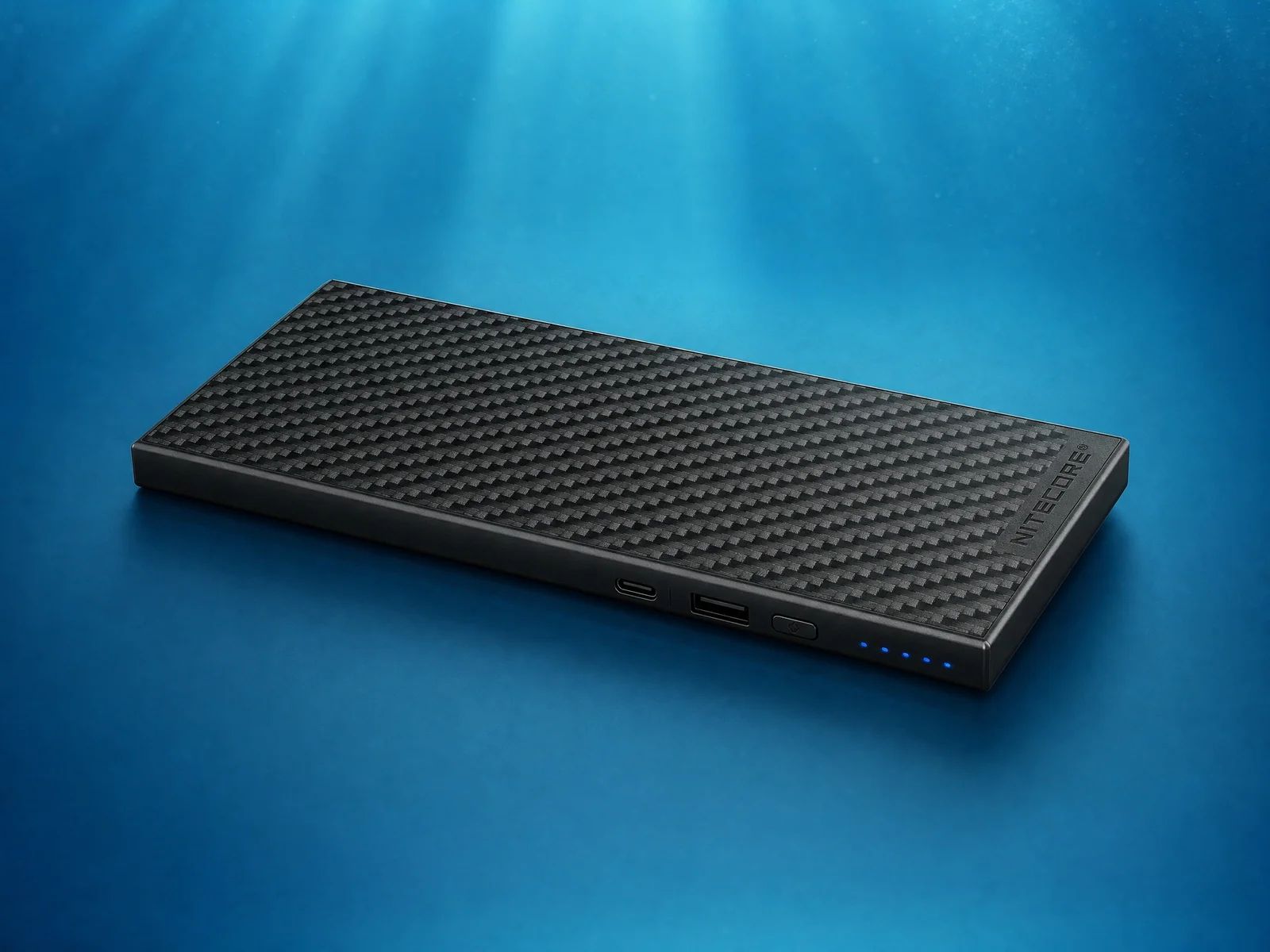
Choosing an external battery for a diving trip involves a trade-off between capacity and size. The Nitecore NB10000 Gen 2 solves this equation with a 10,000 mAh solution in a carbon fiber housing. Weighing just 150 grams, it is one of the lightest options in its category. For underwater photographers, this accessory keeps critical devices charged without adding excessive weight to your equipment bag.
A carbon fiber structure designed for the field
The unique feature of this battery is its chassis made of carbon fiber reinforced polymer (CFRP). This material, used in the aerospace industry, offers an exceptional strength-to-weight ratio. This structure reduces the overall weight while protecting the cells from impacts and crushing, which are common during transfers in a Zodiac boat or in a camera equipment bag.The housing features a striated texture that improves grip, even with wet fingers. Unlike aluminum housings, the carbon composite material maintains its integrity and resists scratches. The plates cover the main surfaces, while the reinforced corners absorb the energy from a fall onto a boat deck. This design choice justifies the AquaExposure robustness rating, a benchmark for construction quality and not the result of laboratory tests [1].
Performance and Ports: Essential for Your Peripherals
Beneath this protective shell, the NB10000 Gen 2 houses a 10,000 mAh lithium-polymer battery, providing 38.5 Wh of power. This capacity can recharge a recent smartphone approximately twice or power a dive computer multiple times. The connectivity is streamlined to maintain compactness, featuring a bidirectional USB-C port and a standard USB-A port.
The USB-C port supports Power Delivery 3.0 and delivers 20W of output, a power level suitable for charging a phone between dives. The USB-A port offers an 18W output compatible with Quick Charge 3.0. If both ports are used simultaneously, the total output is limited to 15W. This shared power management results in a longer charging time if you are simultaneously restoring the power of an action camera and a phone [2].
This protection does not mean it is completely waterproof. The battery is not designed for submersion. A drop into a rinsing tank or the ocean would cause it to fail. This IPX5 resistance provides peace of mind during surface intervals, but a waterproof pouch is still recommended for prolonged exposure to salty spray. Maintaining the USB ports after exposure to the marine environment is a basic precaution to prevent oxidation [1].
The low-current charging mode is an essential function. Many accessories, such as dive watches or small backup lights, consume very little power during charging. On standard batteries, this low current draw can cause the battery to automatically shut off before the charging cycle is complete.A long press on the mode button illuminates a white LED, indicating that this function is activated. It provides a constant power supply for sensitive devices. This is a valuable feature to ensure that your dive computer is ready for the next dive. A full battery charge takes approximately 180 minutes with an 18W charger [2].
The NB10000 Gen 2 has an energy rating of 38.5 Wh, which is well below the 100 Wh limit allowed by IATA for in-cabin transport without authorization. It complies with the UN38.3 standard, certifying that the battery has passed safety tests for air transport [3].
These batteries are strictly prohibited in checked baggage and must be transported exclusively in carry-on luggage. Although this model meets international limits, the rules of a specific carrier or local authority always take precedence. Compliance is subject to verification of conditions at the time of travel. Protecting the ports against short circuits, for example, with the original housing, remains a necessary precaution.
It is ideal for technical divers who want a backup power source for their dive computers. Its carbon fiber construction is durable enough to withstand the conditions of liveaboard dive trips. However, its limited capacity will not be sufficient to power a video production team for several days without access to a primary charging source.
This battery has certain limitations. Its 20W output is not sufficient to charge a laptop while it is in use. To restore the battery life of a MacBook Pro, you will need models capable of delivering 65W or more. The NB10000 Gen 2 is limited to small mobile devices and dive accessories.
The 10,000 mAh capacity provides approximately two charges for a smartphone, which may be insufficient on a long trip. The lack of an LCD screen to display the exact percentage remaining may be frustrating. The indication by three blue LEDs provides a less precise approximation than the digital displays found on heavier models.
[1]: https://www.nitecore.us/mobile-product/nb10000 "Nitecore NB10000 Product Page" [2]: https://www.nitecore.co.uk/products/nitecore-nb10000-gen-2-power-bank.html "Nitecore NB10000 Gen 2 Specifications" [3]: https://www.iata.org/en/youandiata/travelers/batteries/ "IATA Lithium Batteries Passenger Rules"
Visual 2: A diver in a wetsuit holds the battery, illustrating its compactness and slim profile in relation to the hand.
Alt text: Compact format of the Nitecore NB10000 Gen 2 battery held by a diver.