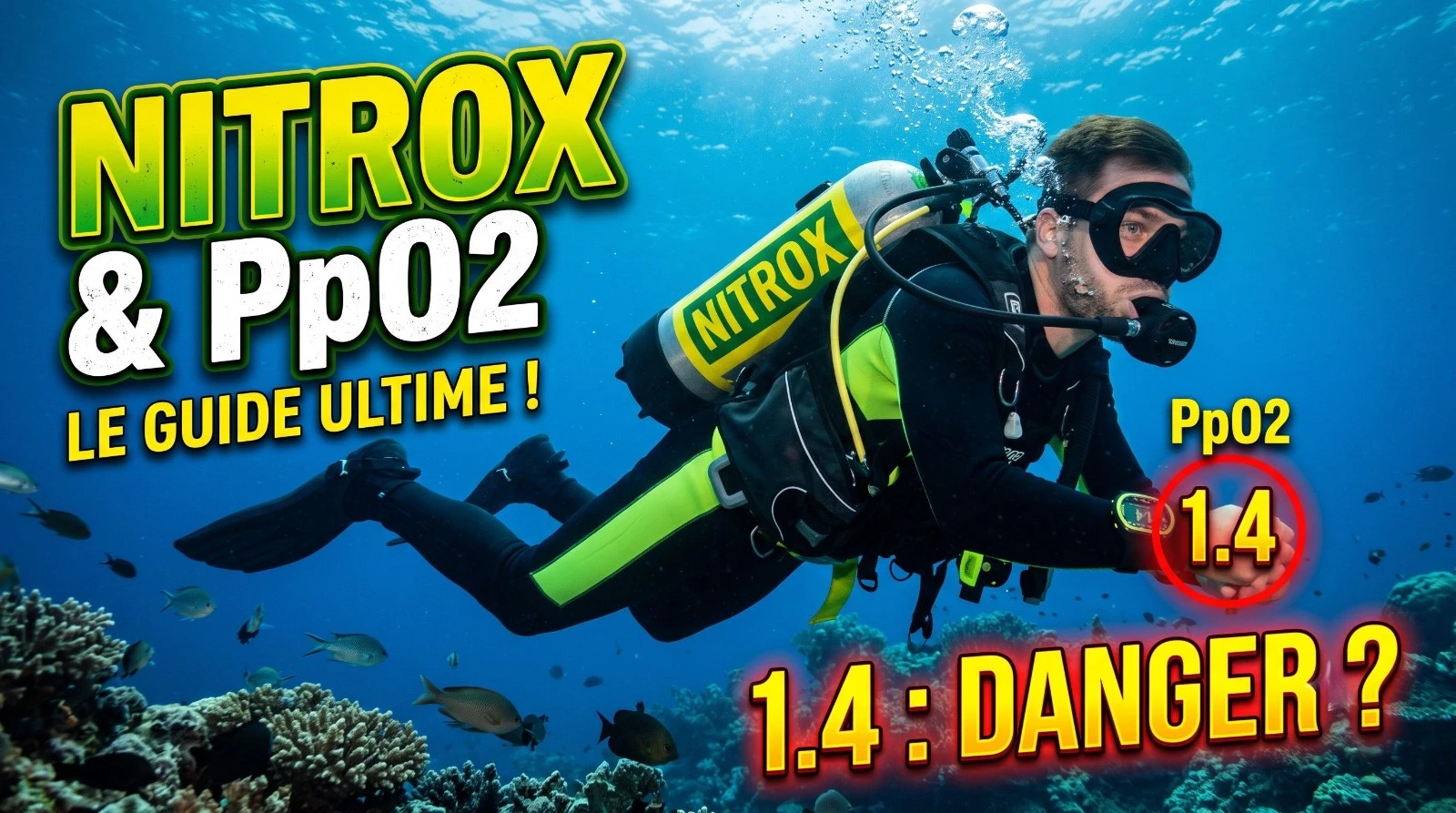
Understanding the difference between maximum partial pressure of oxygen (PpO2) limits of 1.4 bar (PADI/SSI) and 1.6 bar (FFESSM/LIFRAS). Explanations regarding physiology, training philosophy, and impact on your dive computer.
To learn how to get the most out of your gear underwater, discover the AquaExposure Training.
Introduction
You have chosen your computer and you finally understand how its algorithm calculates your decompression stops. But if you are diving with Nitrox, another fundamental parameter dictates your safety underwater: the Partial Pressure of Oxygen (PpO2). If you have already traveled or discussed with divers from different schools, you have surely noticed a striking contradiction in the standards. International agencies like PADI or SSI claim that the absolute safety limit is a PpO2 of 1.4 bar, while in France within the FFESSM or in Belgium at LIFRAS, it is traditionally taught that the limit is 1.6 bar.
I remember a supervised dive in Zeeland to a depth of thirty meters. My student, trained within a European national federation, had set his partial pressure of oxygen (PpO2) to 1.6 bar to gain a few extra meters of exploration. A slight loss of buoyancy control due to an unexpected current caused him to descend to thirty-five meters. His computer started vibrating violently, while the PpO2 of his gas mixture was dangerously close to the critical threshold for hyperoxia. It is at this precise moment that the theoretical concept of a safety margin takes on its full clinical meaning, and one understands why planning our dives requires absolute rigor.
The Basics: What is PaO2 and why is it dangerous?
Oxygen is essential for life, but under pressure, it transforms into a formidable poison for our central nervous system, a phenomenon known as the Paul Bert effect. Beyond a certain concentration threshold in the air being breathed (the infamous PpO2), oxygen can cause violent and sudden hyperoxic seizures. Underwater, the onset of these crises almost invariably leads to the drowning of the diver due to the loss of the regulator.
From a medical and physiological standpoint, the scientific consensus sets the threshold for rapid intoxication at 1.6 bar. Beyond this level, the risk of seizures increases exponentially. Therefore, the question is not about where the actual physical danger lies, but rather about determining what safety margin we should adopt before crossing this critical boundary.
The PADI/SSI School (1.4 bar): The principle of the safety cushion.
International training agencies, heavily influenced by North American culture, have based their standards on rigorous standardization and a very strict management of legal responsibility. Their philosophy is simple: one never crosses the line.
PADI and SSI set the normal usage limit at 1.4 bar of partial pressure of oxygen (PpO2). The goal is to provide you with a safety margin of 0.2 bar to account for unforeseen circumstances in the marine environment.
Imagine that you are planning a dive using Nitrox 32 with a safety margin set at 1.4 bar, which gives you a Maximum Operating Depth (MOD) of 33 meters. If, distracted by the sight of a ray or a turtle, you accidentally descend to a depth of 36 meters, your partial pressure of oxygen (PpO2) will rise to 1.5 bar. You have made a buoyancy error, but you are still protected by this safety margin. For these agencies, 1.4 bar is the strict planning limit, while the 1.6 bar range is reserved as a contingency limit, intended for emergency situations.
The FFESSM/LIFRAS/CMAS School (1.6 bar): A Cartesian Approach to Responsibility.
The approach of the European federations affiliated with CMAS is historically different. It relies on in-depth technical training and a trust in the diver's education, considering them a fully responsible adult capable of finely managing their physical parameters.
Their philosophy considers that since the scientific limit for hyperoxia is 1.6 bar, it should be taught as the maximum acceptable pressure for use in diving.
With the same Nitrox 32 mix, setting your PpO2 alarm to 1.6 bar theoretically allows you to descend up to 40 meters. However, at a depth of 40 meters, you are precisely on the physiological "red line." Even a slight accidental descent of just a few meters or sustained physical exertion in a current can instantly put you into the immediate danger zone.
The Direct Impact on Your Computer and Your Diving Experience
This debate is not merely theoretical, it fundamentally alters your level of autonomy beneath the surface. Consider the difference in Maximum Operating Depth (MOD) depending on the setting chosen for the most common mixtures:
| Mixture | MOD if set to 1.4 bar (PADI/SSI) | MOD if set to 1.6 bar (FFESSM/LIFRAS) |
|---|---|---|
| Nitrox 32 | 33.7 meters | 40.0 meters |
| Nitrox 36 | 28.8 meters | 34.4 meters |
| Nitrox 40 | 25.0 meters | 30.0 meters |
Configuring your computer for an alarm at 1.6 bar allows you to access deeper depths or wrecks, but this eliminates any margin of error in buoyancy and requires constant monitoring of your settings.
The Modern Consensus: Technical Diving Brings Everyone Together
Today, with the development of technical diving (Tek), a rational global consensus has emerged, harmonizing these different approaches:
During the initial phase (the active exploration), the safety margin is set at 1.4 bar. This is when the diver is moving, finning against the current, and may be distracted, which justifies maintaining the safety buffer.
During the decompression stop phase (static decompression), the limit is extended to 1.6 bar. At this point, the diver is motionless and relaxed at a shallow depth, making the risk of exertion or accidental descent almost negligible. Using a partial pressure of oxygen (PpO2) of 1.6 bar with a very rich mixture (such as pure oxygen at a 6-meter stop) allows for a spectacular acceleration of nitrogen desaturation.
This consensus applies to all types of decompression algorithms, whether it's the Bühlmann ZHL-16C model configured with Gradient Factors, the adaptive ADT MB model from Scubapro, the permissive Pelagic DSAT model, or the Pelagic Z+ model, the classic RGBM from Wienke, Suunto algorithms like the Fused RGBM 2 and the historical Suunto RGBM, or even the technical VPM-B model.
If you are looking for an instrument capable of managing these different PpO2 thresholds easily, we recommend that you consult our AquaExposure dive computer comparison tool, which details the alarms and multi-gas capabilities of each model.
Conclusion
If you are a recreational diver with only one tank on your back, the wise choice is to set the PpO2 alarm on your dive computer to 1.4 bar. This provides a valuable safety margin that ensures you will always return to the boat safely, regardless of the color of your depth gauge. Stars in your eyes.
Share
Table of Contents
- 01Introduction
- 02The Basics: What is PaO2 and why is it dangerous?
- 03The PADI/SSI School (1.4 bar): The principle of the safety cushion.
- 04The FFESSM/LIFRAS/CMAS School (1.6 bar): A Cartesian Approach to Responsibility.
- 05The Direct Impact on Your Computer and Your Diving Experience
- 06The Modern Consensus: Technical Diving Brings Everyone Together
- 07Conclusion
Questions about the Journal
Can I use the photographs from this journal?
All images are protected by copyright. For any commercial or editorial use, please contact us via our form.
How can I be notified of new articles?
Follow us on social media or join the Sentinels Circle to receive our immersion stories before anyone else.
Do you offer hands-on workshops?
Yes, we organize masterclasses and field expeditions for members of our school. Check the Training page for details.


